Teaching & Learning
- UCR’s instructional guidelines also state that the Instructor of Record has broad latitude to determine whether and how generative AI may be used in instructional settings, subject to applicable UCR policies and rules (including data security)
- UCR indicates that expectations for student use of generative AI on academic work (including assignments and papers) should be confirmed with the course instructor, and emphasizes that AI should assist rather than replace a student’s original work
We encourage you to discuss with your professors for specific policies or expectations before engaging in the use of Generative AI resources on academic assignments, papers, tests, etc.
Using AI tools should assist or enhance, not replace, your original work.
In instructional settings, this means the Instructor of Record has broad latitude to determine whether and how generative AI may be used, provided this use is consistent with applicable policies and rules governing data security and instruction at UCR.
- UCR advises students to consult their professors for specific expectations before using generative AI on tests
- UCR’s instructional guidelines also recommend that instructors establish clear expectations for each assessment, and note that instructors should keep in mind automated AI detection tools can be inaccurate and prone to bias when addressing suspected misconduct
We encourage you to discuss with your professors for specific policies or expectations before engaging in the use of Generative AI resources on academic assignments, papers, tests, etc.
Also establish clear expectations for each assessment to help avoid potential problems related to academic integrity.
If you suspect academic misconduct, follow the standard campus procedures and keep in mind that automated AI detection tools can be inaccurate and prone to bias.
- UCR also warns students that AI responses may be inaccurate, may violate intellectual property rights, and may perpetuate bias
- UCR’s instructional guidelines describe study-support uses of generative AI (e.g., summarizing notes/articles, brainstorming, and generating practice problems) as ways AI can support learning, but frame student use as needing to be consistent with course standards set by the instructor
Consider how students can utilize generative AI, consistent with your course standards.
It can help students brainstorm topics for a writing assignment, summarize research articles or class notes, create presentation outlines, and generate practice problems including for Canvas quizzes.
If you choose to use AI during the course of your academic studies, please be aware that AI can produce responses that are not always accurate and/or may violate intellectual property rights. They also may perpetuate biases inherent in their design and/or training datasets.
- The provided sources do not explicitly address code generation or programming assignments specifically
- UCR’s provided instructional guidelines emphasize that generative AI use standards are context-dependent and are determined with broad latitude by the Instructor of Record, provided use complies with UCR policies and rules (including data security)
Generative AI is a broadly applicable tool. Standards of use tend to be highly dependent on local circumstances and context, and on the preferences and judgments of those with local authority. In instructional settings, this means the Instructor of Record has broad latitude to determine whether and how generative AI may be used, provided this use is consistent with applicable policies and rules governing data security and instruction at UCR.
Research
- The provided sources do not specifically address research manuscripts, theses, or dissertation drafting/editing beyond this general requirement
- UCR’s instructional guidelines state that anyone using generative AI to assist with creating intellectual material must conform with ethical scholarship practices, plagiarism rules, and standards for representing work as one’s own
Anyone who utilizes generative AI to assist with the creation of intellectual material must conform with prevailing ethical scholarship practices, rules related to plagiarism, and standards for representing intellectual products as one’s own work.
- The provided sources do not specifically define research data analysis practices, but they do set conditions for what data can be used with different AI tools
- UCR’s instructional guidelines and security guidance emphasize information security risks and restrict the use of publicly available AI tools to public data only unless the tool has passed a campus security review; UCR notes it provides secure tools for other data classifications
Anything that is uploaded to a publicly available AI tool effectively enters the public domain. Generative AI tools which have not passed a campus security review may be used with public data only. For all other data classifications, UCR provides access to secure tools including Google Gemini and Microsoft Copilot.
At present, any use of ChatGPT should be with the assumption that no personal, confidential, or otherwise sensitive information may be used with it.
- UCR’s instructional guidelines state that users are accountable for consequences of generative AI use, including violations of academic integrity, institutional rules, and laws such as intellectual property laws
- The sources also state that using generative AI to create intellectual material must conform to ethical scholarship practices and plagiarism rules; the provided sources do not specifically mention grant proposals, IRB applications, or other research compliance submissions
Anyone using generative AI for any purpose is accountable for the consequences of their use, regardless of the nature of the AI-generated content.
This accountability applies to all aspects of teaching and learning and includes but is not limited to violations of academic integrity policies, other institutional policies and rules, and applicable laws including those related to intellectual property.
Anyone who utilizes generative AI to assist with the creation of intellectual material must conform with prevailing ethical scholarship practices, rules related to plagiarism, and standards for representing intellectual products as one’s own work.
Academic Integrity
- UCR’s instructional guidelines recommend that instructors set expectations in the syllabus, including how students should cite and document generative AI use in their work
- UCR also states generally that anyone using generative AI to assist with creating intellectual material must follow plagiarism rules and standards for representing work as one’s own
Talk about generative AI with your students. Establish clear expectations in your syllabus, including how students should cite and document the use of generative AI in their work.
Anyone who utilizes generative AI to assist with the creation of intellectual material must conform with prevailing ethical scholarship practices, rules related to plagiarism, and standards for representing intellectual products as one’s own work.
- The provided sources do not define specific penalties for undisclosed AI use, but they reference standard campus misconduct procedures
- UCR’s instructional guidelines advise that when academic misconduct is suspected, instructors should follow standard campus procedures and caution that automated AI detection tools can be inaccurate and prone to bias
If you suspect academic misconduct, follow the standard campus procedures and keep in mind that automated AI detection tools can be inaccurate and prone to bias.
Institutional & Administrative
- The guidelines also emphasize information security considerations and user accountability for consequences of AI use
- UCR’s instructional guidelines describe potential instructor uses of generative AI for course management and content creation (e.g., drafting syllabus sections, lesson planning, summarizing readings, generating prompts, analyzing student performance data, and drafting announcements)
Consider how your course can benefit. Generative AI can assist with course management tasks and streamline content creation and organization. It can draft or revise sections of your syllabus, create lesson plans, summarize readings, generate ideas or outlines for presentations, develop assignment prompts to encourage critical thinking, analyze spreadsheet data to identify trends in student performance, and provide personalized feedback. It can also automate administrative tasks in Canvas such as generating quiz questions or drafting announcements.
Be mindful of security and privacy issues. Generative AI offers benefits but also raises security and privacy concerns.
Anyone using generative AI for any purpose is accountable for the consequences of their use, regardless of the nature of the AI-generated content.
- UCR also provides security guidance that ChatGPT should be used assuming no personal, confidential, or otherwise sensitive information may be used with it
- For virtual meetings, UCR states Zoom AI Companion is the only approved AI tool for virtual meetings, and asks hosts to review AI meeting summary notes for sensitive and accurate data before sharing
- UCR states that anything uploaded to a publicly available AI tool effectively enters the public domain, and that AI tools that have not passed a campus security review may be used with public data only; for other data classifications, UCR provides access to secure tools including Google Gemini and Microsoft Copilot
Anything that is uploaded to a publicly available AI tool effectively enters the public domain. Generative AI tools which have not passed a campus security review may be used with public data only. For all other data classifications, UCR provides access to secure tools including Google Gemini and Microsoft Copilot.
At present, any use of ChatGPT should be with the assumption that no personal, confidential, or otherwise sensitive information may be used with it.
At UCR, the only approved AI tool for virtual meetings is Zoom AI Companion, Zoom's built-in AI tool.
meeting hosts are asked to review the notes for sensitive and accurate data prior to sharing the content.
- The provided sources do not define a campus-wide AI governance body or a formal AI strategy roadmap beyond these guidelines and tool/security statements
- UCR’s instructional guidelines state UCR is committed to equipping students, faculty, and staff to appropriately and effectively use generative AI, and present guiding principles (beneficial use, mission-aligned use, information security, local authority, user accountability, and transparency) as a foundational resource for integrating generative AI into instructional settings
Recognizing this, UCR is committed to equipping our students, faculty, and staff with the knowledge and skills to appropriately and effectively utilize generative AI in their professional and personal lives.
These guiding principles and suggested practices serve as a foundational resource for responsibly integrating these powerful tools into instructional settings at UCR.
Guiding Principles
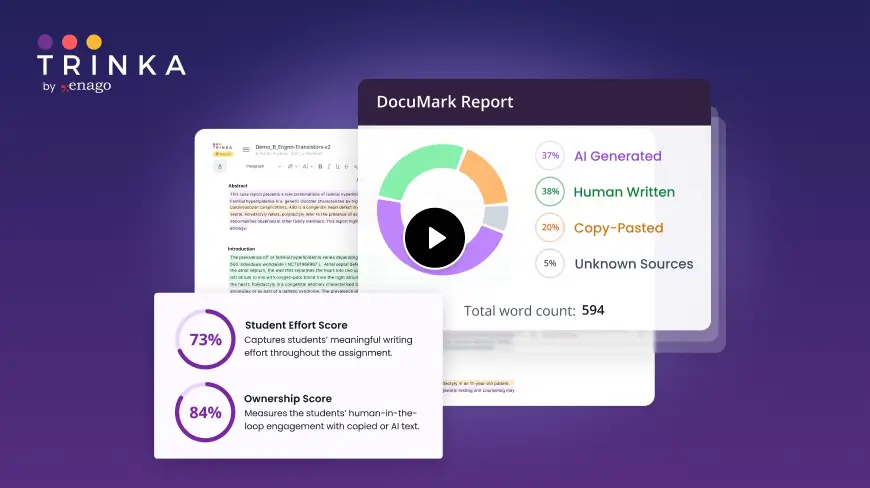
DocuMark: Responsible AI Use for Academic Integrity
Knowing your institution's AI policy is step one. DocuMark helps enforce it fairly by empowering universities to manage AI-generated content, prevent cheating, and support student writing through responsible AI use.
Common Questions About University of California, Riverside's AI Policies
University of California, Riverside has defined AI policies in 12 of 12 categories, with an overall coverage score of 100%.
UCR’s instructional guidelines recommend that instructors set expectations in the syllabus, including how students should cite and document generative AI use in their work. UCR also states generally that anyone using generative AI to assist with creating intellectual material must follow plagiarism rules and standards for representing work as one’s own.
UCR’s instructional guidelines advise that when academic misconduct is suspected, instructors should follow standard campus procedures and caution that automated AI detection tools can be inaccurate and prone to bias. The provided sources do not define specific penalties for undisclosed AI use, but they reference standard campus misconduct procedures.
UCR states that anything uploaded to a publicly available AI tool effectively enters the public domain, and that AI tools that have not passed a campus security review may be used with public data only; for other data classifications, UCR provides access to secure tools including Google Gemini and Microsoft Copilot. UCR also provides security guidance that ChatGPT should be used assuming no personal, confidential, or otherwise sensitive information may be used with it. For virtual meetings, UCR states Zoom AI Companion is the only approved AI tool for virtual meetings, and asks hosts to review AI meeting summary notes for sensitive and accurate data before sharing.