Teaching & Learning
- For the UCSF School of Pharmacy, use of AI on assignments is not allowed unless an instructor explicitly authorizes it, and students remain responsible for the accuracy and integrity of submitted work
- In the Bridges Curriculum, students may use approved AI tools only for specific activities that faculty permit; use is banned for assessments and assignment components that faculty designate as not AI-permitted, and all use must comply with copyright, privacy, and documentation requirements
Use of AI tools that are not explicitly authorized by the instructor or course leader in these and other circumstances may be considered plagiarism or cheating and may result in an Honor Code violation.
Even where AI tools are used and expressly authorized, students remain responsible for their submitted work, ensuring its accuracy, originality, and compliance with course expectations.
Students are allowed to use approved Generative AI applications as specified in individual course syllabi and with guidance from faculty. Such use must align with the professional, ethical, and educational standards expected of future physicians and comply with all UCSF and School of Medicine policies and procedures.
Students may not use Generative AI for any assessment, assignment, or component thereof explicitly designated by faculty as not permitting AI use.
Students are prohibited from using unapproved AI applications or entering content protected by copyright, FERPA, HIPAA, or university intellectual property into any Generative AI tool.
When AI use is allowed, students must follow faculty instructions regarding documentation and disclosure of tool usage.
- The School of Pharmacy policy also treats unauthorized AI use as potential cheating or plagiarism
- In the Bridges Curriculum, students are prohibited from using generative AI during any assessment, quiz, examination, OSCE, simulation, competency evaluation, or graded activity unless faculty expressly authorize it
Use of AI tools in assessments, tests, and examinations, unless expressly authorized by the instructor or course leader
Use of AI tools that are not explicitly authorized by the instructor or course leader in these and other circumstances may be considered plagiarism or cheating and may result in an Honor Code violation.
Students may not use Generative AI for any assessment, assignment, or component thereof explicitly designated by faculty as not permitting AI use.
AI tools may not be used in the following situations unless specifically authorized by faculty or school administration:
• During any formal assessment (quizzes, exams, OSCEs, simulations, competency evaluations, or graded clinical documentation exercises)
• To submit work for grading or evaluation without explicit faculty approval and required disclosure
• During any remediation or re-assessment activity unless specifically authorized
- UCSF permits student use of approved generative AI for learning support in the Bridges Curriculum when faculty and course syllabi allow it
- Permitted examples include study guides, flashcards, concept review, differential diagnosis practice, and communication rehearsal, provided students verify outputs and do not rely on AI in place of their own clinical reasoning
Permissible Uses of Generative AI
Students may use approved Generative AI tools in support of learning when permitted by course faculty and where consistent with educational objectives. Examples include:
• Creating study guides, flashcards, or review questions
• Reviewing basic science or clinical concepts
• Generating differential diagnosis ideas for educational discussion (but not for real patient care)
• Practicing communication skills, patient counseling, or history-taking scenarios
• Brainstorming ideas for presentations or projects when allowed by the instructor
Students are allowed to use approved Generative AI applications as specified in individual course syllabi and with guidance from faculty.
Students should critically evaluate any content generated by AI and must not rely on it as a substitute for developing their own clinical reasoning, decision-making, or communication skills.
- UCSF guidance for researchers and staff permits the use of generative AI for coding support, but requires human oversight, critical evaluation, and final review to ensure quality, originality, and policy compliance
Use GenAI tools for tasks such as editing and refining, coding support, improving readability, helping structure your writing, and addressing blind spots while critically evaluating and enhancing the quality and originality of the final output.
Consider using GenAI to support faculty and staff in drafting content, editing and refining, coding support, improving readability, or helping structure or tailor your writing, while ensuring human oversight, final review, and policy compliance.
Research
- In the Institute for Global Health Sciences policy, AI use in proposals and reports is allowed only as a support tool and cannot replace independent thought or scholarly judgment
- At UCSF, researchers may use AI tools for editing, language support, brainstorming, coding support, and, with caution, to summarize information or assist with drafting, but they remain fully responsible for verifying accuracy, addressing bias, protecting confidential information, and ensuring originality
Use GenAI tools for tasks such as editing and refining, coding support, improving readability, helping structure your writing, and addressing blind spots while critically evaluating and enhancing the quality and originality of the final output.
Researchers may use GenAI tools to:
• Brainstorm ideas, identify gaps in argumentation, or improve readability.
• Summarize well-understood content or assist in drafting sections with caution.
• Edit for clarity, grammar, and style.
Researchers should not use GenAI to:
• Submit AI-generated text, references, or analysis without thorough verification.
• Input confidential, proprietary, or unpublished data into public AI tools.
• Allow AI-generated content to replace critical thinking, originality, or authorship.
Researchers remain fully responsible for all content in proposals and reports, including factual accuracy, originality, proper attribution, and compliance with sponsor and IGHS requirements. AI-generated content does not diminish the author’s accountability.
Staff and faculty may use AI tools to support writing-related tasks (e.g., grammar correction, summarization, idea generation), but all substantive content, analysis, and conclusions must be independently developed and verified by the author.
Use of AI must not replace independent thought, scholarly judgment, or professional expertise.
- The IGHS policy further requires human review of AI-generated data visualizations, literature summaries, and other analytical assistance, and bars using AI to fabricate, falsify, or misrepresent research information
- UCSF requires caution when using AI with research data: confidential, unpublished, personally identifiable, sensitive, or regulated data must not be entered into public AI tools, and researchers must validate any AI-assisted analysis or output
Evaluate whether the data include personally identifiable, unpublished, or sensitive information. Public AI tools may retain and use submitted content for training, potentially violating confidentiality obligations or data use agreements.
Input confidential, unpublished, proprietary, or regulated data into public GenAI tools.
Use GenAI tools for support tasks (e.g., transcribing interviews, coding support, summarizing papers, outlining presentations) only when confidentiality, accuracy, and compliance with the AI guidance are ensured.
Note: This guidance applies to research and scholarly work. Research use of AI also raises issues related to data confidentiality, authorship, accuracy, bias, and academic integrity.
AI may not be used to fabricate, falsify, or misrepresent data, findings, references, or supporting evidence.
Any AI-assisted outputs used in proposal development or reporting (e.g., literature summaries, data visualizations, draft narratives) must be reviewed and validated by the author.
Users must not upload or input confidential, proprietary, unpublished, personally identifiable, or sponsor-restricted information into any AI system unless it is institutionally approved and secure.
- UCSF ties AI use in research to existing research integrity and ethics obligations
- Researchers are instructed to consult funder, publisher, and disciplinary rules, verify all AI-assisted content, avoid undisclosed or unverified AI-generated analysis or references, and follow institutional policies on plagiarism and authorship; the IGHS policy also requires disclosure when AI use materially affects content, analysis, or language in proposals and reports
Review the expectations of collaborators, publishers, journals, conference organizers, regulatory bodies, and funders regarding GenAI use, disclosure, and authorship. Requirements vary significantly, and it is your responsibility to ensure that AI use aligns with all applicable policies and expectations before submission or publication.
Researchers should not use GenAI to:
• Submit AI-generated text, references, or analysis without thorough verification.
Follow all institutional and publisher/funder policies on plagiarism, originality, and authorship.
Proposals and reports must comply with all applicable sponsor, UCSF, UC, and IGHS policies regarding confidentiality, intellectual property, authorship, and research integrity. Users are responsible for understanding sponsor-specific guidance on AI use and disclosure.
Any use of AI that materially affects the content, analysis, language, or preparation of a proposal or report should be disclosed when required by the sponsor, publisher, IGHS, or other governing body.
Academic Integrity
- Disclosure requirements are explicit in the Bridges Curriculum and IGHS policy
- Bridges students must follow faculty instructions on documentation and disclosure when AI use is allowed, and IGHS requires acknowledgment or disclosure of material AI use whenever required by a sponsor, publisher, IGHS, or another governing body
When AI use is allowed, students must follow faculty instructions regarding documentation and disclosure of tool usage.
Acknowledge any AI use as directed by faculty or school policy.
Any use of AI that materially affects the content, analysis, language, or preparation of a proposal or report should be disclosed when required by the sponsor, publisher, IGHS, or other governing body.
Where disclosure is required, it should clearly describe the nature and extent of AI assistance.
- The provided sources do not define a university position on AI detection software specifically
- UCSF states that unauthorized AI use may be treated as plagiarism, cheating, or unprofessional conduct and may trigger Honor Code, School of Medicine, or other university disciplinary processes
Use of AI tools that are not explicitly authorized by the instructor or course leader in these and other circumstances may be considered plagiarism or cheating and may result in an Honor Code violation.
Violations of this policy may constitute academic dishonesty or unprofessional conduct and may be addressed under applicable School of Medicine and UCSF learner conduct policies.
Noncompliance may result in administrative or disciplinary action, including proposal revision, rejection, or referral to appropriate oversight bodies.
Institutional & Administrative
- UCSF permits faculty and staff to use approved AI tools for work support, including drafting and editing communications and writing-related tasks, but requires human judgment, verification, and professional accountability
- In the Bridges Curriculum, faculty are responsible for defining when student AI use is allowed, modeling appropriate use, reviewing any AI-generated evaluation content, and not using AI as a substitute for direct observation or judgment in high-stakes student assessment
Consider using GenAI to support faculty and staff in drafting content, editing and refining, coding support, improving readability, or helping structure or tailor your writing, while ensuring human oversight, final review, and policy compliance.
Staff and faculty may use AI tools to support writing-related tasks (e.g., grammar correction, summarization, idea generation), but all substantive content, analysis, and conclusions must be independently developed and verified by the author.
Faculty are responsible for clearly communicating whether, how, and when students may use Generative AI in their courses, clerkships, and assessments.
Faculty and staff should model responsible use of AI and avoid creating overdependence on AI-generated content in educational settings.
Faculty may use approved AI tools to support educational tasks such as generating case examples, writing quiz questions, drafting feedback, or enhancing teaching materials. However, they remain responsible for reviewing all generated content for accuracy, bias, and appropriateness.
Faculty may not use AI as a substitute for direct observation, professional judgment, or individualized assessment in high-stakes evaluation of students.
- UCSF restricts what data may be used with AI systems and directs users to approved, secure institutional platforms
- PHI, PII, unpublished research, proprietary, sponsor-restricted, FERPA-protected, copyrighted, and other confidential or sensitive information must not be entered into public AI tools
- UCSF provides approved enterprise tools such as Versa and ChatGPT Enterprise (launched in early 2024) for handling UCSF work, with sensitive data only permitted in these systems under institutional safeguards
Public GenAI tools should not be used with Institutional Data classified as Level 3 or Level 4.
Only use GenAI tools approved and managed by UCSF IT for UCSF business and data.
Do not submit Institutional Data classified as Level 3 or 4, including:
• UC PII
• Patient information (PHI)
• Proprietary or confidential information
• Research data requiring protection or confidentiality
Use institutionally approved, secure AI platforms (such as UCSF’s enterprise AI tools) when handling sensitive or unpublished work.
Students are prohibited from using unapproved AI applications or entering content protected by copyright, FERPA, HIPAA, or university intellectual property into any Generative AI tool.
Versa is a secure UCSF generative AI platform... approved for UCSF data... including protected health information (PHI) and personally identifiable information (PII).
UCSF is launching OpenAI’s ChatGPT Enterprise in early 2024 for UCSF faculty, staff, and learners.
ChatGPT Enterprise will be approved for use with UCSF data classified as low, moderate, and high risk, including protected health information (PHI) and personally identifiable information (PII), when used in compliance with UCSF policy.
- UCSF has institution-level AI governance and strategy centered on trustworthy AI, risk-based guidance, and deployment of approved enterprise platforms
- Its published framework emphasizes privacy, transparency, accountability, fairness, safety, and human oversight, and UCSF provides institutional guidance and implementation channels such as UCSF AI guidance, Trustworthy AI principles, and the Versa program
UCSF is committed to enabling responsible, secure, and effective use of generative AI in support of our mission.
UCSF’s approach to AI is grounded in the principles of trustworthy AI.
Trustworthy AI at UCSF means developing and using AI systems in ways that are:
• Safe and effective
• Transparent and explainable
• Fair and inclusive
• Accountable
• Privacy-protective and secure
• Subject to human oversight
Use the UCSF AI Guidance to determine which AI tools are approved, what types of data may be used, and what review may be required.
Versa is part of UCSF’s strategy to provide secure, institutionally supported generative AI tools for the UCSF community.
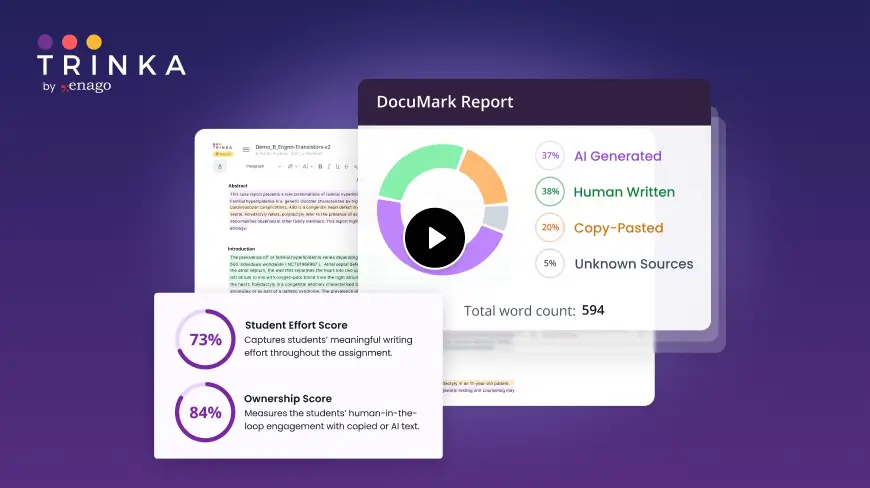
DocuMark: Responsible AI Use for Academic Integrity
Knowing your institution's AI policy is step one. DocuMark helps enforce it fairly by empowering universities to manage AI-generated content, prevent cheating, and support student writing through responsible AI use.
Common Questions About University of California, San Francisco (UCSF) — Medical/Health Sciences's AI Policies
University of California, San Francisco (UCSF) — Medical/Health Sciences has defined AI policies in 12 of 12 categories, with an overall coverage score of 100%.
Disclosure requirements are explicit in the Bridges Curriculum and IGHS policy. Bridges students must follow faculty instructions on documentation and disclosure when AI use is allowed, and IGHS requires acknowledgment or disclosure of material AI use whenever required by a sponsor, publisher, IGHS, or another governing body.
UCSF states that unauthorized AI use may be treated as plagiarism, cheating, or unprofessional conduct and may trigger Honor Code, School of Medicine, or other university disciplinary processes. The provided sources do not define a university position on AI detection software specifically.
UCSF restricts what data may be used with AI systems and directs users to approved, secure institutional platforms. PHI, PII, unpublished research, proprietary, sponsor-restricted, FERPA-protected, copyrighted, and other confidential or sensitive information must not be entered into public AI tools. UCSF provides approved enterprise tools such as Versa and ChatGPT Enterprise (launched in early 2024) for handling UCSF work, with sensitive data only permitted in these systems under institutional safeguards.