Teaching & Learning
- Beyond that university-level baseline, Cambridge says local teaching bodies should set their own rules on allowable AI use and communicate expectations clearly
- For summative assessed work, unacknowledged AI-generated content submitted as a student's own work is treated as academic misconduct unless the assessment brief explicitly allows otherwise
A student using any unacknowledged content generated by artificial intelligence within a summative assessment as though it is their own work constitutes academic misconduct, unless explicitly stated otherwise in the assessment brief.
Given the wide variety of subjects and teaching and learning styles at the University of Cambridge, it would be difficult to provide a policy that accurately represents the multitude of ambitions, considerations, and feelings surrounding the use of AI in education. We instead will be providing a framework for triposes, departments, faculties, and colleges, to determine their own local allowance and rational for the use of AI within their own contexts.
We encourage staff to clearly communicate their expectations to students and encourage use of available guidance where relevant and useful.
- Cambridge also frames this as a university statement that still allows discipline-specific definitions of appropriate use
- The university states that in summative assessments, students may not use unacknowledged AI-generated content as their own work unless the assessment brief explicitly says otherwise
“A student using any unacknowledged content generated by artificial intelligence within a summative assessment as though it is their own work constitutes academic misconduct, unless explicitly stated otherwise in the assessment brief.”
This statement aims to provide more specific clarity around the use of GenAI tools in summative assessments whilst allowing for discipline-specific definitions of what is appropriate.
- Students are permitted to use AI appropriately for personal study, research, and formative work
- The university recommends that students discuss such use with their supervisor or lecturer and check local guidance because expectations differ across disciplines and local units
Students are permitted to make appropriate use of artificial intelligence tools to support their personal study, research and formative work. Where doing so, it is recommended that you discuss this with your supervisor or lecturer to understand how best to engage with these tools whilst still benefiting from the educational experience as intended.
Students are permitted to make appropriate use of GenAI tools to support their personal study, research and formative work, however, due to differences between disciplines across the University, you should always consult local guidance (e.g., from your department, faculty, college etc.)
Research
- The verified sources do not set an AI-specific university rule for using AI to draft or edit research manuscripts
- The research integrity guidance instead requires named authors to take responsibility for the paper's contents and to acknowledge contributors properly
Anyone listed as an author on a paper should accept responsibility for ensuring that he or she is familiar with the contents of the paper and can identify his or her contribution to it. Honorary authorship is not good practice.
The contributions of formal collaborators and all others who directly assist or indirectly support the research should be both specified and properly acknowledged.
- There is no AI-specific research rule in the verified sources governing AI for research data collection or analysis
- One university administrative AI guidance document notes that its scope does not cover research undertaken with GenAI and says those cases are handled through established research ethics processes; separately, the general research guidance requires clear and accurate records of procedures, approvals, interim results, and final outcomes
It does not apply to any research undertaken with the assistance of any form of GenAI. The ethics and appropriateness of its use in those circumstances will be assessed by other established means (e.g. research ethics processes).
Researchers should keep clear and accurate records of the procedures followed and the approvals granted during the research process, including records of the interim results obtained as well as of the final research outcomes.
- The broader research integrity framework commits the university to high standards of integrity and ethics and says allegations of research misconduct are taken very seriously
- Cambridge's verified sources do not provide an AI-specific rule for grant proposals, ethics applications, or declarations, but they do state that AI-assisted research is to be assessed through established research ethics processes
It does not apply to any research undertaken with the assistance of any form of GenAI. The ethics and appropriateness of its use in those circumstances will be assessed by other established means (e.g. research ethics processes).
The University of Cambridge is committed to achieving excellence in research and scholarship. The pursuit of excellent research and the fulfilment of our responsibilities to participants in research, research users and the wider community require the maintenance of the highest standards of integrity and ethics.
The University takes allegations of research misconduct very seriously. Our procedure outlines the process we follow when we receive allegations.
Academic Integrity
- For university-wide student assessment, AI-generated content must not be left unacknowledged in summative work
- In Cambridge Advance Online courses, AI use in assessed work must be declared and clearly explained, and work must include adequate citation and transparent referencing; the administrative staff AI guidance also says outputs should be cited where appropriate
A student using any unacknowledged content generated by artificial intelligence within a summative assessment as though it is their own work constitutes academic misconduct, unless explicitly stated otherwise in the assessment brief.
AI (as defined below) must be declared and clearly explained in all assessed work submitted to University of Cambridge Online courses.
Any use of AI must not breach Cambridge’s plagiarism policy. Work must be your own and not present others’ ideas, data, words or other material without adequate citation and transparent referencing.
It is also important that GenAI outputs are thoroughly checked by a human being and cited where appropriate.
- Undisclosed AI use in summative assessment is treated as academic misconduct
- For enforcement, Cambridge states that the same academic misconduct procedure used for plagiarism also applies to AI use, and departments may use text-matching software while examiners or supervisors may also identify misconduct independently
A student using any unacknowledged content generated by artificial intelligence within a summative assessment as though it is their own work constitutes academic misconduct, unless explicitly stated otherwise in the assessment brief.
The information below primarily relates to identifying plagiarism, a similar process can be conducted for other forms of academic misconduct including collusion and the use of AI and the procedure used is identical.
In relation to plagiarism, the University offers access to text-matching software, which can support Departments in identifying text copied from elsewhere. Individual Examiners or supervisors may also identify possible copied text or other forms of misconduct independently, as a result of their subject knowledge.
Institutional & Administrative
- For administrative work, staff may use GenAI for tasks such as background research, summarising information, drafting documents or presentations, and numerical analysis, but they remain responsible for lawful and reasonable use under university policies
- In communications work, Cambridge says staff will not publish content that is 100% AI-produced and will fact-check, apply brand guidelines, and rewrite in their own words; for teaching and learning contexts, staff are encouraged to communicate expectations to students and may use the AI policy framework to set local rules
Ultimately, staff are responsible for ensuring any use of GenAI is conducted reasonably, lawfully and in conjunction with relevant University policies and procedures.
Consider using GenAI:
o for background research.
o to summarise information.
o to draft a document or presentation.
o for numerical analysis.
o for other appropriate and beneficial administrative purposes.
For all of these reasons, we will not publish any press releases, articles, social media posts, blog posts, internal emails or other written content that is 100% produced by generative AI. We will always apply brand guidelines, fact-check responses, and re-write in our own words.
We encourage staff to clearly communicate their expectations to students and encourage use of available guidance where relevant and useful.
Together with the University Statement on AI and Assessment and available guidance on Plagiarism and Academic Misconduct , we welcome staff to use this framework to present clear and transparent expectations for their students that best reflect the intended outcomes for their studies.
- Cambridge directs staff to prefer the university's licensed AI tools and sets stronger rules where personal data is involved
- The Copilot service page also says most staff and students have access to Copilot Chat through their standard Microsoft licence and that enterprise protections mean prompts are not used to train the models
- The university says its standard licensed tools are Copilot, Gemini, and NotebookLM; public free versions must not be used for university activities, personal data should be processed with the licensed versions where necessary, and free or unlicensed tools may expose data as if placed in the public domain
If it is necessary and beneficial to use GenAI tools, it is recommended that wherever practicable the University’s licensed GenAI tools, Copilot, Gemini and NotebookLM are utilised, regardless of the type of data that may be input. Use of other licenced GenAI tools is not prohibited, but such tools must be procured in accordance with any applicable procurement policy or process, including but not limited to the completion of any requisite risk assessments such as DPIAs and/or ISRAs.
The public, free versions of Copilot, Gemini and NotebookLM, available via a web browser, must not be used for University activities and purposes as they do not guarantee a sufficient level of information security or confidentiality.
The University’s standard licensed GenAI tools are Copilot, Gemini and NotebookLM, and these are the tools that should be used to process personal data, where necessary, for which the University is responsible.
By contrast, inputting data into a free or unlicensed GenAI tool could be considered equivalent to putting it into the public domain – signifying a potential personal data breach.
Data input into the University’s licensed versions of Copilot, Gemini and NotebookLM is not used to train those tools.
Most staff and students at the University have a standard Microsoft licence. This includes access to Copilot Chat.
When you sign into CoPilot Chat with your University account, you access the enterprise version of CoPilot. This ensures your data is private. Your data and prompts are not used to train the AI large language models.
- Cambridge has a university-level AI policy framework for education that intentionally delegates local decisions on AI use to triposes, departments, faculties, and colleges
- It also provides institution-wide administrative AI guidance for staff, indicates the guidance is periodically reviewed because tools and licensing are changing quickly, and frames staff use around lawful, reasonable use under existing university policies and procedures
Given the wide variety of subjects and teaching and learning styles at the University of Cambridge, it would be difficult to provide a policy that accurately represents the multitude of ambitions, considerations, and feelings surrounding the use of AI in education. We instead will be providing a framework for triposes, departments, faculties, and colleges, to determine their own local allowance and rational for the use of AI within their own contexts.
This page provides guidance on the use of Generative Artificial Intelligence (GenAI) for administrative tasks in support of University activities, and links to sources of further information.
This guidance was first published in February 2025 and last updated in December 2025. It is accurate as of the latter date. Due to the fast pace of change in this area, in particular with regard to the range of licensed GenAI tools being made available to staff and students, it will be reviewed and updated again during summer 2026.
Ultimately, staff are responsible for ensuring any use of GenAI is conducted reasonably, lawfully and in conjunction with relevant University policies and procedures.
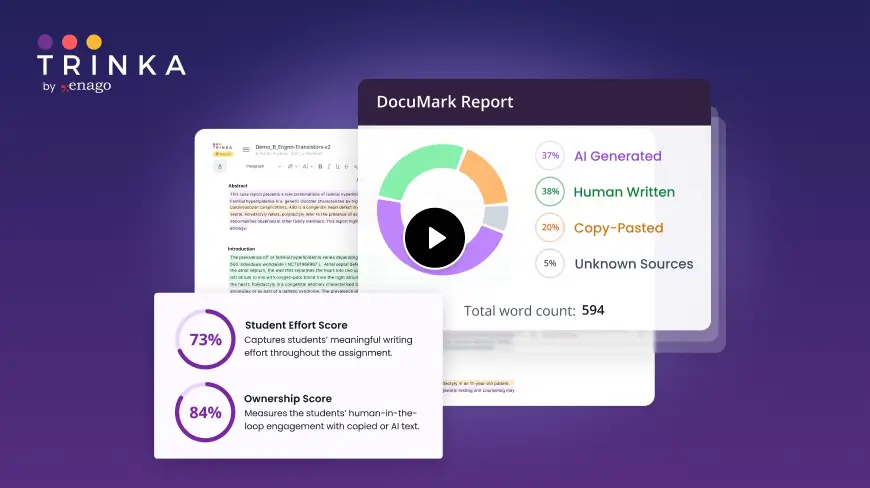
DocuMark: Responsible AI Use for Academic Integrity
Knowing your institution's AI policy is step one. DocuMark helps enforce it fairly by empowering universities to manage AI-generated content, prevent cheating, and support student writing through responsible AI use.
Common Questions About University of Cambridge's AI Policies
University of Cambridge has defined AI policies in 11 of 12 categories, with an overall coverage score of 92%.
For university-wide student assessment, AI-generated content must not be left unacknowledged in summative work. In Cambridge Advance Online courses, AI use in assessed work must be declared and clearly explained, and work must include adequate citation and transparent referencing; the administrative staff AI guidance also says outputs should be cited where appropriate.
Undisclosed AI use in summative assessment is treated as academic misconduct. For enforcement, Cambridge states that the same academic misconduct procedure used for plagiarism also applies to AI use, and departments may use text-matching software while examiners or supervisors may also identify misconduct independently.
Cambridge directs staff to prefer the university's licensed AI tools and sets stronger rules where personal data is involved. The university says its standard licensed tools are Copilot, Gemini, and NotebookLM; public free versions must not be used for university activities, personal data should be processed with the licensed versions where necessary, and free or unlicensed tools may expose data as if placed in the public domain. The Copilot service page also says most staff and students have access to Copilot Chat through their standard Microsoft licence and that enterprise protections mean prompts are not used to train the models.