Teaching & Learning
- Within instructor-created syllabus policies, students may be required to acknowledge and describe AI use, and undisclosed AI use can be treated as academic dishonesty with course-level penalties
- UConn states it does not have a blanket AI policy for coursework; instead, instructors are encouraged to include an AI policy in their syllabus, and course policies may range from banning AI to fully integrating it
While the university does not have a blanket AI policy, AI use is governed by the Data Classification Policy, the Academic, Scholarly, and Professional Integrity and Misconduct Policy, and the Family Educational Rights and Privacy Act of 1974 (FERPA). Instructors are encouraged to put an AI policy on their syllabi. AI policies typically range from banning the use of AI to fully integrating it into every aspect of the course.
For example, “I used ChatGPT when I was struck at the start and retained substantial parts of what it produced, including X and Y ideas and most of the wording in paragraphs 3 and 4” or “After I wrote my first 2 paragraphs, I used GPT-3 playground to extend the text for another 200 words but then edited…”
If you engage in intentional academic dishonesty–whether plagiarizing or submitting the work of others or copying from others on a test or failing to acknowledge use of AI or other tools–you will fail not only that assignment but the course.
- UConn also notes a preference for a balanced approach rather than focusing narrowly on surveillance and detection
- UConn provides guidance noting faculty concern about student use of ChatGPT to answer test and exam questions, and provides sample syllabus language framing undisclosed AI use and copying on a test as academic dishonesty with failure consequences
Based on conversations to date, our faculty are simultaneously interested in learning how ChatGPT3 and similar chat bots might transform teaching, learning, and assessment in innovative ways, and concerned about students use of Chat GPT3 to answer test and exam questions and generate content for written papers and assignments.
We believe maintaining a balanced and realistic perspective of the impacts of AI is more productive and appropriate than a narrow focus on surveillance and detection.
If you engage in intentional academic dishonesty–whether plagiarizing or submitting the work of others or copying from others on a test or failing to acknowledge use of AI or other tools–you will fail not only that assignment but the course.
- UConn encourages instructors to set expectations in their syllabi and notes that course AI policies can range from bans to full integration
- UConn’s teaching and learning guidance indicates that acceptable collaboration and boundaries may differ by instructor and tool, contributing to student confusion about what is allowed
There is confusion, however, about which professors allow AI to be used in projects, and where the boundary lies between appropriate collaboration and cheating.
While the university does not have a blanket AI policy, AI use is governed by the Data Classification Policy, the Academic, Scholarly, and Professional Integrity and Misconduct Policy, and the Family Educational Rights and Privacy Act of 1974 (FERPA). Instructors are encouraged to put an AI policy on their syllabi. AI policies typically range from banning the use of AI to fully integrating it into every aspect of the course.
While safeguarding the integrity of assessment practices is critical, it is equally important to recognize that cheating and plagiarism often stem from reasons other than lack of ethics. For example, students may not know what acceptable collaboration looks like; acceptable collaboration may differ from instructor to instructor, or tool to tool; students may be overwhelmed by the course material or other priorities in their lives such as jobs or family duties.
- UConn’s academic integrity guidance defines plagiarism to include "code" and defines cheating to include unauthorized assistance on assignments or exams
- UConn does not define a university-wide policy specific to AI code generation for programming assignments; instead it indicates there is no blanket AI policy and encourages instructors to articulate course-specific AI rules in syllabi
While the university does not have a blanket AI policy, AI use is governed by the Data Classification Policy, the Academic, Scholarly, and Professional Integrity and Misconduct Policy, and the Family Educational Rights and Privacy Act of 1974 (FERPA). Instructors are encouraged to put an AI policy on their syllabi.
Cheating: Unauthorized acts, actions, or behaviors in academic or scholarly areas.Examples of cheating include, but are not limited to:
providing or receiving help on an assignment or exam intended to reflect the individual student’s work product when not authorized to do so by the instructor.
Plagiarizing: Using one’s own previously published, presented, or disseminated material, or another person’s language/text, data, ideas, expressions, digital/graphic element, passages of music, mathematical proofs, scientific data, code, or other original material without authorization of the originating source or proper acknowledgement, attribution, or citation of the originating source.
Research
- UConn does not define a specific university-wide policy for using AI to draft or edit research manuscripts in the provided sources
- However, UConn’s academic integrity policy scope includes research (including undergraduate, graduate, postdoctoral scholar, and faculty research), and its definitions of plagiarism and cheating cover unauthorized use and lack of proper acknowledgement/attribution/citation of others’ material
This policy applies to all members of the University Community engaged in academic and scholarly efforts in, but is not limited to, the following contexts in undergraduate and graduate education:
research, including undergraduate, graduate, postdoctoral scholar, and faculty research; and
Plagiarizing: Using one’s own previously published, presented, or disseminated material, or another person’s language/text, data, ideas, expressions, digital/graphic element, passages of music, mathematical proofs, scientific data, code, or other original material without authorization of the originating source or proper acknowledgement, attribution, or citation of the originating source.
Cheating: Unauthorized acts, actions, or behaviors in academic or scholarly areas.Examples of cheating include, but are not limited to:
Failure to disclose unauthorized assistance on work submitted for evaluation, i.e., assistance obtained outside channels approved by instructors, that is used to complete a course, program, or degree requirement.
- UConn does not define AI-specific rules for research data analysis in the provided sources, but it does define institutional data protection requirements that apply broadly and can constrain what data may be used with AI services
- The ITS guidance warns that protected and confidential information entered into public AI tools can be stored and shared outside the University, and points to the Data Classification Policy requirements for protected/confidential data storage in cloud systems managed or contracted by the University
This means that protected and confidential information entered by an employee can be stored by the application and shared with others outside of the University.
UConn’s Data Classification Policy is the institutional safeguard that applies in this situation. If housed in the cloud, protected and confidential data is required to be stored only on information systems managed or contracted by the University. Sharing of this information with other online systems (e.g., opensource cloud solutions, free software-as-a-service offerings, etc.) is not permitted.
Protected data must also meet these requirements:
If stored in the cloud, stored only on cloud-based information systems managed or contracted by the University.
- The provided sources do not state AI-specific requirements for grant proposals or IRB submissions
- UConn’s academic integrity policy applies to research activities across undergraduate, graduate, postdoctoral, and faculty contexts
- It defines cheating to include unauthorized help and failure to disclose unauthorized assistance, and defines plagiarism broadly to include use of others’ data/ideas/code without authorization or proper acknowledgement/attribution/citation
This policy applies to all members of the University Community engaged in academic and scholarly efforts in, but is not limited to, the following contexts in undergraduate and graduate education:
research, including undergraduate, graduate, postdoctoral scholar, and faculty research; and
Cheating: Unauthorized acts, actions, or behaviors in academic or scholarly areas.Examples of cheating include, but are not limited to:
providing or receiving help on an assignment or exam intended to reflect the individual student’s work product when not authorized to do so by the instructor.
Failure to disclose unauthorized assistance on work submitted for evaluation, i.e., assistance obtained outside channels approved by instructors, that is used to complete a course, program, or degree requirement.
Plagiarizing: Using one’s own previously published, presented, or disseminated material, or another person’s language/text, data, ideas, expressions, digital/graphic element, passages of music, mathematical proofs, scientific data, code, or other original material without authorization of the originating source or proper acknowledgement, attribution, or citation of the originating source.
Academic Integrity
- UConn’s guidance includes sample syllabus language requiring students to acknowledge and describe their use of AI tools when used, and warns students they are responsible for content they submit
- UConn’s academic integrity policy also defines cheating to include failure to disclose unauthorized assistance and defines plagiarism to include using others’ material without proper acknowledgement/attribution/citation
For example, “I used ChatGPT when I was struck at the start and retained substantial parts of what it produced, including X and Y ideas and most of the wording in paragraphs 3 and 4” or “After I wrote my first 2 paragraphs, I used GPT-3 playground to extend the text for another 200 words but then edited…”
You will be responsible for any inaccurate, biased, offensive, or otherwise unethical content you submit, regardless of whether it originally comes from you or an AI tool (these last 2 sentences adapted from the course policies of Ryan S. Baker, University of Pennsylvania).
Failure to disclose unauthorized assistance on work submitted for evaluation, i.e., assistance obtained outside channels approved by instructors, that is used to complete a course, program, or degree requirement.
Plagiarizing: Using one’s own previously published, presented, or disseminated material, or another person’s language/text, data, ideas, expressions, digital/graphic element, passages of music, mathematical proofs, scientific data, code, or other original material without authorization of the originating source or proper acknowledgement, attribution, or citation of the originating source.
- UConn’s teaching and learning guidance discourages a narrow focus on surveillance and detection related to AI
- UConn also provides a resource link suggesting trying an AI detection tool (GPTZero), but does not define an institution-wide detection mandate in the provided text
- The academic integrity process documentation describes instructor reporting obligations and outlines sanctions and procedures when a student is found in violation; sample syllabus language includes course-level penalties (failing an assignment and the course) for academic dishonesty including failing to acknowledge AI use
We believe maintaining a balanced and realistic perspective of the impacts of AI is more productive and appropriate than a narrow focus on surveillance and detection.
If you engage in intentional academic dishonesty–whether plagiarizing or submitting the work of others or copying from others on a test or failing to acknowledge use of AI or other tools–you will fail not only that assignment but the course.
The instructor must report this action, the nature of the violation, and the proposed academic consequence in writing using the Academic, Scholarly, Professional Integrity and Misconduct Report Form. A copy of this report, which will document the allegations and intended consequences, will be sent to the student via their official University email address.
When a respondent has been found “In Violation,” the Board shall examine the student’s academic transcript and student conduct history, accept impact statements by both the respondent and complainant, and then impose the appropriate sanction(s).
18. Try out AI detection
Institutional & Administrative
- The provided sources do not define specific rules about faculty using AI for grading, feedback, recommendation letters, or other teaching-adjacent tasks; they primarily address availability and data security expectations
- UConn indicates AI services are available to employees (e.g., Microsoft Copilot) and that ChatGPT licenses are available to faculty and staff via ITS under an official agreement with OpenAI for secure and compliant use of university data
Two artificial intelligence (AI) services are available to UConn employees. Microsoft has released Copilot, an AI assistant similar to ChatGPT, and Copilot for Microsoft 365, which integrates with core Microsoft 365 applications.
ChatGPT licenses are now available to UConn faculty and staff through Information Technology Services (ITS). Through an official agreement with OpenAI, the organization that developed ChatGPT, the license ensures secure and compliant use of university data within the ChatGPT environment.
If you currently have a paid ChatGPT account directly with OpenAI that you use for institutional activities, you will be required to transition to a university license.
- UConn states AI use is governed by its Data Classification Policy, and ITS warns that protected and confidential information entered into public AI tools may be stored and shared outside the University
- UConn also identifies institutionally-provided AI platforms (Microsoft 365 Copilot Chat / Copilot) as secure under Microsoft agreements when signed in with UConn credentials, and provides a UConn ChatGPT license for faculty and staff for secure/compliant use of university data
- UConn’s Data Classification Policy applies to students, faculty, staff, volunteers, and contractors and requires protected data stored in the cloud be on University-managed/contracted systems; ITS explicitly states sharing protected/confidential information with other online systems is not permitted
While the university does not have a blanket AI policy, AI use is governed by the Data Classification Policy, the Academic, Scholarly, and Professional Integrity and Misconduct Policy, and the Family Educational Rights and Privacy Act of 1974 (FERPA).
These services include natural language processing and machine learning in their architecture, which are utilized to interact with people and generate content. They are “trained” on the data they consume and pull from this growing body of knowledge for subsequent interactions. This means that protected and confidential information entered by an employee can be stored by the application and shared with others outside of the University.
UConn’s Data Classification Policy is the institutional safeguard that applies in this situation. If housed in the cloud, protected and confidential data is required to be stored only on information systems managed or contracted by the University. Sharing of this information with other online systems (e.g., opensource cloud solutions, free software-as-a-service offerings, etc.) is not permitted.
Applies to: A ll students, faculty, staff, volunteers, and contractors
If stored in the cloud, stored only on cloud-based information systems managed or contracted by the University.
Both are also fully secure under our agreement with Microsoft, which means they are safe to use with institutional data. As long as you are signed in with UConn credentials, prompts, the information retrieved, and the responses generated remain protected and are not used to train the underlying AI models.
ChatGPT licenses are now available to UConn faculty and staff through Information Technology Services (ITS). Through an official agreement with OpenAI, the organization that developed ChatGPT, the license ensures secure and compliant use of university data within the ChatGPT environment.
- UConn CLAS describes a college-level AI governance and strategy effort via an AI Task Force (2024–2025) that produced recommendations, with implementation beginning spring 2026
- CLAS states it will establish a standing committee on AI implementation and participate in university-level AI governance, and it frames responsible and effective AI use as a priority across CLAS and the University
The responsible and effective use of artificial intelligence (AI) is a top priority in the College of Liberal Arts and Sciences (CLAS) and across the University.
In 2024-2025, CLAS established an AI Task Force comprising faculty and staff from across academic and administrative units. The group was charged with considering the pros and cons of AI across the college, and producing a report with recommended actions the college should take to ensure the responsible and ethical use of AI by CLAS staff, faculty, and students.
Beginning spring 2026, the college will begin following the recommendations of the task force by implementing the steps described below.
Establish a Standing Committee on AI Implementation. CLAS will form a permanent committee (e.g., CLAS AI Innovation Committee) to guide the strategic implementation of AI across operational areas.
Participate in University-Level AI Governance. CLAS will actively contribute to the development of AI governance at the University level, bringing expertise in ethics, policy, and pedagogy.
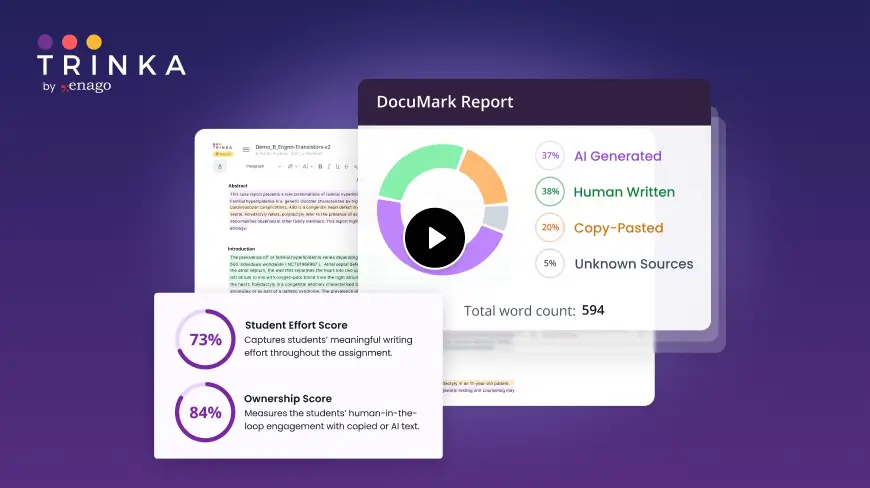
DocuMark: Responsible AI Use for Academic Integrity
Knowing your institution's AI policy is step one. DocuMark helps enforce it fairly by empowering universities to manage AI-generated content, prevent cheating, and support student writing through responsible AI use.
Common Questions About University of Connecticut's AI Policies
University of Connecticut has defined AI policies in 12 of 12 categories, with an overall coverage score of 100%.
UConn’s guidance includes sample syllabus language requiring students to acknowledge and describe their use of AI tools when used, and warns students they are responsible for content they submit. UConn’s academic integrity policy also defines cheating to include failure to disclose unauthorized assistance and defines plagiarism to include using others’ material without proper acknowledgement/attribution/citation.
UConn’s teaching and learning guidance discourages a narrow focus on surveillance and detection related to AI. The academic integrity process documentation describes instructor reporting obligations and outlines sanctions and procedures when a student is found in violation; sample syllabus language includes course-level penalties (failing an assignment and the course) for academic dishonesty including failing to acknowledge AI use. UConn also provides a resource link suggesting trying an AI detection tool (GPTZero), but does not define an institution-wide detection mandate in the provided text.
UConn states AI use is governed by its Data Classification Policy, and ITS warns that protected and confidential information entered into public AI tools may be stored and shared outside the University. UConn’s Data Classification Policy applies to students, faculty, staff, volunteers, and contractors and requires protected data stored in the cloud be on University-managed/contracted systems; ITS explicitly states sharing protected/confidential information with other online systems is not permitted. UConn also identifies institutionally-provided AI platforms (Microsoft 365 Copilot Chat / Copilot) as secure under Microsoft agreements when signed in with UConn credentials, and provides a UConn ChatGPT license for faculty and staff for secure/compliant use of university data.