Teaching & Learning
- For assessed student work, AI-generated material is not prohibited outright, but students must acknowledge it appropriately
- Presenting generative AI material as their own work, or using text from generative AI without acknowledgement, is treated as plagiarism under the academic misconduct procedure
(ii) Plagiarism has occurred when the student:
* Does not acknowledge the work of another person or persons, or
* Has not identified the source or cited quotations in any work presented for assessment, or
* Presents as if own work material created by any form of Generative AI without appropriate acknowledgment of how the material has been utilised or amended, or
* Has used illustrations, computer code, images, music, video, patents or other creative materials without acknowledgement of their provenance, or
* Has copied another student’s work without their knowledge, or
* Presents other people’s research findings as their own or
* Has submitted the same piece of their own work for assessment and award of credit in two (or more) modules (self plagiarism).
(iii) If a student's work is found to contain verbatim (or near verbatim) quotation from the work of others (including from Generative AI) without acknowledgement, then plagiarism has been committed
- The university applies its academic misconduct rules to all assessment activity, and AI use in assessed work must be acknowledged
- It does not provide a separate AI-specific exam rule in the provided sources, but undisclosed generative AI use in assessment falls within plagiarism and academic misconduct
J1.2 Academic Misconduct is any action by a student which gives or has the potential to give an unfair advantage in an examination or assessment, or might assist someone else to gain an unfair advantage, or any activity likely to undermine the integrity essential to scholarship and research. This procedure applies to all students engaged in any University assessment activity whether on or off site including collaborative programmes.
(ii) Plagiarism has occurred when the student:
* Presents as if own work material created by any form of Generative AI without appropriate acknowledgment of how the material has been utilised or amended, or
- The guidance explicitly recommends using AI for ideas, planning, and suggestions rather than asking it to produce finished text for copying
- The university permits advisory use of AI for planning, reflection, and refinement in non-submitted writing support contexts, while requiring that the final wording remain the student's own
AI tools like ChatGPT can be useful when you’re planning your personal statement, but if you use them the wrong way, it could damage your application.
Think of AI as a tool you can bounce ideas off, not someone who writes your statement. It can help you plan, reflect and refine, but the final words need to be yours.
Goal: what do you want help with? This is what you want AI to do. Keep it focused on ideas or planning, not asking it to write your paragraph.
>
Role: who do you want AI to act as? This tells AI the kind of support you want, like a careers adviser or admissions guide – so it gives advice, not finished writing.
>
Output: How should AI respond? Choose a format you can build on, such as bullet points or suggestions, not full paragraphs you could copy.
This is what safe AI use looks like: AI guides you, but you write the final version. Stick to this approach and you’ll create a statement that’s genuine, polished and entirely your own.
- For assessed work, code produced with generative AI must be acknowledged
- Using computer code without acknowledging its provenance is treated as plagiarism, and presenting generative AI material as one's own without acknowledgement is also plagiarism
(ii) Plagiarism has occurred when the student:
* Presents as if own work material created by any form of Generative AI without appropriate acknowledgment of how the material has been utilised or amended, or
* Has used illustrations, computer code, images, music, video, patents or other creative materials without acknowledgement of their provenance, or
Research
- The sources do not state a detailed standalone rule here on when AI drafting or editing is allowed, so the position is only defined at a high level through integrity, referencing, and referral to research guidance
- For postgraduate research writing, the provided sources require proper referencing and acknowledgement in thesis-related material, and direct students to separate university guidance on responsible generative AI use in research
(v) For PGR students it is good practice to publish their research during their programme of study. Copies of any publications should be included as an appendix to the thesis and appropriately referenced within the text of the thesis. Research students should consult the University’s PGR Regulations concerning rights to reproduce their own published papers, images etc.as part of their thesis or critical appraisal.
In relation to Gen AI, the University should capitalise on the opportunities of AI but in a way that protects academic rigour and integrity in higher education. Further guidance on Gen AI can be found in the University Publication and Open Access Policy (POAP) and Guidance on the Acceptable and Responsible use of Generative Artificial Intelligence in Research.
* Guidance on the Acceptable and Responsible use of Generative Artificial Intelligence in Research - The aim of this Guide is to support researchers at the University to use Gen AI in an ethical way with integrity
- They only refer generally to responsible GenAI use in research and to broader research ethics and integrity standards
- The provided sources do not define a specific policy on using AI for research data collection, analysis, statistical processing, synthetic data, or interpretation of results
In relation to Gen AI, the University should capitalise on the opportunities of AI but in a way that protects academic rigour and integrity in higher education. Further guidance on Gen AI can be found in the University Publication and Open Access Policy (POAP) and Guidance on the Acceptable and Responsible use of Generative Artificial Intelligence in Research.
* Guidance on the Acceptable and Responsible use of Generative Artificial Intelligence in Research - The aim of this Guide is to support researchers at the University to use Gen AI in an ethical way with integrity
- Its broader research ethics and misconduct policies require research to follow integrity, transparency, legal, ethical, and professional standards
- The university states that GenAI in research should be used in ways that protect academic rigour and integrity, and it points researchers to dedicated guidance on acceptable and responsible use
In relation to Gen AI, the University should capitalise on the opportunities of AI but in a way that protects academic rigour and integrity in higher education. Further guidance on Gen AI can be found in the University Publication and Open Access Policy (POAP) and Guidance on the Acceptable and Responsible use of Generative Artificial Intelligence in Research.
* Guidance on the Acceptable and Responsible use of Generative Artificial Intelligence in Research - The aim of this Guide is to support researchers at the University to use Gen AI in an ethical way with integrity
The University of Derby supports the principles which underpin the European Code of Conduct for Research Integrity (2010) and the UUK (2012) Concordat to Support Research Integrity. University research is committed to the principle of the pursuit of truth. The university seeks to build a positive environment for research where the principles that underpin responsible research practice are part of everyday experience of our researchers, students and collaborators.
These principles of research integrity include honesty, objectivity, openness, integrity, carefulness, respect for intellectual property, confidentiality, responsible publication, responsible mentoring, respect for colleagues, social responsibility, non‐ discrimination, competence, legality, animal care and protection for human research participants.
Research at the University of Derby (hereby referred to as ‘The University’) is conducted according to the principles of integrity, academic excellence, accountability, inclusiveness and professionalism. The University promotes the general principles of honesty, academic rigour, transparency and open communication, and care and respect. All research must follow appropriate ethical, legal and professional frameworks, obligations, and standards.
Academic Integrity
- Students are required to acknowledge generative AI use in assessed work and to identify sources or cited quotations
- The policy specifically requires acknowledgement of how AI-generated material has been used or amended; failure to do so is plagiarism
(ii) Plagiarism has occurred when the student:
* Does not acknowledge the work of another person or persons, or
* Has not identified the source or cited quotations in any work presented for assessment, or
* Presents as if own work material created by any form of Generative AI without appropriate acknowledgment of how the material has been utilised or amended, or
* Has used illustrations, computer code, images, music, video, patents or other creative materials without acknowledgement of their provenance, or
(iii) If a student's work is found to contain verbatim (or near verbatim) quotation from the work of others (including from Generative AI) without acknowledgement, then plagiarism has been committed
- The university enforces AI-related misconduct through its academic misconduct process
- In admissions guidance, the university also warns that AI use can be detected and that suspicious personal statements could be rejected
- Students may be required to prove authorship in an investigation, including through a viva or other assessment, and sanctions can be severe up to termination of registration
If a student is found to have committed academic misconduct it may result in the imposition of sanctions which could have severe consequences for the student's future and in the most serious of cases result in termination of registration.
J1.8 The University applies the principle of strict liability to academic misconduct. This means that a student’s intentions are not relevant to whether or not they have committed the misconduct, but are likely to be a relevant consideration when the penalty is decided
J1.9 The student may be required to demonstrate ownership of authorship during an investigation into alleged academic misconduct. The student may be asked to undertake a viva or another appropriate assessment at any step during the process.
* AI use can be detected - Universities may use tools to spot AI-generated text. If your statement looks suspicious, it could be rejected.
Institutional & Administrative
- Users must ensure data protection by not entering Personally Identifiable Information (PII), sensitive, or confidential university data into public generative AI tools
Refer to the Library Guide on Generative Artificial Intelligence: Personally Identifiable Information for specific guidelines prohibiting the input of sensitive data into AI systems.
- The university has an institutional strategic position that it should capitalize on AI opportunities while protecting academic rigour and integrity
- Its research strategy says innovation is governed through named research committees and explicitly includes leveraging GenAI and data science among key priorities
In relation to Gen AI, the University should capitalise on the opportunities of AI but in a way that protects academic rigour and integrity in higher education.
Our 'One University' Strategy, governed by the Innovation and Research Executive Steering Committee and implemented via College Research Committees, integrates key strategies: REF2029, Business and Engagement, Careers and Employment, Teaching and Learning, Global Engagement, and the Civic Agenda.
Key priorities include fostering a positive research culture, building partnerships, advancing interdisciplinary research, and leveraging innovations like GenAI and data science.
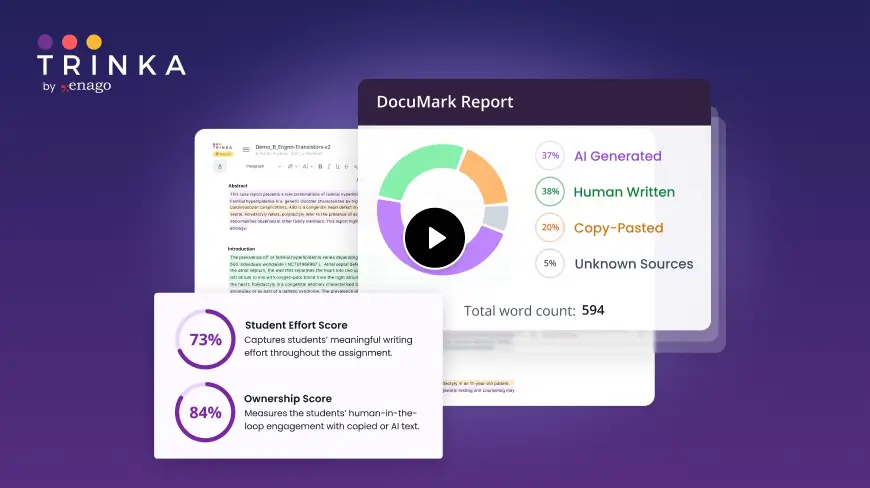
DocuMark: Responsible AI Use for Academic Integrity
Knowing your institution's AI policy is step one. DocuMark helps enforce it fairly by empowering universities to manage AI-generated content, prevent cheating, and support student writing through responsible AI use.
Common Questions About University of Derby's AI Policies
University of Derby has defined AI policies in 11 of 12 categories, with an overall coverage score of 92%.
Students are required to acknowledge generative AI use in assessed work and to identify sources or cited quotations. The policy specifically requires acknowledgement of how AI-generated material has been used or amended; failure to do so is plagiarism.
The university enforces AI-related misconduct through its academic misconduct process. Students may be required to prove authorship in an investigation, including through a viva or other assessment, and sanctions can be severe up to termination of registration. In admissions guidance, the university also warns that AI use can be detected and that suspicious personal statements could be rejected.
Users must ensure data protection by not entering Personally Identifiable Information (PII), sensitive, or confidential university data into public generative AI tools.