Teaching & Learning
- Use of generative AI in coursework is permitted only when the assessment instructions expressly allow it
- Students remain responsible for the accuracy of submitted work, must declare any AI use, and using AI in a way not allowed by the assessment brief is treated as academic misconduct
You are only allowed to use GAI when the assessment instructions clearly state that it can be used.
If you use GAI in your work, you must declare that use within your assignment submission by using the following statement:
I acknowledge the use of [insert AI system(s) and link] to [specific use of generative artificial intelligence]. I confirm that I have critically reviewed and edited the generated content and take full responsibility for the final submission.
Any assessment or assignment that uses GAI where this is not expressly permitted in the assignment brief may be deemed to be academic misconduct and treated as such under the University's academic misconduct procedures.
- Where assessment rules prohibit or do not expressly permit AI, using it can be treated as academic misconduct
- AI use in assessments is controlled at the assessment level: students may use it only when instructions clearly permit it
You are only allowed to use GAI when the assessment instructions clearly state that it can be used.
Any assessment or assignment that uses GAI where this is not expressly permitted in the assignment brief may be deemed to be academic misconduct and treated as such under the University's academic misconduct procedures.
The use of AI software and systems in assessments and examinations should be transparent, with students being informed of what is and what is not permitted.
- Students are warned not to rely on AI outputs without checking them and to avoid entering sensitive personal information
- The university allows students to use AI tools for study support such as understanding concepts, checking grammar, generating ideas, creating study plans, and practicing skills, provided this is done responsibly
There are many legitimate and ethical ways that students can use generative artificial intelligence (GAI) to support their studies and develop their digital skills.
GAI can support your studies if you use it appropriately. For example, you might use AI tools to:
understand key concepts and topics by asking for explanations, examples, analogies, or quizzes
check your writing for clarity, grammar, and spelling
brainstorm ideas, create mind maps, and organise your thinking
revise and practise by asking questions, testing your knowledge, or generating flashcards
create study plans, checklists, or timetables
build confidence with coding, data analysis, or creative work, where relevant to your course
When using GAI, it is important to remember that these tools can be wrong, biased, or made up. They may confidently present false information, incorrect references, or misleading advice. This is sometimes called a “hallucination.”
Do not include any personal, confidential, or sensitive information in prompts. This includes your own personal data, details about other people, or anything private relating to your studies or placement.
- Students must declare any such AI use and remain responsible for the final submission
- AI may be used to support coding and data-analysis learning, but for assessed programming work it is only allowed where the assessment instructions clearly permit it
build confidence with coding, data analysis, or creative work, where relevant to your course
You are only allowed to use GAI when the assessment instructions clearly state that it can be used.
If you use GAI in your work, you must declare that use within your assignment submission by using the following statement:
I acknowledge the use of [insert AI system(s) and link] to [specific use of generative artificial intelligence]. I confirm that I have critically reviewed and edited the generated content and take full responsibility for the final submission.
Research
Academic Integrity
- Disclosure of AI use in student work is mandatory when AI is used
- The university provides a required declaration statement, expects students to specify the AI system and its use, and requires students to confirm they critically reviewed and edited the generated content and accept responsibility for the submission
If you use GAI in your work, you must declare that use within your assignment submission by using the following statement:
I acknowledge the use of [insert AI system(s) and link] to [specific use of generative artificial intelligence]. I confirm that I have critically reviewed and edited the generated content and take full responsibility for the final submission.
You should also save and keep copies of your prompts and any outputs generated. Staff may ask to see these if there is a concern or question about how the work was produced.
- Undisclosed or unauthorized AI use in student assessments may be treated as academic misconduct under university procedures
- The university also states that AI use in assessments should be transparent, but the provided sources do not define a specific institutional position on AI-detection software such as Turnitin or GPTZero
Any assessment or assignment that uses GAI where this is not expressly permitted in the assignment brief may be deemed to be academic misconduct and treated as such under the University's academic misconduct procedures.
You should also save and keep copies of your prompts and any outputs generated. Staff may ask to see these if there is a concern or question about how the work was produced.
Academic misconduct can include, but is not limited to, plagiarism, collusion, contract cheating, fabrication, and falsification.
The use of AI software and systems in assessments and examinations should be transparent, with students being informed of what is and what is not permitted.
Institutional & Administrative
- The provided sources do not define broader university-wide rules for staff use of AI in grading, recommendation letters, or administrative communications
- Staff are expected to design assessments and communicate clearly what AI use is or is not permitted, and the university advises that AI use in assessment should be transparent
Teaching staff should design assessments in a way that promotes academic integrity and provides clarity to students around what is expected of them.
The use of AI software and systems in assessments and examinations should be transparent, with students being informed of what is and what is not permitted.
We recommend that clear guidance is provided to students, including where the use of AI is permitted and where it is not, and that any such use should be openly acknowledged by students in their submissions.
- Students are instructed not to input personal, confidential, or sensitive information into AI systems
- The sources also indicate that the university provides Microsoft 365 access, but they do not define an AI-specific approved-platform list or a formal institutional data-classification framework for AI use
Do not include any personal, confidential, or sensitive information in prompts. This includes your own personal data, details about other people, or anything private relating to your studies or placement.
As a student, you have free access to Microsoft 365 while you study with us, including online versions of Word, PowerPoint, Excel, and Teams.
- However, the provided sources do not set out a broader formal AI strategy, governance committee, or adoption roadmap
- The university has institution-level guidance and policy statements on the use of generative AI in teaching, learning, and assessment, emphasizing responsible use, transparency, and academic integrity
This page explains when students at the University of Dundee can and cannot use generative artificial intelligence (GAI) tools in their assessed work.
This guide explains how students at the University of Dundee can use generative artificial intelligence (GAI) to support learning and study in responsible and ethical ways.
This page provides advice for teaching staff on how to respond to the increasing use of artificial intelligence (AI) tools in relation to teaching, learning and assessment.
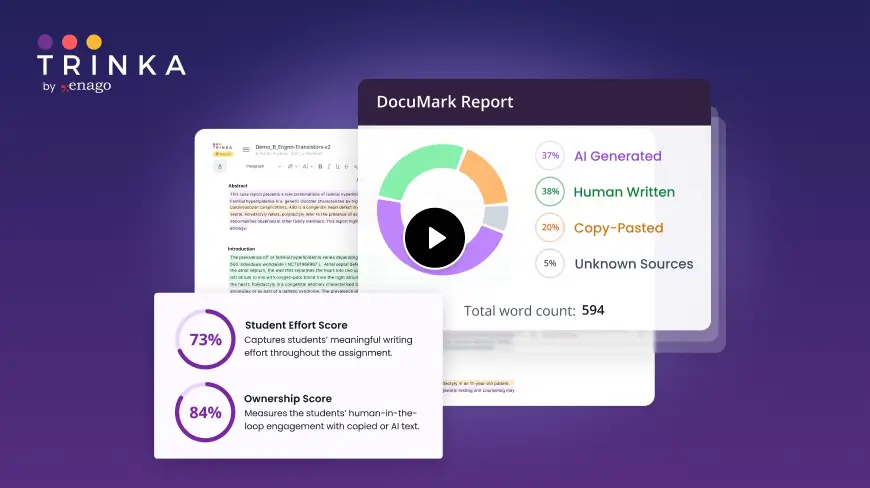
DocuMark: Responsible AI Use for Academic Integrity
Knowing your institution's AI policy is step one. DocuMark helps enforce it fairly by empowering universities to manage AI-generated content, prevent cheating, and support student writing through responsible AI use.
Common Questions About University of Dundee's AI Policies
University of Dundee has defined AI policies in 9 of 12 categories, with an overall coverage score of 75%.
Disclosure of AI use in student work is mandatory when AI is used. The university provides a required declaration statement, expects students to specify the AI system and its use, and requires students to confirm they critically reviewed and edited the generated content and accept responsibility for the submission.
Undisclosed or unauthorized AI use in student assessments may be treated as academic misconduct under university procedures. The university also states that AI use in assessments should be transparent, but the provided sources do not define a specific institutional position on AI-detection software such as Turnitin or GPTZero.
Students are instructed not to input personal, confidential, or sensitive information into AI systems. The sources also indicate that the university provides Microsoft 365 access, but they do not define an AI-specific approved-platform list or a formal institutional data-classification framework for AI use.