Teaching & Learning
- Use of generative AI in coursework is permitted only within the limits set by the assessment brief and the university’s AI principles, policy, and guidance
- Submitting AI-generated content as a student's own work without acknowledgement, or using GenAI beyond what is allowed in the assessment brief, is treated as academic misconduct
Integrity: Assessments should be designed to enable students to demonstrate their own knowledge and skills, and to minimise opportunity for plagiarism or other practice in breach of University regulations. Any use of generative artificial intelligence (AI) in assessment must be strictly in accordance with the University’s principles, policy and guidance. Where relevant, assessments will be designed to meet course specific and/or PSRB academic integrity requirements.
1. Including in your own work material whether written, visual or oral without giving suitable acknowledgement to its creator and/or author including in your own work material whether written, visual or oral without giving suitable acknowledgement to its creator and/or author. This includes the use of Generative Artificial Intelligence (GenAI) tools beyond what is allowed in the assessment brief.
12. The submission of AI-generated content as your own work, without adequate referencing or acknowledgement.
- For assessments generally, any AI use must follow the university’s AI principles, policy, and guidance
- In examinations, the use of an electronic device is prohibited unless it has been expressly permitted for that examination
Integrity: Assessments should be designed to enable students to demonstrate their own knowledge and skills, and to minimise opportunity for plagiarism or other practice in breach of University regulations. Any use of generative artificial intelligence (AI) in assessment must be strictly in accordance with the University’s principles, policy and guidance. Where relevant, assessments will be designed to meet course specific and/or PSRB academic integrity requirements.
6. The application of an electronic device unless this has been expressly permitted for that examination.
- The university promotes AI for learning support when it enhances learning rather than replacing teaching or bypassing assessment
- UEL describes AI learning coaches and guidance for integrating AI into teaching and assessment in ways that are transparent, skill-building, and protective of academic integrity
AI with Integrity in Learning & Development explores how generative AI can enhance learning, not undermine it. We design and test approaches that keep human educators at the centre while using AI to support curiosity, feedback and skills development for diverse learners.
A research-informed pilot at the University of East London that experiments with subject-specific AI learning coaches. The focus is on supporting students’ thinking, practice and confidence – not replacing teaching or short-circuiting assessment – with clear guardrails for ethical and inclusive use.
Examples and guidance on integrating AI into teaching, seminars and assessments in transparent ways that build academic skills, digital literacy and employability, while protecting academic integrity.
- The university’s general AI policy covers code as a form of GenAI output, but it does not set a programming-specific student rule
- For assessed work, code-generating AI falls under the same requirement that AI use must follow university policy and any limits in the assessment brief
1.2.2 Definition: For the purposes of this policy, Generative Artificial Intelligence (Gen AI) refers to algorithms and models that generate new content based on learned patterns from existing data (often mimicking human creativity). These outputs can be in a range of formats, including (but not limited to) text, images, sound, video, code, simulations, designs, animations, music compositions, data tables, synthetic data, diagrams, charts, etc.
Integrity: Assessments should be designed to enable students to demonstrate their own knowledge and skills, and to minimise opportunity for plagiarism or other practice in breach of University regulations. Any use of generative artificial intelligence (AI) in assessment must be strictly in accordance with the University’s principles, policy and guidance. Where relevant, assessments will be designed to meet course specific and/or PSRB academic integrity requirements.
1. Including in your own work material whether written, visual or oral without giving suitable acknowledgement to its creator and/or author including in your own work material whether written, visual or oral without giving suitable acknowledgement to its creator and/or author. This includes the use of Generative Artificial Intelligence (GenAI) tools beyond what is allowed in the assessment brief.
Research
- The university supports researchers using generative AI responsibly across the research lifecycle, including writing and review
- It also frames AI-assisted research writing as something that should be transparent, with disclosure of how AI tools were used in research outputs
AI with Integrity supports researchers to use generative AI in ways that enhance quality, integrity and reproducibility – not undermine them. We focus on practical, transparent workflows for AI-assisted research across qualitative, quantitative and mixed-methods projects.
A concise, practice-oriented guide that walks researchers through when and how to use generative AI responsibly across the research lifecycle, from scoping and literature work to analysis, writing and review. It addresses the challenges, potential risks, and recent debates and offers practice and evidence-based solutions.
AI Disclosure Statement: A transparent declaration of how AI tools were used in the preparation of a research output.
- The university supports AI-assisted research analysis when researchers can evaluate outputs, validate them independently, and protect privacy and confidentiality
- Its research resources explicitly cover qualitative and quantitative workflows, analysis, synthetic data within the general GenAI definition, and documentation tools such as prompt logs and audit trails
1.2.2 Definition: For the purposes of this policy, Generative Artificial Intelligence (Gen AI) refers to algorithms and models that generate new content based on learned patterns from existing data (often mimicking human creativity). These outputs can be in a range of formats, including (but not limited to) text, images, sound, video, code, simulations, designs, animations, music compositions, data tables, synthetic data, diagrams, charts, etc.
AI with Integrity supports researchers to use generative AI in ways that enhance quality, integrity and reproducibility – not undermine them. We focus on practical, transparent workflows for AI-assisted research across qualitative, quantitative and mixed-methods projects.
Templates and micro-workflows (including prompt logs, risk–benefit notes and audit trails) that make AI use visible and defensible in ethics applications, methods sections and supervision conversations.
A continuing programme of webinars and small-group clinics on topics such as responsible AI use and risk assessment, AI-assisted qualitative analysis (coding, memoing and synthesis) and AI-assisted quantitative workflows, co-facilitated with internal and external experts.
3. Will AI use compromise participant privacy or confidentiality?
* If YES → Don't use AI or ensure complete anonymisation
* If NO → Continue to question 4
4. Can I validate AI outputs through independent means?
* If NO → Don't use AI for this task
- It also requires attention to participant privacy/confidentiality and states that human researchers remain accountable for AI-assisted outputs
- The university requires AI-assisted research to preserve quality, integrity, and reproducibility, and it expects researchers to document AI use in ways that are visible and defensible in ethics applications and methods sections
AI with Integrity supports researchers to use generative AI in ways that enhance quality, integrity and reproducibility – not undermine them. We focus on practical, transparent workflows for AI-assisted research across qualitative, quantitative and mixed-methods projects.
Templates and micro-workflows (including prompt logs, risk–benefit notes and audit trails) that make AI use visible and defensible in ethics applications, methods sections and supervision conversations.
3. Will AI use compromise participant privacy or confidentiality?
* If YES → Don't use AI or ensure complete anonymisation
* If NO → Continue to question 4
Accountability: The principle that human researchers remain responsible for AI-assisted outputs and their consequences.
Academic Integrity
- For research outputs, the university also defines an AI disclosure statement as a transparent declaration of how AI tools were used
- Students must give suitable acknowledgement when GenAI is used in assessed work, and AI-generated content submitted as their own work without referencing or acknowledgement is misconduct
1. Including in your own work material whether written, visual or oral without giving suitable acknowledgement to its creator and/or author including in your own work material whether written, visual or oral without giving suitable acknowledgement to its creator and/or author. This includes the use of Generative Artificial Intelligence (GenAI) tools beyond what is allowed in the assessment brief.
12. The submission of AI-generated content as your own work, without adequate referencing or acknowledgement.
AI Disclosure Statement: A transparent declaration of how AI tools were used in the preparation of a research output.
- The university enforces AI-related misconduct through its academic misconduct rules
- It explicitly treats attempts to circumvent similarity-checking systems and the submission of AI-generated content as one's own work without acknowledgement as unfair practice
11. Attempts to circumvent the similarity checking programmes that the University uses (including the use of spinning websites to rephrase text).
12. The submission of AI-generated content as your own work, without adequate referencing or acknowledgement.
Institutional & Administrative
- Its learning-and-development approach also keeps human educators at the centre
- The university’s AI policy applies to staff, and UEL provides staff development for lecturers, trainers, and professional services staff on setting expectations, designing AI-aware activities, and using AI within a compassionate and inclusive learning environment
1.2.1 Scope: The policy applies to all staff, students, third-party suppliers, partners, and affiliates of UEL who engage in the development, deployment, or use of Gen AI technologies.
AI with Integrity in Learning & Development explores how generative AI can enhance learning, not undermine it. We design and test approaches that keep human educators at the centre while using AI to support curiosity, feedback and skills development for diverse learners.
Practical sessions for lecturers, trainers and professional services staff on setting expectations, designing AI-aware learning activities, and using AI tools as part of a compassionate, inclusive learning environment.
- In research use, it also instructs users not to use AI where participant privacy or confidentiality would be compromised unless complete anonymisation is ensured
- The university requires AI use to follow safety, security, privacy, data protection, and intellectual property protections, but it does not identify approved AI platforms in the provided sources
UEL emphasises the importance of safety, security, privacy, transparency, fairness, and accountability in the use of AI systems. Systems should be as transparent and explainable as possible, while rigorously adhering to data protection, intellectual property (IP) protection, privacy, and fairness.
Commitments:
* AI systems must be designed and implemented in ways that prioritise user safety and ethical standards.
* Clear documentation must be provided to ensure transparent and explainable AI.
* Regular audits should be conducted to ensure the fairness of AI systems, preventing biases and ensuring equitable outcomes.
* Robust security protocols must be implemented to protect AI systems from malicious attacks and unauthorised access.
3. Will AI use compromise participant privacy or confidentiality?
* If YES → Don't use AI or ensure complete anonymisation
- UEL has an overarching AI governance and strategy position centred on ethical, human-centred, values-led use of generative AI across research, learning, and organisational decision-making
- Its policy applies university-wide, ties AI use to institutional values and Vision 2028, and includes commitments to communications, webinars, workshops, internal forums, working groups, partnerships, pilots, and continuous capability-building
1.1.1 The purpose of this policy is to ensure that Gen AI technologies are utilised in a manner consistent with UEL's values and ethical principles in order to achieve our Vision 2028 goals.
1.2.1 Scope: The policy applies to all staff, students, third-party suppliers, partners, and affiliates of UEL who engage in the development, deployment, or use of Gen AI technologies.
2.2.4 A regular series of communications, webinars and workshops will be conducted to keep the university informed on relevant AI advancements.
* Encourage integration of AI-related topics into existing curricula to foster a deeper understanding of AI technologies.
* A mentorship programme is made available where knowledgeable staff and industry professionals can guide students and less experienced staff in AI-related projects and research.
* Foster partnerships and collaborations with other academic institutions, industry, and AI experts to share knowledge and best practices.
* Participate in AI research initiatives and contribute to the global AI community.
* Establish internal forums and working groups to facilitate the exchange of ideas and experiences related to AI.
Human-centred governance for AI in research, learning and organisations. AI with Integrity helps universities and organisations use generative AI in ways that are ethical, inclusive and sustainable – without sacrificing performance, creativity or wellbeing.
From research workflows to student learning and organisational decision-making, we co-create practical frameworks, toolkits and pilots that keep humans firmly in the loop.
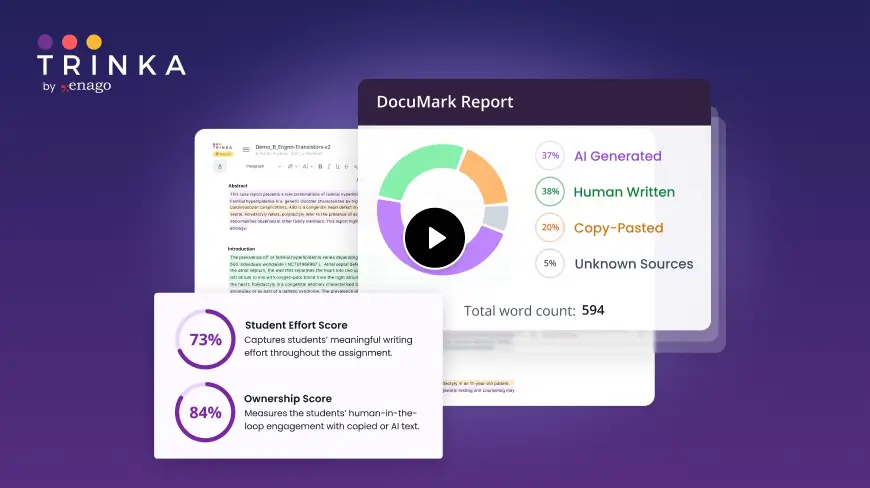
DocuMark: Responsible AI Use for Academic Integrity
Knowing your institution's AI policy is step one. DocuMark helps enforce it fairly by empowering universities to manage AI-generated content, prevent cheating, and support student writing through responsible AI use.
Common Questions About University of East London's AI Policies
University of East London has defined AI policies in 12 of 12 categories, with an overall coverage score of 100%.
Students must give suitable acknowledgement when GenAI is used in assessed work, and AI-generated content submitted as their own work without referencing or acknowledgement is misconduct. For research outputs, the university also defines an AI disclosure statement as a transparent declaration of how AI tools were used.
The university enforces AI-related misconduct through its academic misconduct rules. It explicitly treats attempts to circumvent similarity-checking systems and the submission of AI-generated content as one's own work without acknowledgement as unfair practice.
The university requires AI use to follow safety, security, privacy, data protection, and intellectual property protections, but it does not identify approved AI platforms in the provided sources. In research use, it also instructs users not to use AI where participant privacy or confidentiality would be compromised unless complete anonymisation is ensured.