Teaching & Learning
- In the Hydro master’s guidance for written work, only listed uses are allowed and all other uses are prohibited
- Department-level guidance shows variation: Theology forbids uses that perform core tasks, while Chinese Studies allows supportive use only and treats fully AI-written passages as cheating
- At the university-wide level, use of generative AI in coursework is not uniformly allowed or banned; the policy says instructors may allow it in assessment settings when it serves AI competence development or is relevant to the discipline
Teachers may provide for the use of generative AI in assessment scenarios, provided that this is linked to the development of generative AI competencies or that such use is relevant to the subject area and academic practice.
Alle Verwendungsweisen von LLMs, die die Kernaufgaben zum Erreichen der Ausbildungsziele ausführen, sind nicht zulässig.
The use of artificial intelligence (AI) is generally permitted, but AI tools may only be used in a supportive capacity, i.e. they may never fully replace your own work.
Submitting text passages fully formulated by LLMs as your own work constitutes cheating and is thus never permitted.
Dieses Dokument gibt einen Überblick über mögliche Anwendungsbereiche (mit Beispielen) von generativer Künstlicher Intelligenz (KI) in Haus- und Abschlussarbeiten und legt fest, wofür KI eingesetzt werden darf. In nicht aufgeführten Anwendungsbereichen ist der Einsatz von KI grundsätzlich untersagt.
- It applies across coursework, exams, theses, and other study-related work
- Faculty-level guidance in Theology also states that whether some supportive uses are acceptable can depend on the specific course and specific assessment
- The university-wide policy places AI use in assessments at instructor discretion, with the condition that fair, verifiable, and individual assessment must be preserved
In assessment contexts, the fair, verifiable, and individual assessment of performance must be ensured. Teachers may provide for the use of generative AI in assessment scenarios, provided that this is linked to the development of generative AI competencies or that such use is relevant to the subject area and academic practice.
The policy includes recommendations for teachers, students, and staff involved in teaching and learning at the University of Freiburg. It applies to courses, modules, coursework and exams, theses, and other study-related work in bachelor’s, master’s, and state examination programs.
Weitere Anwendungsszenarien, die eher der Unterstützung des eigenen Denkprozesses dienen und repetitive bzw. zeitaufwändige Tätigkeiten erleichtern, bei denen die Kernaufgabe aber nicht in unzulässiger Weise an die KI abgegeben wird, sind aus unserer Sicht – ähnlich wie andere Computer‐Tools oder auch menschliche Unterstützung in definiertem Umfang – grundsätzlich zulässig. Dies betrifft beispielsweise (ggfs. abhängig von der konkreten Lehrveranstaltung und den konkreten Studien- oder Prüfungsleistungen):
- The university explicitly supports use of generative AI as a pedagogical support tool for learning
- Departmental guidance in Theology also permits supportive uses that aid thinking or time-consuming tasks so long as core academic work is not offloaded to AI
- Its stated goals include individualized learning, tailored feedback, and knowledge acquisition, and it expects students to develop critical and reflective AI competence
Students should develop the skills needed to use generative AI systems in a critical and reflective way, to understand how these systems work, and to analyse their societal implications.
Teachers and students should be able to use generative AI as a pedagogical support tool, for example to promote individualised learning, tailored feedback, and the acquisition of knowledge.
Weitere Anwendungsszenarien, die eher der Unterstützung des eigenen Denkprozesses dienen und repetitive bzw. zeitaufwändige Tätigkeiten erleichtern, bei denen die Kernaufgabe aber nicht in unzulässiger Weise an die KI abgegeben wird, sind aus unserer Sicht – ähnlich wie andere Computer‐Tools oder auch menschliche Unterstützung in definiertem Umfang – grundsätzlich zulässig.
- The university-wide teaching policy does not define a single rule for programming assignments
- Research guidance also recognizes programming code generation and debugging as a common AI use case, but that is framed for research rather than coursework
- Department-level materials vary: Chinese Studies says creation and debugging of programming code do not require documentation, while the Hydro master’s guidance allows programming and debugging in house and thesis work and gives ChatGPT as an example of a permitted programming aid
The following uses of AI do not require documentation:
b. creation and debugging of programming code;
Einige KI-Tools dürfen für bestimmte Zwecke verwendet werden, für andere jedoch nicht (z.B. ChatGPT als Programmierhilfe, aber nicht zur Generierung neuer Texte).
Programmieren und Debuggen GitHub CoPilot, ChatGPT, Gemini Erlaubt
Chatbots based on generative language models, such as ChatGPT or You.com, excel at generating texts with a wide range of applications from literature reviews to generating programming code or debugging it.
Research
- The research policy permits AI-assisted text generation for research writing only with transparency and human responsibility
- Researchers should disclose the AI systems used, document the use, and retain responsibility for the content, results, and references
- AI cannot be listed as an author in scientific publications, and AI use in publications must be transparently listed in the methods section
Researchers should disclose which AI systems they have used and clearly label their contributions.
The potential for generating texts, e.g., as templates for modifications by authors, can be used as long as this is documented and the authors take responsibility for the content, results (such as codes), and references.
The Committee on Publication Ethics (2023, 5. ) states clearly that AI systems cannot be authors in scientific publications, among other reasons because they are not legal persons. The use of AI tools must be transparently listed in the methods section of publications. Only natural persons can appear as authors in scientific publications.
- The research policy allows AI use in research data and analysis only with documentation, reproducibility efforts, and researcher accountability
- AI-generated data and derived results must be identified, and the origin and use of methods, systems, and data sources must be fully documented
- Researchers remain responsible for the accuracy of generated data and results, and must minimize bias and avoid harmful or discriminatory outcomes
Researchers remain responsible for the accuracy of the generated data, texts, and results, even if they are AI-generated or AI-based.
It must be indicated whether data and the results derived from them are AI-generated. The origin and use of the utilized methods, AI systems, and data sources must be fully documented, ideally in a way that the results can be reproduced.
Researchers must ensure that their results are scientifically grounded and must consider and, if necessary, avoid potential harm scenarios. The use of genAI also carries the risk of biases that can lead to discriminatory decisions. In relation to the training data used, systematic bias that stems from societal conditions, where certain prejudices are inherent in the data, must be avoided.
Bias during the data collection or data annotation process, or in the choice of algorithm or system design, should be minimized.
- In high-risk or doubtful cases, researchers are directed to consult the Committee for Responsibility in Research
- The university treats undisclosed AI use as a research-integrity risk and requires transparency and accountability in research
- For DFG review processes, use of generative models is prohibited because review documents are confidential and must not be entered into such systems
Moreover, scientific misconduct, such as failing to disclose the use of genAI, poses a risk of misuse, as does the potential infringement of intellectual property.
The use of generative models in applications to funding by the DFG is evaluated by the DFG itself as neither positive nor negative. However, when preparing reviews, the DFG (2023, 3. ) prohibits the use of generative models with regard to the confidentiality of the review process. Documents submitted for review are confidential and must not be used as input for generative models.
In doubtful cases, especially in instances with a high risk of abuse, researchers should consult the Committee for Responsibility in Research (Kommission für Verantwortung in der Forschung, KVF), which can discuss such issues in an interdisciplinary setting and advise researchers.
Academic Integrity
- Disclosure requirements are defined in research policy and in several department-level student declarations
- In research, researchers should disclose AI systems used, label contributions, indicate AI-generated data/results, and fully document methods and data sources; in publications, AI use must be listed in the methods section
- In student work, requirements vary by department: Chinese Studies mandates acknowledgment and detailed documentation for certain AI uses, while Hydro requires an AI-use declaration and written reflection in the thesis/work
Researchers should disclose which AI systems they have used and clearly label their contributions.
It must be indicated whether data and the results derived from them are AI-generated. The origin and use of the utilized methods, AI systems, and data sources must be fully documented, ideally in a way that the results can be reproduced.
The use of AI tools must be transparently listed in the methods section of publications.
The following uses of generative AI, in particular LLMs (such as ChatGPT), must be acknowledged and require detailed documentation:
a. the creation of outlines;
b. support in the compilation and preparation of secondary literature;
c. support in the preparation and structuring of data.
Erlaubt: Die Nutzung von KI ist erlaubt, muss aber angegeben werden („Erklärung zum Einsatz von KI“, s. unten) und in der Arbeit schriftlich reflektiert werden (z.B. im Methodenteil).
- The university’s research policy also identifies failure to disclose AI use as scientific misconduct
- University-wide AI detection and enforcement rules are not defined in the provided central teaching policy, but department-level enforcement exists in Chinese Studies
- There, students must consent to checks with plagiarism software and AI-detection software, work without the declaration is not accepted, and submitting fully LLM-written text as one’s own is classified as cheating
With my signature, I agree that my work may be checked using plagiarism software as well as software to detect the use of AI and that electronic copies (anonymized) may be made and retained for this purpose.
* Work submitted without this declaration will not be accepted.
Submitting text passages fully formulated by LLMs as your own work constitutes cheating and is thus never permitted.
Moreover, scientific misconduct, such as failing to disclose the use of genAI, poses a risk of misuse, as does the potential infringement of intellectual property.
Institutional & Administrative
- It also states that staff handling LLMs for official work must complete the university’s online introductory training
- For institutional AI access, the university provides approved tools for administration, teaching, learning, and research
- The university states that the teaching-and-learning policy includes recommendations for teachers and staff involved in teaching and learning, but the provided texts do not set specific rules on grading, feedback, recommendation letters, or administrative communications
The policy includes recommendations for teachers, students, and staff involved in teaching and learning at the University of Freiburg.
The University of Freiburg is providing its members and associates with a new web application – HAWKI – that enables them data-protection-compliant access to generative AI models for administration, research, teaching and learning.
Bitte beachten Sie, dass die Voraussetzung zum dienstlichen Umgang mit LLMs bzw. generativer KI die Bearbeitung der Online-Schulung „Teil 1: Einführung in den Einsatz von generativen KI-Systemen/LLMs Allgemein“ über die Lernplattform ILIAS ist.
- The university also states that processing personal data or research and business secrets through external AI providers such as ChatGPT and MistralAI is generally not permitted
- The university provides institutionally approved AI platforms for data-protection-compliant use, first HAWKI and later Open WebUI, for administration, research, teaching, and learning
- It states that Open WebUI/Open WebUI internal models keep data within the secured university environment, and that HAWKI routes requests through the university API without transmitting user personal data; prompts are not used to train the AI and are deleted after 30 days
The University of Freiburg is providing its members and associates with a new web application – HAWKI – that enables them data-protection-compliant access to generative AI models for administration, research, teaching and learning.
HAWKI is an open-source web application developed at the University of Applied Sciences and Arts (HAWK Hildesheim, Germany) that enables all members and associates of the University of Freiburg with a university account to use various AI models in compliance with data protection.
All enquiries are sent bundled via the application interface (API) of the University of Freiburg to the third-party providers, no user personal data is transmitted.
In addition, the data stored in prompts (instructions or requests to AI) are not used to train that AI and are deleted after a retention period of 30 days.
Open WebUI ist eine webbasierte Oberfläche, mit der alle Mitglieder der Universität Freiburg Large Language Models (LLMs) sicher und unkompliziert in Verwaltung, Studium, Lehre und Forschung einsetzen können. Der Service wird vom Rechenzentrum der Universität betrieben und erfüllt höchste Standards in Sachen Datenschutz und IT‑Sicherheit.
Datenschutz + Compliance: Alle Daten bleiben bei Verwendung der internen Modelle innerhalb der gesicherten Uni‑Umgebung. Bei der Nutzung externer Modelle werden Ihre Anfragen über den zentralen API Zugang der Universität an die Anbieter weitergeleitet.
Die Verarbeitung personenbezogener Daten bzw. von Forschungs- und Betriebsgeheimnissen durch externe KI Dienstleister wie ChatGPT und MistralAI ist grundsätzlich nicht gestattet.
- In research governance, the university directs high-risk cases to the Committee for Responsibility in Research
- The university has an overarching AI governance approach through Senate-adopted policies for teaching/studies and research
- In teaching and learning, the policy frames three central goals: building AI competencies, supporting teaching and learning, and safeguarding assessment integrity, and states that the university sees provision of current data-protection-compliant AI systems as part of its responsibility
To help faculty and students navigate the use of AI, the University of Freiburg Senate adopted guidelines on the use of generative AI in teaching and studies.
The University regards the provision of up-to-date AI systems as part of its responsibility for contemporary university teaching. It ensures that teachers and students have access to a broad range of current AI tools that comply with data protection regulations.
The policy on the use of generative AI in learning and teaching pursues three central goals:
1. Fostering AI competencies:
2. Supporting teaching and learning:
3. Safeguarding assessment integrity:
The university has developed a policy on the use of generative AI in research.
In doubtful cases, especially in instances with a high risk of abuse, researchers should consult the Committee for Responsibility in Research (Kommission für Verantwortung in der Forschung, KVF), which can discuss such issues in an interdisciplinary setting and advise researchers.
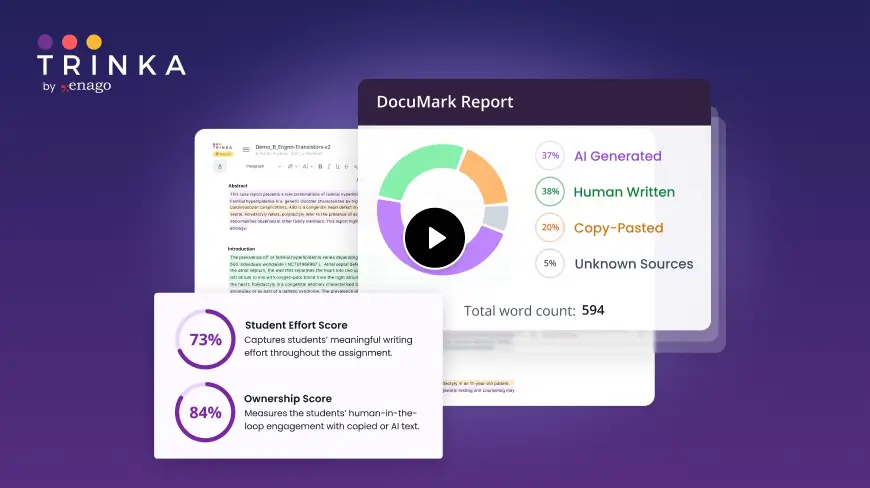
DocuMark: Responsible AI Use for Academic Integrity
Knowing your institution's AI policy is step one. DocuMark helps enforce it fairly by empowering universities to manage AI-generated content, prevent cheating, and support student writing through responsible AI use.
Common Questions About University of Freiburg's AI Policies
University of Freiburg has defined AI policies in 12 of 12 categories, with an overall coverage score of 100%.
Disclosure requirements are defined in research policy and in several department-level student declarations. In research, researchers should disclose AI systems used, label contributions, indicate AI-generated data/results, and fully document methods and data sources; in publications, AI use must be listed in the methods section. In student work, requirements vary by department: Chinese Studies mandates acknowledgment and detailed documentation for certain AI uses, while Hydro requires an AI-use declaration and written reflection in the thesis/work.
University-wide AI detection and enforcement rules are not defined in the provided central teaching policy, but department-level enforcement exists in Chinese Studies. There, students must consent to checks with plagiarism software and AI-detection software, work without the declaration is not accepted, and submitting fully LLM-written text as one’s own is classified as cheating. The university’s research policy also identifies failure to disclose AI use as scientific misconduct.
The university provides institutionally approved AI platforms for data-protection-compliant use, first HAWKI and later Open WebUI, for administration, research, teaching, and learning. It states that Open WebUI/Open WebUI internal models keep data within the secured university environment, and that HAWKI routes requests through the university API without transmitting user personal data; prompts are not used to train the AI and are deleted after 30 days. The university also states that processing personal data or research and business secrets through external AI providers such as ChatGPT and MistralAI is generally not permitted.