Teaching & Learning
- The university also states that course coordinators may set additional limits or prohibit AI for particular assessments, so the exact rules can vary by assessment
- For unsupervised coursework and take-home assessments, students may use GenAI if they acknowledge its use, keep the work substantially their own, verify accuracy, and follow any course-specific restrictions
For unsupervised assessments (i.e., assessments which are not supervised or invigilated), students may use Generative AI (GenAI) tools provided they acknowledge this use appropriately and the submitted work remains substantially their own.
For most coursework and take-home assessments, students may use GenAI tools provided they:
● Acknowledge their use – explain what tools were used and how
● Ensure the work remains substantially their own – GenAI should assist,
not replace, original, independent thinking and learning
● Verify accuracy – check all information, citations, and claims
● Follow any specific instructions – course coordinators may set additional
requirements or restrictions.
Course coordinators will specify, on an assessment-by-assessment basis, whether any limitations apply for the usage of AI within that assessment (including if AI must be used in only particular ways or, indeed, if AI use is not permitted at all).
- The university also states that using GenAI when it is not permitted is a breach of academic integrity
- In supervised assessments, including examinations and other invigilated tasks, GenAI is prohibited unless the course coordinator gives express permission in the assessment brief
For supervised assessments – including examinations, in-class tests, and other invigilated tasks – students are not permitted to use GenAI unless the course coordinator has given express permission in the assessment brief.
This applies to:
● In-person written examinations
● in-class tests and quizzes
● supervised practical work
● oral presentations and vivas
● any other assessment conducted under controlled conditions.
This restriction extends to wearable devices and other emerging technologies with AI capabilities. Using GenAI when it is not permitted constitutes a breach of academic integrity
- This use is permitted as part of digital literacy development, but students must still follow university academic integrity and ICT use policies
- For general learning purposes outside summative assessment, students are encouraged to explore how GenAI can support study activities such as explanations, brainstorming, practice questions, and improving clarity
For general learning purposes – as distinct from summative assessment – students are encouraged to explore how GenAI might support their studies. This could include:
* exploring complex topics and generating explanations
* brainstorming ideas and structuring arguments
* practising concepts through dialogue with AI
* checking grammar and improving clarity
* summarising reading materials
* generating practice questions.
Students should follow all University policies when using GenAI for learning, including the Academic Integrity Policy and Acceptable Use of ICT Resources Policy.
- Students may not have an AI tool prepare their work, and they must reference all content they use or consult, including open-source programming code
- The university does not set a separate university-wide AI rule just for programming assignments; code-related GenAI use follows the same assessment rules as other academic work
You must not copy, translate, or lightly edit, someone else’s work, you must not have any other person, service or AI tool prepare your work, and you must not prepare your work with another person (except in specific assignments where it is clearly marked as a group effort).
Remember that you must reference all content you use or consult, including open-source programming code.
Generative AI (GenAI) refers to technologies capable of creating digital content – including text, images, video, music, and computer code.
Research
- For research writing, the university permits AI use only with critical analysis, user oversight, and transparent acknowledgement
- It urges caution when using AI to check writing, states that AI cannot be an author, and provides citation and acknowledgement guidance for reporting AI use in academic writing
There is therefore one overriding principle, which applies to all staff, students, and researchers at the University: any use of generative AI tools must be accompanied by critical analysis and oversight on the part of the user.
Further, the University’s position on the use of AI in writing is clear: work that is not your own effort or is without appropriately transparent acknowledgement of sources or tools used (e.g. work submitted that is the product of Generative AI) does not meet crucial requirements for assessment or academic/research integrity.
We would urge caution when using AI tools to check your writing.
It is important to understand that AI tools cannot be the author of a work.
It may be more appropriate to acknowledge the use of AI tools rather than to cite them, e.g. depending on the guidance for submitting your assessment or the guidance provided by your publisher.
- It explicitly warns that exposing data, ideas, or research to AI may put them into the public domain, compromise confidentiality, or enable use without attribution
- The university allows AI use in research only with critical analysis and user oversight, and it warns researchers to be very careful about entering research data or work into AI tools
There is therefore one overriding principle, which applies to all staff, students, and researchers at the University: any use of generative AI tools must be accompanied by critical analysis and oversight on the part of the user.
Many tools incorporate inputs into how AI models are 'trained' to respond and therefore researchers should exercise great care in putting their data or work into these tools.
Exposing your data, ideas, or research, or those of others without permission, to an AI tool may, in effect, put it into the public domain, compromise confidentiality, or allow the work to be used without attribution, accountability, context, or completeness.
- The university states a general research integrity rule that any use of generative AI by staff, students, and researchers must involve critical analysis and user oversight
- It also states that work lacking transparent acknowledgement of AI tools does not meet academic or research integrity requirements, but the provided sources do not define specific university rules for grant proposals or ethics applications
This guidance seeks to support the responsible, appropriate, and informed use of AI tools and to support academic and research integrity.
There is therefore one overriding principle, which applies to all staff, students, and researchers at the University: any use of generative AI tools must be accompanied by critical analysis and oversight on the part of the user.
Further, the University’s position on the use of AI in writing is clear: work that is not your own effort or is without appropriately transparent acknowledgement of sources or tools used (e.g. work submitted that is the product of Generative AI) does not meet crucial requirements for assessment or academic/research integrity.
Academic Integrity
- The university requires students to acknowledge AI use in academic work and says AI-generated content cannot be submitted as if it were the student's own
- It also provides detailed research citation guidance: users should name the AI platform, include the date and prompts where possible, identify the person entering the prompts, keep records of outputs, and be transparent about AI use
Students must still acknowledge how AI has been used and content generated by an AI cannot be submitted as though it is the student's own work.
If using any form of GenAI tool, you must acknowledge how the tools have been used within your work. You cannot submit any content produced by GenAI as your own work.
The specific rules for many referencing styles are still to be finalised, but the general rules are:
* Name the AI platform used (e.g., OpenAI ChatGPT or Google Bard)
* Include details on the date of use of AI
* Ideally, include details on the prompts input (and, if possible, the responses received)
* Include details of the person who input the prompts
* Keep records of the responses output by AI, even if you do not include these in the submission itself
* Be clear, open and transparent in your use of AI
It may be more appropriate to acknowledge the use of AI tools rather than to cite them, e.g. depending on the guidance for submitting your assessment or the guidance provided by your publisher.
- Undisclosed or impermissible AI use is treated as academic misconduct or a breach of academic integrity
- The university states that using GenAI to generate content and submitting it as one's own work is academic misconduct, and it warns students that misuse can lead to a conduct case; the provided sources do not define a stance on AI detection tools
Students using GenAI to generate content and submitting it as their own work is academic misconduct.
Using GenAI when it is not permitted constitutes a breach of academic integrity
Otherwise, you may create suspicion and mystery around the tools, leading to students potentially misusing GenAI and thus falling into the territory of creating an unfair advantage and facing a conduct case.
Institutional & Administrative
- Faculty and staff are instructed to communicate clearly to students how far GenAI may be used in assessments and to design assessments accordingly
- For university AI outputs more broadly, the institution requires human review, and it notes that many staff members are already using ChatGPT in their own work
It is important to note that students will expect communication about the extent to which GenAI can be used in assessment activities. You can do this via various communication channels such as Moodle, assessment briefs and in-class discussions.
In determining that some GenAI usage is permissible, staff must consider before finalising the assessment design, how they wish their students to use or engage with the tools. Avoid partial use of GenAI unless you are very clear how you would know if GenAI had been used in ways other than those permitted. Assessment design is crucial.
Anything Copilot produces must be reviewed by a human.
Many staff members are already using ChatGPT in their own work and it is only reasonable to assume students are too.
- Microsoft Copilot Chat is the only AI service approved for use with university data
- The university prohibits putting confidential or sensitive university or third-party information into AI tools, requires human review of Copilot outputs, and says AI tools are not recommended for confidential meetings or meetings involving special category, legal, compliance, or regulatory matters
Copilot, a new feature in Microsoft 365, is an Artificial Intelligence (AI) companion created by Microsoft and is the only AI service approved for use with University data.
Copilot Chat is the only AI service approved for use with University data.
Anything Copilot produces must be reviewed by a human.
Confidential or sensitive information (including, for example, IP) belonging to the University or any third party should not be put into AI tools
Microsoft Copilot Chat is the only AI service that the University has currently assessed as having sufficient security controls for processing University data.
AI tools are also not recommended for use in confidential meetings such as grievance, disciplinary or student conduct meetings, or in meetings discussing special category data, legal, compliance or regulatory matters.
Users of personal or other confidential data must take appropriate security measures against unauthorised access to, or alteration, disclosure or destruction of, that data and against its accidental loss or destruction. The Guidelines on handling Confidential Data are designed to provide a secure framework within which confidential material may be protected and must be followed.
- Its approach is guided by stated principles including transparency and accountability, and it also maintains university-wide researcher guidance with an overriding principle of critical analysis and human oversight
- The university has an overarching institutional position that GenAI is both potentially transformative and disruptive, and that it has a responsibility to prepare students for an AI-augmented world through ethical experimentation and understanding
The University of Glasgow believes Generative Artificial Intelligence (GenAI) tools are potentially transformative as well as disruptive. They increasingly feature in academic and professional workplaces, which means that our students will graduate into an GenAI-augmented world. The university has a responsibility to prepare students for this world, providing space to experiment with, and understand the potential of, GenAI in an ethical way.
The University’s approach is guided by the following principles:
● Transparency – students and staff should discuss GenAI use openly,
acknowledge when it has been used, and build trust through honest
engagement
● Accountability – individuals remain responsible for work they submit,
There is therefore one overriding principle, which applies to all staff, students, and researchers at the University: any use of generative AI tools must be accompanied by critical analysis and oversight on the part of the user.
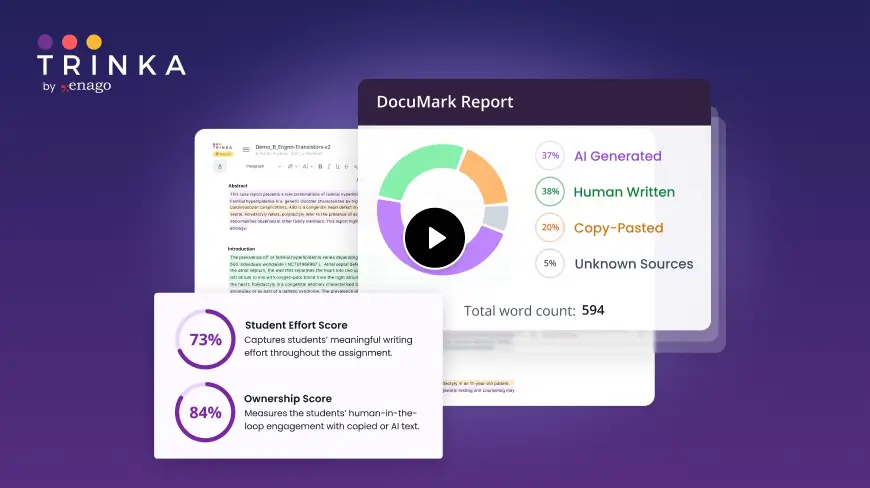
DocuMark: Responsible AI Use for Academic Integrity
Knowing your institution's AI policy is step one. DocuMark helps enforce it fairly by empowering universities to manage AI-generated content, prevent cheating, and support student writing through responsible AI use.
Common Questions About University of Glasgow's AI Policies
University of Glasgow has defined AI policies in 12 of 12 categories, with an overall coverage score of 100%.
The university requires students to acknowledge AI use in academic work and says AI-generated content cannot be submitted as if it were the student's own. It also provides detailed research citation guidance: users should name the AI platform, include the date and prompts where possible, identify the person entering the prompts, keep records of outputs, and be transparent about AI use.
Undisclosed or impermissible AI use is treated as academic misconduct or a breach of academic integrity. The university states that using GenAI to generate content and submitting it as one's own work is academic misconduct, and it warns students that misuse can lead to a conduct case; the provided sources do not define a stance on AI detection tools.
Microsoft Copilot Chat is the only AI service approved for use with university data. The university prohibits putting confidential or sensitive university or third-party information into AI tools, requires human review of Copilot outputs, and says AI tools are not recommended for confidential meetings or meetings involving special category, legal, compliance, or regulatory matters.