Teaching & Learning
- The regulations also state that misuse of generative AI may amount to plagiarism, fabrication, or procedural dishonesty, and penalties apply through the assessment offences process
- For taught students, submitting coursework that someone else or generative AI has completed in its entirety as the student's own work is prohibited and treated as procedural dishonesty
6.18.1 Assessment Offences include (but are not limited to): plagiarism, unauthorised collusion, re-presentation (self-plagiarism), fabrication, impersonation, breaching the rules of examinations, not adhering to the University’s Research Ethics: Principles and Procedures or the use of essay mills or a service where someone else (or generative AI) has completed the entire assessment which the student then submits as their own (treated as procedural dishonesty).
Misuse of generative AI could constitute a number of forms of academic offence e.g. plagiarism, fabrication or procedural dishonesty.
First Offence, logged on the student’s record as a formal Caution only, the work marked according to the published assessment criteria, and the material deemed to have been presented in breach of the University Academic Regulations for Taught Provision will not be considered when arriving at the mark;
Second Offence (or procedural dishonesty), logged on the student’s record, with a loss of all marks for the module, a grade of BR recorded, and the module deemed to have been failed;
Third Offence, with a loss of all marks for the module and a requirement to withdraw from the programme and from the University and a grade of BR recorded.
- The regulations also classify breaches of examination rules as assessment offences, and research degree oral examinations may be conducted face to face or online
- The university does not set a separate AI-specific exam rule in the provided sources, but it treats misuse of generative AI within assessment as an assessment offence
6.18.1 Assessment Offences include (but are not limited to): plagiarism, unauthorised collusion, re-presentation (self-plagiarism), fabrication, impersonation, breaching the rules of examinations, not adhering to the University’s Research Ethics: Principles and Procedures or the use of essay mills or a service where someone else (or generative AI) has completed the entire assessment which the student then submits as their own (treated as procedural dishonesty).
Misuse of generative AI could constitute a number of forms of academic offence e.g. plagiarism, fabrication or procedural dishonesty.
9.7 URDC will approve examination arrangements using the most appropriate platform for the candidate. This may be either face to face examination, or online.
- It also provides Turnitin-based formative text matching on designated modules to support learning about paraphrasing, citation, and referencing
- The university does not define a university-wide rule on using AI as a study aid, but it tells students to seek guidance from their course team if they are unsure about appropriate AI use
If you are unsure about appropriate use of AI, your course team can offer guidance.
You can also use text matching within your Virtual Learning Environment on designated modules each year. This gives you the opportunity to learn more about paraphrasing, citation and referencing.
For formative use, tutors will explain how to interpret the report and how to use this feedback in your learning.
Research
- The provided sources do not state any AI-specific permission or prohibition for drafting or editing research writing
- For research degrees, the thesis must acknowledge sources and any assistance received, and the author's declaration requires the work to be original except where specifically referenced
13.4 The thesis must acknowledge published or other sources of material consulted and any assistance received.
I declare that the work in this thesis was carried out in accordance with the regulations of the University of Gloucestershire and is original except where indicated by specific reference in the text. No part of the thesis has been submitted as part of any other academic award. The thesis has not been presented to any other education institution in the United Kingdom or overseas.
- However, the provided sources do not define any AI-specific rules for using AI in research data collection, analysis, or interpretation
- The university's research ethics framework states that ethical dimensions of research include the collection, use, and interpretation of research data
The ethical dimensions of research relate to issues of research integrity and as such involve more than these specific responsibilities to take account the interests of the public and the researchers to incorporate the credibility and standing of scholarly research. Some of these dimensions include:
* The collection, use, and interpretation of research data
- The provided sources do not set AI-specific research ethics rules
- The university requires research conducted under its name to follow its research ethics policy and expects high standards of research integrity from staff and students
- For research degrees, use of unfair means such as plagiarism in thesis preparation is investigated and can result in failure of the thesis with no possibility of re-examination
1.5 At the University of Gloucestershire, ethical review is intended to be a constructive and collaborative enterprise that promotes valuable research in the interest of the common good. The University’s Research Ethics Committee (REC) is responsible for reviewing applications for ethical approval. This document sets out the University’s policy and practice on the ethical conduct of any research carried out under its name.
1.7 Maintenance of ethical literacy in research and a system of research ethics based in best practice is fundamental to the development and enhancement of research integrity. Although not the same thing, an ethically sound approach to research is a key component of research integrity. The University of Gloucestershire is working to ensure that it achieves the highest standards of research integrity, and expects the same of all its staff and students.
9.11 Where evidence of the use of unfair means, such as plagiarism, in the preparation of the thesis comes to light during examination this must be discussed in detail in the joint examination report to assist URDC in its consideration of the matter; if necessary in consultation with the examiners URDC will undertake an investigation and if the use of unfair means is upheld by the investigation panel, they will take appropriate action, which includes failing the thesis with no possibility of re-examination.
Academic Integrity
- The university requires acknowledgement of sources in assessed work and, for research degrees, acknowledgement of sources and any assistance received in the thesis
- The provided sources do not give an AI-specific disclosure or citation format, but they do direct students to guidance on citing and referencing and to course teams for guidance on appropriate AI use
In exercising their judgement, Examiners may penalise any work where the standard of English, numeracy or presentation adversely affects the quality of the work, or where the work submitted exceeds the published size or time limits, or where the work fails to follow normal academic conventions for acknowledging sources.
13.4 The thesis must acknowledge published or other sources of material consulted and any assistance received.
You can get help with academic writing, citing and referencing, and understanding reports through your course team and Library Services.
If you are unsure about appropriate use of AI, your course team can offer guidance.
- The university states that Turnitin text matching is used for staff review of online text-based summative work, but similarity scores are not proof of plagiarism and staff interpret reports in context
- For taught provision, assessment offences involving generative AI are investigated by an Academic Conduct Officer or Review Panel, with penalties ranging from a caution to failure of the module or withdrawal
- It also states that text matching tools do not reliably detect AI-generated text, and concerns about possible AI misuse are handled through established academic integrity procedures using evidence and fair process
All text based summative work submitted online is automatically checked to compare sources and highlight similarities for staff review. A similarity score is not proof of plagiarism and does not make assumptions about intent. Staff interpret the report alongside your work and consider the context.
Text matching tools do not reliably detect AI generated text. Our focus is on helping you understand academic integrity and designing assessments clearly and fairly. Concerns about possible misuse of AI are handled through established academic integrity procedures, using evidence and fair process.
6.18 Assessment offences shall be investigated by an Academic Conduct Officer who will also decide the outcome. In the event of complex cases, the Academic Conduct Officer may refer the case to an Assessment Offences Review Panel which will then become the designated decision making body.
First Offence, logged on the student’s record as a formal Caution only, the work marked according to the published assessment criteria, and the material deemed to have been presented in breach of the University Academic Regulations for Taught Provision will not be considered when arriving at the mark;
Second Offence (or procedural dishonesty), logged on the student’s record, with a loss of all marks for the module, a grade of BR recorded, and the module deemed to have been failed;
Third Offence, with a loss of all marks for the module and a requirement to withdraw from the programme and from the University and a grade of BR recorded.
Institutional & Administrative
- The provided sources do not define a general policy for faculty or staff using AI for grading, feedback, lesson planning, letters, or administrative communications
- They do state that academic colleagues and professional services staff who support learning, teaching and assessment should familiarise themselves with staff guidance on using Turnitin, and that staff use analytics to inform conversations rather than make assumptions
Academic colleagues and professional services staff who support learning, teaching and assessment should familiarise themselves with the Guidance for staff on using Turnitin (please note: this link is not available externally).
Staff use analytics to inform conversations, not to make assumptions.
- The university requires compliance with its data protection and privacy policies when using institutional systems and learning analytics
- Student work is processed through approved systems as part of assessment processes, but the provided sources do not name approved AI platforms
- Users must keep personal data private and confidential, share personal information securely, and access university data only through appropriate procedures
All activities in this area will comply with the institution’s Data Protection Policy and Student Privacy Notice plus UK Data Protection legislation.
Learning analytics will not be used to inform significant action at an individual level without human intervention.
Your work is processed through approved systems as part of our assessment processes and in line with the Student Privacy Notice.
Only share personal information securely, encrypting any transferred data outside the university network.
Follow the data protection policy and keep personal data private and confidential unless required by law or university policy to disclose such information.
Access data from university systems without following the appropriate procedure/process.
- The provided sources do not set out an overarching institutional AI strategy, AI committee, or AI adoption roadmap
- The only AI-related governance statements in the sources are operational: the Turnitin Text Matching Policy is owned by the Academic Affairs Committee, and the Learning Analytics Policy assigns overall responsibility for learning analytics to the Chief Operating Officer
Owner: Academic Affairs Committee
Overall responsibility for learning analytics at University of Gloucestershire is held by the Chief Operating Officer.
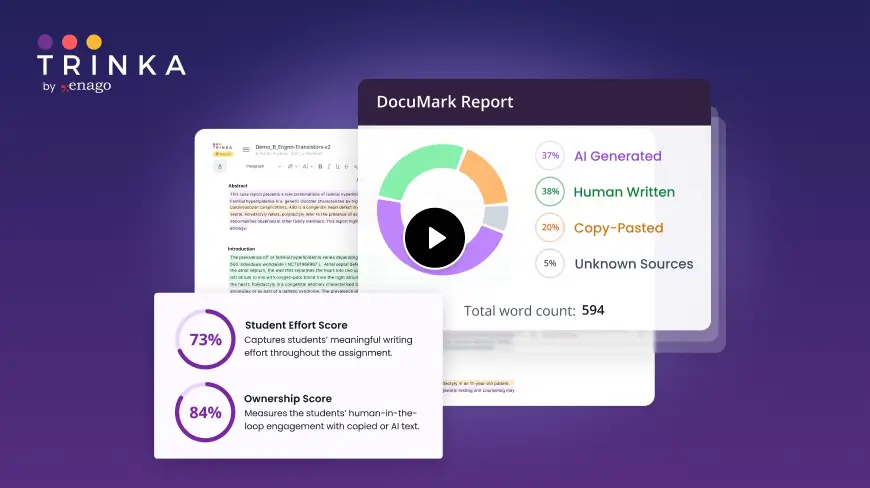
DocuMark: Responsible AI Use for Academic Integrity
Knowing your institution's AI policy is step one. DocuMark helps enforce it fairly by empowering universities to manage AI-generated content, prevent cheating, and support student writing through responsible AI use.
Common Questions About University of Gloucestershire's AI Policies
University of Gloucestershire has defined AI policies in 11 of 12 categories, with an overall coverage score of 92%.
The university requires acknowledgement of sources in assessed work and, for research degrees, acknowledgement of sources and any assistance received in the thesis. The provided sources do not give an AI-specific disclosure or citation format, but they do direct students to guidance on citing and referencing and to course teams for guidance on appropriate AI use.
The university states that Turnitin text matching is used for staff review of online text-based summative work, but similarity scores are not proof of plagiarism and staff interpret reports in context. It also states that text matching tools do not reliably detect AI-generated text, and concerns about possible AI misuse are handled through established academic integrity procedures using evidence and fair process. For taught provision, assessment offences involving generative AI are investigated by an Academic Conduct Officer or Review Panel, with penalties ranging from a caution to failure of the module or withdrawal.
The university requires compliance with its data protection and privacy policies when using institutional systems and learning analytics. Users must keep personal data private and confidential, share personal information securely, and access university data only through appropriate procedures. Student work is processed through approved systems as part of assessment processes, but the provided sources do not name approved AI platforms.