Teaching & Learning
- Work generated by AI and submitted as if it were the student's own is treated as academic misconduct
- Students remain responsible for the accuracy, originality, and proper acknowledgement of any AI-assisted work
- Use of generative AI in assessed coursework is only permitted when it has been specifically authorized and students must follow assignment or module guidance
You should only use AI in your assignments if it has been authorised by your module convenor or lecturer and if you know how to use it responsibly.
Unless explicitly authorised, using AI-generated text, code, images or other content in your work and presenting it as your own is a form of academic misconduct.
You are responsible for the work you submit, including any part generated or supported by AI tools.
Use of AI must be clearly acknowledged where required by your school, module or assessment brief.
- The university also states that in-person exams are one way to reduce risks associated with AI use
- AI use in exams and formal assessments is not uniformly allowed and depends on the assessment instructions
- Students must check the rules for each assessment, and using unauthorized AI in an assessment is treated as academic misconduct
AI may or may not be allowed in your assessments, depending on the type of assessment and the instructions you are given.
Always check your assessment brief or ask your lecturer if you are unsure whether AI use is permitted.
Using AI in a way that breaches assessment rules may be considered academic misconduct.
In person examinations are one method of maintaining the integrity of our degrees, not because of AI but because of the changing world of education and in response to various technological developments.
- Students are encouraged to use AI to aid learning rather than replace their own thinking and to verify outputs critically
- The university permits students to use AI for personal study support such as explaining concepts, testing understanding, generating practice materials, and supporting revision, provided the use is responsible
You can use generative AI tools to support your learning in a number of ways, for example:
explaining difficult concepts in simpler language
generating revision questions or flashcards
testing your understanding of a topic
brainstorming essay structures or project ideas
practising language skills or interview questions
AI should support your learning, not replace it.
Always check the accuracy of AI outputs and use your own judgement.
- AI-generated code is only allowed for assessed work when the module or lecturer has explicitly authorized it
- Submitting AI-generated code as one's own without permission is academic misconduct, and students are responsible for any code they submit, including verifying correctness and compliance with assessment rules
Unless explicitly authorised, using AI-generated text, code, images or other content in your work and presenting it as your own is a form of academic misconduct.
You should only use AI in your assignments if it has been authorised by your module convenor or lecturer and if you know how to use it responsibly.
You are responsible for the work you submit, including any part generated or supported by AI tools.
Research
- Researchers are expected to verify outputs and protect confidential material
- For research writing, researchers may use AI tools only with caution and remain accountable for the final content
- AI tools cannot be listed as authors, and any use may need to be disclosed depending on publisher, funder, or disciplinary requirements
Researchers may use generative AI tools to support aspects of the research writing process, but they remain fully responsible for the accuracy, originality and integrity of their work.
AI tools cannot be credited as authors.
You should check the policies of your publisher, funder, school or discipline to determine whether and how AI use should be disclosed.
Do not upload confidential, personal or unpublished research data into public AI tools unless you are sure this is permitted.
- The university allows AI to support some research processes, but researchers must use caution with data and analysis and remain responsible for the validity of results
- Confidential, personal, or unpublished data must not be uploaded to public AI tools unless permitted, and researchers must consider data protection, ethical approval, and disciplinary expectations before using AI
Do not upload confidential, personal or unpublished research data into public AI tools unless you are sure this is permitted.
You must consider data protection, intellectual property, ethical approval requirements and disciplinary norms before using AI in your research.
Researchers remain responsible for checking any outputs produced by AI and for ensuring that their methods and findings are robust and appropriate.
- AI use in research must not compromise originality, transparency, or accountability, and researchers must evaluate whether disclosure is required by external or internal rules
- The university requires researchers using AI to comply with research integrity and ethics expectations, including considering ethical approval, disciplinary norms, and responsibility for the final work
You must consider data protection, intellectual property, ethical approval requirements and disciplinary norms before using AI in your research.
Researchers may use generative AI tools to support aspects of the research writing process, but they remain fully responsible for the accuracy, originality and integrity of their work.
You should check the policies of your publisher, funder, school or discipline to determine whether and how AI use should be disclosed.
Academic Integrity
- The university also directs researchers to check whether publisher, funder, school, or disciplinary rules require disclosure
- There is no single university-wide citation formula stated in the provided text, but transparency where required is mandatory
- Disclosure of AI use is required when specified by the school, module, or assessment brief, and students must follow local instructions on acknowledgement
Use of AI must be clearly acknowledged where required by your school, module or assessment brief.
Always follow the guidance you are given on how to acknowledge any use of AI.
You should check the policies of your publisher, funder, school or discipline to determine whether and how AI use should be disclosed.
- The provided sources do not define a specific institutional stance on AI detection tools themselves
- Unauthorized AI use can be investigated and penalized under the university's academic misconduct procedures
- The policy states that presenting AI-generated work as one's own is a form of academic misconduct, and misconduct outcomes can include penalties under formal procedures
Unless explicitly authorised, using AI-generated text, code, images or other content in your work and presenting it as your own is a form of academic misconduct.
Using AI in a way that breaches assessment rules may be considered academic misconduct.
Academic misconduct is any action or attempted action that may result in creating an unfair academic advantage for yourself or an unfair academic advantage or disadvantage for any other member or members of the academic community.
If you are found to have committed academic misconduct, a penalty will be applied.
Institutional & Administrative
- They do show staff privacy information for institutional AI access and broader academic integrity principles, but no explicit operational rules for the listed staff use cases are defined
- The provided sources do not set out a clear university-wide policy for faculty or staff use of AI in grading, feedback, lesson planning, recommendation letters, or administrative communications
not defined
- It emphasizes privacy, data protection, and checking what kind of data can be shared, with institutional privacy notices applying to approved services
- The university provides approved institutional AI options including Microsoft Copilot and ChatGPT Edu, and it warns users not to enter sensitive or confidential data into public AI tools unless permitted
Microsoft Copilot Chat is available to Kent students and staff through your University account.
Do not share confidential, personal, sensitive or copyrighted material with AI tools unless you know it is safe and permitted to do so.
ChatGPT Edu will be available free to all Kent students.
The University has completed due diligence and a Data Protection Impact Assessment for ChatGPT Edu.
Do not upload confidential, personal or unpublished research data into public AI tools unless you are sure this is permitted.
- The provided sources do not identify a specific AI committee or a detailed governance roadmap
- Its strategy includes rolling out approved institutional tools and framing AI use through principles rather than unrestricted adoption
- The university has articulated institution-level AI principles and responsible-use guidance centered on human responsibility, academic integrity, ethics, safety, and privacy
Our use of AI at Kent is guided by a set of principles that support innovation, protect academic standards and promote responsible use.
AI should be used in ways that are ethical, transparent and accountable.
You remain responsible for decisions you make based on AI outputs.
ChatGPT Edu will be available free to all Kent students.
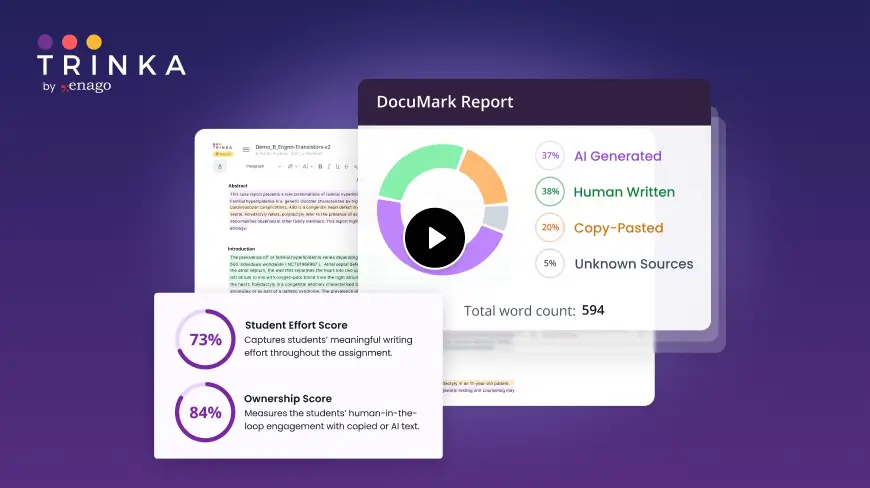
DocuMark: Responsible AI Use for Academic Integrity
Knowing your institution's AI policy is step one. DocuMark helps enforce it fairly by empowering universities to manage AI-generated content, prevent cheating, and support student writing through responsible AI use.
Common Questions About University of Kent's AI Policies
University of Kent has defined AI policies in 12 of 12 categories, with an overall coverage score of 100%.
Disclosure of AI use is required when specified by the school, module, or assessment brief, and students must follow local instructions on acknowledgement. The university also directs researchers to check whether publisher, funder, school, or disciplinary rules require disclosure. There is no single university-wide citation formula stated in the provided text, but transparency where required is mandatory.
Unauthorized AI use can be investigated and penalized under the university's academic misconduct procedures. The policy states that presenting AI-generated work as one's own is a form of academic misconduct, and misconduct outcomes can include penalties under formal procedures. The provided sources do not define a specific institutional stance on AI detection tools themselves.
The university provides approved institutional AI options including Microsoft Copilot and ChatGPT Edu, and it warns users not to enter sensitive or confidential data into public AI tools unless permitted. It emphasizes privacy, data protection, and checking what kind of data can be shared, with institutional privacy notices applying to approved services.