Teaching & Learning
- No uniform permission or prohibition rule for all assignments is explicitly defined, and course-specific requirements may still apply
- Student use of generative AI in coursework is addressed through the university library guidance rather than a binding university-wide rule
- The guidance says AI output may be used as support only if it is critically reviewed and verified, and it warns that submitting AI-generated text as one's own can constitute plagiarism
Sin embargo, si usas textos creados con IA generativa debes revisarlos críticamente (y corregirlos o reescribirlos en caso necesario) y comprobar la información.
También es importante que cites estas herramientas y seas transparente con su uso, para evitar problemas de plagio.
Plagiar significa copiar en lo sustancial obras ajenas, dándolas como propias. En las facultades, además, presentar como propio un trabajo íntegro o parcialmente elaborado por otra persona o una máquina también se considera plagio.
- The guidance frames AI as assistance rather than a substitute for student judgment
- The university library guidance permits students to use generative AI as a support tool for learning tasks such as summarizing, translating, clarifying ideas, and finding starting points, but it emphasizes that outputs must be reviewed critically and verified
Usar IA generativa no es, en sí mismo, plagiar. Son herramientas que pueden ser de gran ayuda para resumir, traducir, aclarar ideas complejas o encontrar un punto de partida.
Sin embargo, si usas textos creados con IA generativa debes revisarlos críticamente (y corregirlos o reescribirlos en caso necesario) y comprobar la información.
Research
- The policy also forbids listing AI tools as authors or co-authors
- AI cannot replace author responsibilities, and authors must disclose any AI-assisted writing in a specified section of the manuscript
- For the journal policy hosted by the university, authors may use AI tools only to improve readability and language, and they must do so under human oversight
At submission, authors must disclose whether they used artificial intelligence (AI) assisted technologies (such as Large Language Models [LLMs], chatbots, or image creators) in the production of submitted work.
Authors should only use these technologies to improve readability and language. Applying the technology should be done with human oversight and control, and authors should carefully review and edit the result, as AI can generate authoritative-sounding output that can be incorrect, incomplete or biased. Authors are ultimately responsible and accountable for the contents of the work.
Authors should disclose in their manuscript the use of AI and AI-assisted technologies in the writing process by following the instructions below. A statement will appear in the published work.
Declaration: During the preparation of this work the author(s) used [NAME TOOL / SERVICE] in order to [REASON]. After using this tool/service, the author(s) reviewed and edited the content as needed and take(s) full responsibility for the content of the publication.
This declaration does not apply to the use of basic tools for checking grammar, spelling, references etc. If there is nothing to disclose, there is no need to add a statement.
AI and AI-assisted technologies should not be listed as an author or co-author, or be cited as an author.
- The materials are training and guidance resources, but no explicit institutional rule is stated for this category
- The provided sources do not set a university research policy on using AI for data collection, analysis, statistical processing, synthetic data generation, or interpretation of results
not defined
- It also bans AI from being credited as an author
- The journal policy states that authors remain fully responsible for manuscript content when AI tools are used and requires disclosure of AI use in writing
- Beyond this publication policy, the provided sources do not define a broader university-wide AI rule for grant proposals, IRB applications, or ethics filings
Applying the technology should be done with human oversight and control, and authors should carefully review and edit the result, as AI can generate authoritative-sounding output that can be incorrect, incomplete or biased. Authors are ultimately responsible and accountable for the contents of the work.
Authors should disclose in their manuscript the use of AI and AI-assisted technologies in the writing process by following the instructions below.
AI and AI-assisted technologies should not be listed as an author or co-author, or be cited as an author.
Academic Integrity
- The university guidance requires transparency and citation when generative AI is used
- For student-facing library guidance, users are told to cite AI tools and be transparent about their use
- For journal manuscripts, authors must disclose AI-assisted writing in the manuscript using a declaration and remain responsible after reviewing and editing the content
También es importante que cites estas herramientas y seas transparente con su uso, para evitar problemas de plagio.
At submission, authors must disclose whether they used artificial intelligence (AI) assisted technologies (such as Large Language Models [LLMs], chatbots, or image creators) in the production of submitted work.
Authors should disclose in their manuscript the use of AI and AI-assisted technologies in the writing process by following the instructions below. A statement will appear in the published work.
Declaration: During the preparation of this work the author(s) used [NAME TOOL / SERVICE] in order to [REASON]. After using this tool/service, the author(s) reviewed and edited the content as needed and take(s) full responsibility for the content of the publication.
- The university plagiarism guidance treats work produced wholly or partly by another person or a machine and submitted as one's own as plagiarism
- The provided sources do not define a specific AI detection-tool policy, but they do establish that undisclosed machine-generated work can fall under plagiarism rules
Plagiar significa copiar en lo sustancial obras ajenas, dándolas como propias. En las facultades, además, presentar como propio un trabajo íntegro o parcialmente elaborado por otra persona o una máquina también se considera plagio.
El plagio es una conducta académica irregular que conlleva la calificación de suspenso y así está tipificado en el Reglamento sobre régimen disciplinario de los estudiantes de la Universidad de León.
Institutional & Administrative
- However, no binding university-wide policy is stated on grading, recommendation letters, or administrative communications
- The provided sources show that the university offers AI training for faculty on text generation, interactive teaching materials, Moodle uses, and research tools, indicating faculty use is supported for teaching and academic work
IA GENERATIVA PARA TEXTOS Y DOCUMENTOS
CREACIÓN DE MATERIALES DOCENTES INTERACTIVOS CON IA
APLICACIÓN PRÁCTICA DE LA INTELIGENCIA ARTIFICIAL EN MOODLE
HERRAMIENTAS IA PARA LA INVESTIGACION. EDICION 2
- The library guidance warns users not to enter personal, confidential, or sensitive information into AI tools because prompts may be retained and reused
- This is an institutional caution on data protection, but the provided sources do not identify a formal approved-platform list or a detailed data-classification scheme for AI use
No introduzcas datos personales, confidenciales o sensibles. Aunque no siempre se vea, muchas herramientas almacenan lo que escribes y pueden utilizarlo de diferentes formas.
- The university has created central library guidance on generative AI and provides structured AI training for faculty, which shows institutional engagement with AI adoption
- However, the provided sources do not define an overarching university AI governance framework, committee structure, or formal strategy document with binding principles and roadmap
Guía sobre el uso ético y responsable de la IA
Formación en IA
IA GENERATIVA PARA TEXTOS Y DOCUMENTOS
CREACIÓN DE MATERIALES DOCENTES INTERACTIVOS CON IA
APLICACIÓN PRÁCTICA DE LA INTELIGENCIA ARTIFICIAL EN MOODLE
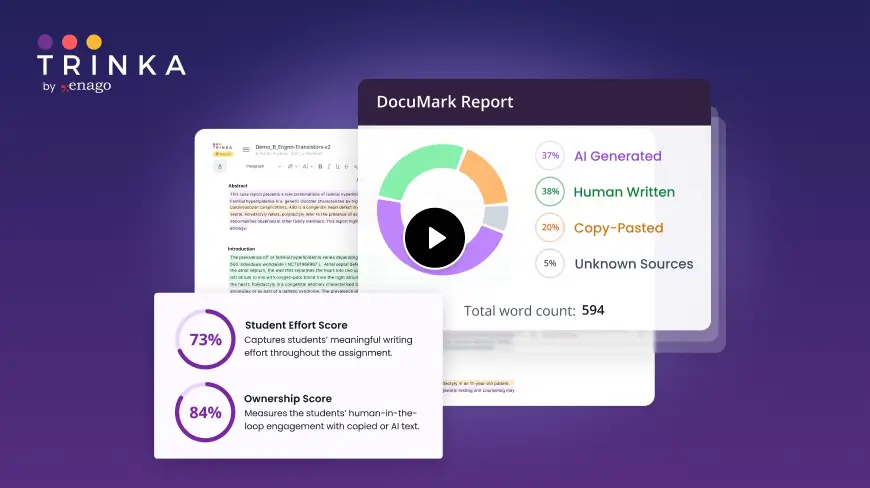
DocuMark: Responsible AI Use for Academic Integrity
Knowing your institution's AI policy is step one. DocuMark helps enforce it fairly by empowering universities to manage AI-generated content, prevent cheating, and support student writing through responsible AI use.
Common Questions About University of Leon's AI Policies
University of Leon has defined AI policies in 10 of 12 categories, with an overall coverage score of 83%.
The university guidance requires transparency and citation when generative AI is used. For student-facing library guidance, users are told to cite AI tools and be transparent about their use. For journal manuscripts, authors must disclose AI-assisted writing in the manuscript using a declaration and remain responsible after reviewing and editing the content.
The university plagiarism guidance treats work produced wholly or partly by another person or a machine and submitted as one's own as plagiarism. The provided sources do not define a specific AI detection-tool policy, but they do establish that undisclosed machine-generated work can fall under plagiarism rules.
The library guidance warns users not to enter personal, confidential, or sensitive information into AI tools because prompts may be retained and reused. This is an institutional caution on data protection, but the provided sources do not identify a formal approved-platform list or a detailed data-classification scheme for AI use.