Teaching & Learning
- Students may use AI only where the assessment guidance permits it and must follow any stated conditions on acceptable use
- Use of generative AI in coursework is not uniformly allowed or banned across the university; it depends on the assessment design and the module leader’s instructions
Students should use GenAI only if and when directed to by the module leader and only in line with the guidance given about what is and is not acceptable use.
The use of GenAI in assessments should be considered and discussed to identify areas where a programme-level response may be required, and where it can be considered at a module level.
The categories are to be used as follows:
Category A—No AI use permitted. The assessment is completed entirely without Al assistance
Category B—AI use permitted for specific tasks only. This category requires students to critically engage with AI outputs
Category C—AI use expected. The assessment is designed to integrate AI use meaningfully, requiring students to evaluate and modify AI-generated content.
- For invigilated in-person exams, students are not allowed to use generative AI unless the assessment has been specifically designed to permit it
- Assessment rules are set through defined AI-use categories, and individual assessments must state whether AI is prohibited, restricted to specified tasks, or expected
The categories are to be used as follows:
Category A—No AI use permitted. The assessment is completed entirely without Al assistance
Category B—AI use permitted for specific tasks only. This category requires students to critically engage with AI outputs
Category C—AI use expected. The assessment is designed to integrate AI use meaningfully, requiring students to evaluate and modify AI-generated content.
Invigilated face-to-face examinations are Category A except when they are specifically designed and designated as Category B or C.
- Students are also told not to rely on AI outputs as a substitute for independent understanding or critical thinking
- Students are encouraged to develop AI literacy and may use AI tools to support learning, but the university warns that outputs can be inaccurate, biased, or fabricated and should be checked carefully
Students should be encouraged to develop their understanding of GenAI and to evaluate their outputs critically.
students should be clear on the strengths and limitations of GenAI tools and be aware that they may not always provide accurate, reliable, or unbiased information.
Students need to understand that there are limitations to GenAI tools. They may produce outputs that are factually incorrect, incomplete, misleading, fabricated and/or highly simplistic. Students should therefore critically evaluate all outputs and not rely on them as a replacement for their own understanding and critical thinking.
- The university does not set a separate institution-wide rule specifically for AI code generation in student programming tasks
- Instead, coding-related AI use falls under the same assessment-category approach and is allowed, restricted, or prohibited according to the module or assessment instructions
The categories are to be used as follows:
Category A—No AI use permitted. The assessment is completed entirely without Al assistance
Category B—AI use permitted for specific tasks only. This category requires students to critically engage with AI outputs
Category C—AI use expected. The assessment is designed to integrate AI use meaningfully, requiring students to evaluate and modify AI-generated content.
Students should use GenAI only if and when directed to by the module leader and only in line with the guidance given about what is and is not acceptable use.
Research
- AI tools must not be listed as authors, and researchers are expected to be transparent about use where required by publishers, funders, or disciplinary norms
- Researchers may use generative AI to support drafting and editing research writing, but they remain fully responsible for the accuracy, originality, and integrity of the final work
Researchers are responsible for all content in their manuscripts, including any parts produced by AI tools, and are therefore liable for any breach of publication ethics.
AI tools cannot be listed as authors because they cannot take responsibility for the work.
Researchers should check the policies of publishers, funders and disciplinary bodies regarding the use and disclosure of AI tools in scholarly writing.
- Researchers may use AI in data-related work only with careful human oversight and in compliance with legal, ethical, and contractual obligations
- The university requires particular caution where confidential, personal, commercially sensitive, or otherwise restricted data are involved, and researchers remain accountable for validating outputs and protecting data
Researchers must ensure that the use of AI tools complies with legal, ethical, contractual and funder requirements, especially when using sensitive, personal or confidential data.
Researchers remain responsible for the accuracy, validity and integrity of any analysis or outputs generated with the assistance of AI tools.
You should not input confidential, personal, commercially sensitive or otherwise restricted data into public GenAI tools unless you have explicit approval and appropriate safeguards in place.
- The university places AI use in research under existing research integrity and ethics responsibilities
- Researchers must comply with ethics, legal, and funder requirements, remain accountable for all submitted content, and should not treat AI systems as authors or responsible agents
Researchers must ensure that the use of AI tools complies with legal, ethical, contractual and funder requirements, especially when using sensitive, personal or confidential data.
Researchers are responsible for all content in their manuscripts, including any parts produced by AI tools, and are therefore liable for any breach of publication ethics.
AI tools cannot be listed as authors because they cannot take responsibility for the work.
Academic Integrity
- For research writing, disclosure expectations are governed by publisher, funder, and disciplinary requirements rather than a single university-wide citation rule
- Where AI use is allowed in assessment, students are expected to acknowledge it in line with the instructions for the task, and assessment design may require explicit critical engagement with AI outputs
Category B—AI use permitted for specific tasks only. This category requires students to critically engage with AI outputs
Category C—AI use expected. The assessment is designed to integrate AI use meaningfully, requiring students to evaluate and modify AI-generated content.
Students should use GenAI only if and when directed to by the module leader and only in line with the guidance given about what is and is not acceptable use.
Researchers should check the policies of publishers, funders and disciplinary bodies regarding the use and disclosure of AI tools in scholarly writing.
- The process emphasizes review of the work and surrounding evidence, and penalties are managed through formal misconduct procedures
- Suspected AI misuse in student work is handled through the university’s academic integrity process rather than by treating AI-detection output as conclusive proof on its own
The output from AI detection tools must not be used as the sole basis for an academic misconduct allegation.
Indicators of possible misuse of GAI should be considered alongside the academic judgement of the marker and any other available evidence.
Cases of suspected misuse of GAI should be dealt with under the existing academic integrity procedures.
Institutional & Administrative
- Staff may use AI to support teaching and administrative work, but they remain responsible for the quality, fairness, and appropriateness of outputs
- In teaching and assessment, staff are expected to make deliberate decisions about whether and how AI is used and to communicate permitted use clearly to students
Staff should be clear about whether students are permitted to use GenAI in learning activities and assessments, and if so, for what purposes.
The use of GenAI in assessments should be considered and discussed to identify areas where a programme-level response may be required, and where it can be considered at a module level.
Users remain responsible for checking AI-generated outputs for accuracy, appropriateness and bias before using them.
- The university requires users to protect personal, confidential, commercially sensitive, and restricted information when using AI tools
- Public generative AI tools should not be used for such data unless explicit approval and safeguards are in place, and institutionally supported platforms such as Copilot are treated separately with university guidance and trial arrangements
You should not input confidential, personal, commercially sensitive or otherwise restricted data into public GenAI tools unless you have explicit approval and appropriate safeguards in place.
Users must comply with data protection law, confidentiality obligations and University information security requirements when using AI tools.
Microsoft Copilot is a generative AI tool made available by the University for trial use.
- Its approach is to enable responsible use of AI while managing risk through policies, practical guidance, and centrally coordinated support activities
- The university has an institution-wide AI framework with stated principles, recommendations, and governance-oriented guidance covering education, research, legal compliance, and supported tools
AI at Liverpool provides information on our approach to the use of artificial intelligence across the University.
This section sets out the University’s vision and recommendations for the use of AI.
This section provides practical guidance on the use of AI across a range of areas, including learning, teaching and assessment, research, and legal, security and data protection considerations.
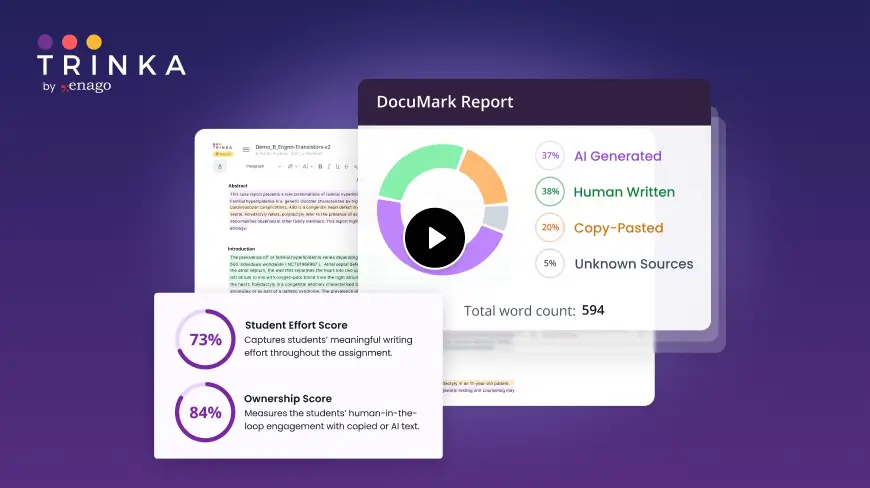
DocuMark: Responsible AI Use for Academic Integrity
Knowing your institution's AI policy is step one. DocuMark helps enforce it fairly by empowering universities to manage AI-generated content, prevent cheating, and support student writing through responsible AI use.
Common Questions About University of Liverpool's AI Policies
University of Liverpool has defined AI policies in 12 of 12 categories, with an overall coverage score of 100%.
Where AI use is allowed in assessment, students are expected to acknowledge it in line with the instructions for the task, and assessment design may require explicit critical engagement with AI outputs. For research writing, disclosure expectations are governed by publisher, funder, and disciplinary requirements rather than a single university-wide citation rule.
Suspected AI misuse in student work is handled through the university’s academic integrity process rather than by treating AI-detection output as conclusive proof on its own. The process emphasizes review of the work and surrounding evidence, and penalties are managed through formal misconduct procedures.
The university requires users to protect personal, confidential, commercially sensitive, and restricted information when using AI tools. Public generative AI tools should not be used for such data unless explicit approval and safeguards are in place, and institutionally supported platforms such as Copilot are treated separately with university guidance and trial arrangements.