Teaching & Learning
- Use of AI in assessed coursework is set at the assessment level rather than uniformly allowed or banned
- Students must declare generative AI use in assessed work, and submitting AI-created work as their own is treated as plagiarism
- Each assessment must be assigned an AI category ranging from prohibited to integrated, and the permitted level of AI use must be stated in the assessment brief
2.1.1 Assessments must be assigned to one of the following AI categories, and this must be communicated to students and stated on assessment briefs, including on the Course Unit Canvas assessment information.
a) AI Prohibited: AI is not permitted or is unable to be used in this assessment.
b) AI Minimal: AI is permitted to be used in this assessment in limited ways that contribute to the presentation (for example surface level use to improve grammar, fluency, and formatting) without changing the ideas, arguments or conclusions developed by the student.
c) AI Permitted: AI may be used to complete the assessment.
d) AI-Integrated: AI use is necessary to meet the course unit intended learning outcomes.
Students should declare any use of generative AI in preparing work for assessment, and explain its role.
Submitting work created by Generative AI as their own, or to misrepresent their understanding of the subject, is plagiarism
- Where AI is prohibited for an assessment, it is not permitted; where allowed, the brief must define acceptable use
- The university requires every assessment to be categorized for AI use and clearly communicated to students in the brief
- AI use in assessments is governed by a university policy that applies across undergraduate and postgraduate taught teaching and assessment
The University has produced a dedicated AI in Teaching and Learning Policy which sets out a shared framework for the use of AI in assessment at the University, defining clear and transparent expectations for students and staff when using AI across undergraduate and postgraduate teaching, learning, assessment, and research or dissertation activities.
1.3.1 This policy applies to students on undergraduate and postgraduate taught programmes and staff members involved in teaching and learning activities.
2.1.1 Assessments must be assigned to one of the following AI categories, and this must be communicated to students and stated on assessment briefs, including on the Course Unit Canvas assessment information.
a) AI Prohibited: AI is not permitted or is unable to be used in this assessment.
c) AI Permitted: AI may be used to complete the assessment. The assessment information must set out what is acceptable AI use.
- More generally, the university states that AI can enhance teaching and learning when used appropriately
- Students may use other AI tools for learning, and they may upload taught-session recordings to their university-provided Microsoft 365 Copilot for learning support
- The university permits students to use AI to support learning outside assessed work, subject to university guidelines, referencing rules, intellectual property restrictions, and research ethics requirements for taught assessment
The University position is that, when used appropriately, AI tools have the potential to enhance teaching and learning and can support inclusivity and accessibility.
2.2.1 In addition to their University-provided Microsoft 365 Copilot service, students may use other AI tools to support their learning where this use is consistent with:
a) The AI category assigned to an assessment;
b) The University’s AI Guidelines (including referencing);
c) The University’s Intellectual Property Policy. Students must not upload any University of Manchester owned materials, including lecture – recordings, slides, question papers, handouts or any other copyrighted resources to external AI tools.
d) The Policy on Ethical Approval of Research on Human Subjects in Taught Assessment.
2.2.2 Where a recording of a taught session is available, students are permitted to use their University of Manchester Microsoft 365 Copilot access to upload this for the purposes of supporting their learning.
- The university does not set a separate university-wide rule specifically for code generation in student work
- Programming-related AI use falls under the same assessment-category system as other assessed work, so whether AI coding tools are prohibited, minimally allowed, permitted, or required depends on the specific assessment brief
2.1.1 Assessments must be assigned to one of the following AI categories, and this must be communicated to students and stated on assessment briefs, including on the Course Unit Canvas assessment information.
a) AI Prohibited: AI is not permitted or is unable to be used in this assessment.
b) AI Minimal: AI is permitted to be used in this assessment in limited ways that contribute to the presentation (for example surface level use to improve grammar, fluency, and formatting) without changing the ideas, arguments or conclusions developed by the student.
c) AI Permitted: AI may be used to complete the assessment.
d) AI-Integrated: AI use is necessary to meet the course unit intended learning outcomes.
Research
- The university permits AI use in manuscript preparation for purposes such as literature review or improving writing style, but the corresponding author remains fully responsible for the content
- Significant AI use in preparing a manuscript must be declared and properly referenced, and authors must follow publisher rules and ensure accuracy, unbiased selection, and proper acknowledgement of sources
The corresponding author of an academic publication carries ultimate responsibility for its accuracy, balance and transparency. It may be legitimate to use AI in preparing a manuscript for publication, for example, to review the literature or improve writing style, but the corresponding author remains responsible for all content, whether AI-generated material is used verbatim or paraphrased. Specifically, the author should ensure:
* publishers’ guidelines on the use of AI-generated content are adhered to;
* any significant use of AI in preparing the manuscript is declared and properly referenced;
* all claims in the text are accurate and sources properly referenced;
* the selection of material is unbiased (e.g. in reviewing the literature);
* references used to support a claim or observation actually do so;"
* the source of all content is properly acknowledged and referenced.
- The university allows AI to generate or synthesize research data only with full transparency
- Using AI to fabricate or manipulate research data or images without clear declaration is classified as research misconduct
- When AI is used to generate data, researchers must clearly distinguish real from synthesized data and detail the methods used
Any use of AI to generate data should be completely transparent. Legitimate uses may include synthesising datasets for use in research on scarce or sensitive data, imputing missing data in real datasets or conducting research on generative AI. In such cases the distinction between real and synthesised data should be made clear, and the methods used should be detailed. Using AI to fabricate or manipulate data such as experimental measurements, interview texts or research images, without clear declaration, constitutes research misconduct.
- No explicit separate rule was found for AI use in grant proposal drafting or IRB application drafting themselves
- The university requires AI use in research contexts to follow its principles for appropriate use and treats undeclared fabrication or manipulation of research material as misconduct
- For peer review and funding-review activities, any AI use must be declared to the publisher or funder, used with extreme caution, and must not breach confidentiality or replace the reviewer’s own judgment
The University recognises the potential of AI to power research and innovation and encourages applications that adhere to the principles for appropriate use.
Using AI to fabricate or manipulate data such as experimental measurements, interview texts or research images, without clear declaration, constitutes research misconduct.
When reviewing papers for publication or applications for funding, AI should be used with extreme caution, and any use must be declared to the publisher or funder. Inappropriate use of AI can be considered research misconduct. Reviewers should avoid:
* breaching a duty of confidentiality by uploading parts of a document under review to an AI service, or writing prompts that contain confidential information;
* relying on AI tools when making reviewing decisions, rather than using their own judgment;
* using AI when it is specifically prohibited by the publisher or funder seeking the review.
Academic Integrity
- The university requires transparency about AI use from staff and students
- Users must explain how AI was used, cite the tools and relevant documentation, and keep records
- In assessed work, students should declare generative AI use and explain its role, and failure to document such use could constitute plagiarism
Always make clear when and how you have used AI in a process or in producing an output, citing relevant details. Specifically:
* describe clearly how you have used AI tools and resources, explaining your original contribution;
* cite the AI tools or resources you used and provide links to their documentation;
* keep detailed records to provide an audit trail for your use of AI tools and resources.
Students should declare any use of generative AI in preparing work for assessment, and explain its role.
3.0.2 Within assessed work, students’ failure to document use of Generative AI could be a form of plagiarism contrary to the Academic Malpractice Procedure.
- The university states that AI-detection tools are unreliable and cannot be used as evidence of malpractice in summative assessment
- Undisclosed AI use in assessed work may be treated as plagiarism or broader academic malpractice under the Academic Malpractice Procedure
- It does use Turnitin and similar software for similarity checking, but academic judgment is required and the university does not currently use software that claims to detect generative AI
Tools to detect AI-generated content are unreliable and biased and cannot be relied on to identify academic malpractice in summative assessment. Output from such tools cannot currently be used as evidence of malpractice.
Passing written work through Turnitin (the University’s similarity detection software), where it is available, or equivalent software identified by the University which is designed to assist in detecting academic malpractice.
Turnitin alone does not confirm the presence of malpractice; an academic judgement must be made to reach this conclusion.
The University does not currently use software which claims to detect Generative AI;
3.1.2.1. Plagiarism: The act of using ideas, words, or creations from either humans or digital systems, such as Generative Artificial intelligence, without proper attribution or permission and presenting them, either intentionally or unwittingly, as one’s own work.
Institutional & Administrative
- Staff use of AI in teaching and learning is allowed but must follow the university’s AI Guidelines
- For teaching and learning activities involving student-identifiable or confidential data, only the university-provided Microsoft 365 Copilot may be used
- Staff are responsible for clearly communicating the AI category for each assessment to students, and for assessed group work the course unit lead must provide clear instructions on how AI may be used and recorded
2.3.1 Staff members who use AI in Teaching and Learning activities must adhere to the University's AI Guidelines. Only the University-provided Microsoft 365 Copilot service may be used for student-identifiable or confidential data.
2.1.1 Assessments must be assigned to one of the following AI categories, and this must be communicated to students and stated on assessment briefs, including on the Course Unit Canvas assessment information.
2.1.4 For assessed group work, the course unit lead must state the category of the assessment and provide clear information to students about how to approach AI use as a group before beginning the activity. The course unit lead must also provide clarity about how students should record any decisions regarding their individual or collective use of AI as a group and whether a record of this needs to be logged prior to beginning the activity.
- The university directs users to prefer university-approved AI tools and places stricter controls on sensitive or university-owned material
- Users must not disclose personal or sensitive data inappropriately, should use approved tools wherever possible, and if using other tools remain responsible for preventing inappropriate disclosure
- For student-identifiable or confidential data in teaching and learning, only the university-provided Microsoft 365 Copilot may be used; students also must not upload university-owned materials to external AI tools
do not disclose or inappropriately repurpose personal or sensitive data;
using AI simply to boost personal productivity does not constitute ‘significant use’;
you must make others aware if an AI tool will be used to process their input (e.g. to a meeting);
you should use University-approved tools wherever possible to avoid inappropriate disclosure;
if you use other tools you are responsible for ensuring there is no inappropriate disclosure.
The University of Manchester provides a range of approved tools to support AI learning, skills development, and professional growth.
2.2.1 In addition to their University-provided Microsoft 365 Copilot service, students may use other AI tools to support their learning where this use is consistent with:
c) The University’s Intellectual Property Policy. Students must not upload any University of Manchester owned materials, including lecture – recordings, slides, question papers, handouts or any other copyrighted resources to external AI tools.
2.3.1 Staff members who use AI in Teaching and Learning activities must adhere to the University's AI Guidelines. Only the University-provided Microsoft 365 Copilot service may be used for student-identifiable or confidential data.
- In teaching and learning, policy issues are reviewed through faculty committees and annual review processes
- The university has an institutional AI governance framework built around published principles for appropriate use and a commitment to responsible use
- It states that the guidelines apply to both staff and students, will be reviewed and updated regularly, and that the university is committed to supporting appropriate AI use through access, training, and formal policy development
These guidelines are intended to provide timely advice to staff and students using or developing AI.
They will be reviewed and updated regularly, and will be developed to provide formal guidance.
The University recognises both and is committed to promoting and supporting the responsible use of AI.
The University has adopted the following principles, building on existing frameworks for academic integrity and emerging guidance on AI.
All staff and students using or developing AI are personally responsible for adhering to these.
The University recognises the potential of AI to power research and innovation and encourages applications that adhere to the principles for appropriate use. It will seek to support appropriate use by providing equitable access to AI technology and training.
2.3.2 Chairs of Faculty Teaching and Learning Committees will collate issues with this policy raised by Schools and are responsible for including a review of the impact of the AI Policy by the Committee at least once a semester.
3.0.3 Staff and students can raise issues in relation to the use of AI in Teaching and Learning through the Teaching and Learning Policy Comments Form. Comments will be reviewed regularly and used to inform the development of training and guidance and contribute to the annual review of AI-related Teaching and Learning policies.
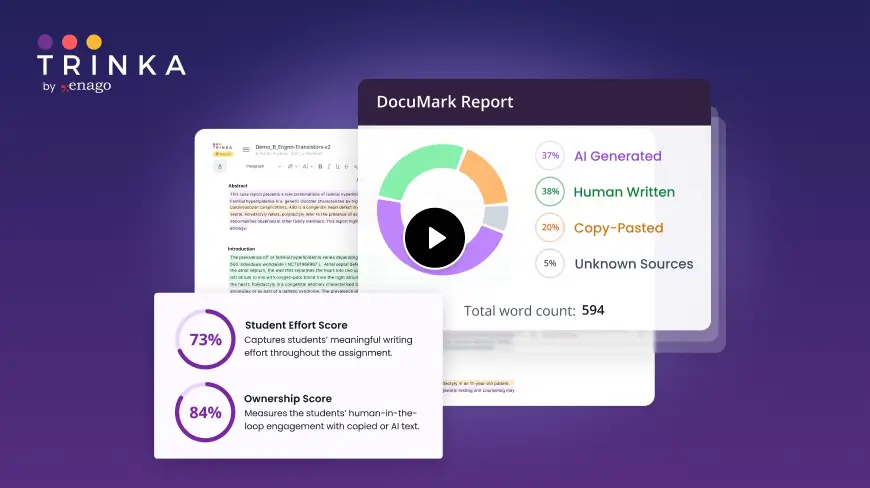
DocuMark: Responsible AI Use for Academic Integrity
Knowing your institution's AI policy is step one. DocuMark helps enforce it fairly by empowering universities to manage AI-generated content, prevent cheating, and support student writing through responsible AI use.
Common Questions About University of Manchester's AI Policies
University of Manchester has defined AI policies in 12 of 12 categories, with an overall coverage score of 100%.
The university requires transparency about AI use from staff and students. Users must explain how AI was used, cite the tools and relevant documentation, and keep records. In assessed work, students should declare generative AI use and explain its role, and failure to document such use could constitute plagiarism.
The university states that AI-detection tools are unreliable and cannot be used as evidence of malpractice in summative assessment. It does use Turnitin and similar software for similarity checking, but academic judgment is required and the university does not currently use software that claims to detect generative AI. Undisclosed AI use in assessed work may be treated as plagiarism or broader academic malpractice under the Academic Malpractice Procedure.
The university directs users to prefer university-approved AI tools and places stricter controls on sensitive or university-owned material. Users must not disclose personal or sensitive data inappropriately, should use approved tools wherever possible, and if using other tools remain responsible for preventing inappropriate disclosure. For student-identifiable or confidential data in teaching and learning, only the university-provided Microsoft 365 Copilot may be used; students also must not upload university-owned materials to external AI tools.