Teaching & Learning
- Unauthorized GenAI use is treated like unauthorized assistance or plagiarism and referred for investigation through student conduct processes
- Students are instructed to assume AI use for completing assignments is not allowed unless the syllabus or assignment directions explicitly say otherwise
- The university states that whether generative AI can be used in coursework is at the individual course instructor’s discretion, and instructors are strongly encouraged to define course-specific expectations
It will be at the course instructor's discretion to determine whether GenAI may be used, to what extent, and for which assignments and assessments. Instructors are strongly encouraged to establish a course-specific policy that defines the appropriate and inappropriate use of GenAI tools, fostering transparency and understanding between instructors and students.
Students should assume that the use of GenAI tools to complete course assignments and assessments is not allowed unless otherwise specified in the course syllabus or assignment/assessment instructions.
Allegations of unauthorized use of GenAI will be treated similarly to allegations of unauthorized assistance (cheating) or plagiarism and investigated by the Office of Student Conduct.
- The university also states that allegations of unauthorized GenAI use will be handled similarly to cheating or plagiarism and investigated by the Office of Student Conduct
- The university indicates that GenAI use for assessments is controlled by instructor discretion, and students should assume GenAI is not allowed for assessments unless explicitly permitted in the syllabus or assessment instructions
It will be at the course instructor's discretion to determine whether GenAI may be used, to what extent, and for which assignments and assessments.
Students should assume that the use of GenAI tools to complete course assignments and assessments is not allowed unless otherwise specified in the course syllabus or assignment/assessment instructions.
Allegations of unauthorized use of GenAI will be treated similarly to allegations of unauthorized assistance (cheating) or plagiarism and investigated by the Office of Student Conduct.
- It also strongly recommends students use UMD-approved tools for study
- The university recognizes GenAI as a common learning aid (e.g., practice problems, exploring concepts, reviewing definitions), but instructs students to confer with instructors about academic integrity policies and course expectations
While using GenAI tools as a learning aid—such as for practicing problems, exploring concepts, or reviewing definitions—is a common practice, students should confer with their instructors about academic integrity policies within their particular courses and assignments.
UMD strongly recommends that all students utilize UMD-approved tools for study, as they are deployed in alignment with institutional security and compliance requirements.
- Separately, UMD privacy guidance notes that student-authored materials such as source code may be used with GenAI tools only if the student gives explicit permission and is allowed to decline without penalty
- The university’s GenAI guidelines do not provide programming-specific rules for student code generation, instead stating that AI permissions for assignments/assessments are set by the course instructor and should be communicated in the syllabus or assignment instructions
It will be at the course instructor's discretion to determine whether GenAI may be used, to what extent, and for which assignments and assessments.
Students should assume that the use of GenAI tools to complete course assignments and assessments is not allowed unless otherwise specified in the course syllabus or assignment/assessment instructions.
It is also possible, if a student gives explicit permission, to use student-authored materials such as essays or source code with these tools, as long as students have been made aware that they may decline such use without penalty.
Research
- The university states that users should review and evaluate GenAI output for accuracy and bias, and should disclose GenAI use with proper attribution
- UMD provides general research and scholarship guidance rather than a specific policy for manuscript drafting/editing, encouraging researchers to consult collaborators, advisors, funding agencies, and field experts on appropriateness
Researchers are encouraged to consult with co-investigators, advisors, collaborators, funding agencies, and field experts to evaluate the appropriateness of using GenAI technology in research activities.
All users should review and evaluate the output for accuracy and potential bias and should disclose the use of GenAI with proper attribution.
- UMD’s research guidance emphasizes protecting confidentiality and intellectual property when using GenAI tools and requires users to review outputs for accuracy and bias
- UMD privacy guidance also identifies certain research-related data types that should never be placed into AI prompts, including controlled research or research containing intellectual property and confidential review materials
Maintaining research integrity and safeguarding intellectual property, confidentiality, and ethical standards are essential when using GenAI tools.
All users should review and evaluate the output for accuracy and potential bias and should disclose the use of GenAI with proper attribution.
In areas of research and administration, some types of data to never put into AI prompts include: information about employees or their performance, research that is controlled or contains Intellectual Property, and papers or grant proposals under review when reviewers are asked to keep materials confidential.
- Separate UMD scholarly integrity policy defines research misconduct (fabrication, falsification, or plagiarism) in proposing, performing, reviewing, or reporting research
- The university also directs researchers to maintain research integrity and safeguard intellectual property, confidentiality, and ethical standards, including evaluating outputs for accuracy and bias and disclosing GenAI use with proper attribution
- UMD’s GenAI guidelines require human ownership/oversight of outputs and state that GenAI should not be used to fabricate, falsify, or misrepresent information except when intentionally used in controlled and ethical pedagogical or research settings
Human Oversight - Anyone using GenAI tools for any activity should take full ownership of the resulting product. Decisions affecting academic or administrative outcomes should include oversight by UMD officials with academic and/or administrative authority. Such decisions should not be based solely on outputs generated by GenAI tools.
GenAI tools should not be used to fabricate, falsify, or misrepresent information, impersonate individuals, or generate deceptive content except when intentionally employed by instructors or researchers for pedagogical or research purposes in a controlled and ethical manner.
Maintaining research integrity and safeguarding intellectual property, confidentiality, and ethical standards are essential when using GenAI tools.
All users should review and evaluate the output for accuracy and potential bias and should disclose the use of GenAI with proper attribution.
“Research Misconduct” means Fabrication, Falsification, or Plagiarism in proposing, performing, or reviewing Research, or in reporting Research results. Research Misconduct does not include honest error or differences of opinion.
Academic Integrity
- For students, when GenAI use is permitted by an instructor, students should acknowledge and cite their GenAI use
- UMD student conduct guidance also notes that plagiarism can include not properly attributing ChatGPT when instructors expressly permit its use
- UMD’s GenAI guidelines state that users should disclose and, when applicable, provide proper attribution for GenAI use across teaching, learning, research, scholarship, and administrative activities
Transparency - All users, including students, faculty, and staff, should disclose and, when applicable, make proper attribution when using GenAI tools in teaching, learning, research, scholarship, and administrative activities.
When permitted by the instructor, students should appropriately acknowledge and cite their use of GenAI applications.
Not properly attributing ChatGPT (when expressly permitted by instructors)
- UMD states that allegations of unauthorized GenAI use will be treated similarly to cheating or plagiarism and investigated by the Office of Student Conduct
- UMD’s academic integrity code describes sanctioning (including that attempts may be sanctioned similarly to completed violations) and provides examples of sanctions such as suspension, with notes on transcript notation and review/approval requirements; it does not provide GenAI-specific detection tool guidance in the provided sources
Allegations of unauthorized use of GenAI will be treated similarly to allegations of unauthorized assistance (cheating) or plagiarism and investigated by the Office of Student Conduct.
Attempts to commit acts prohibited by this Code may be sanctioned to the same extent as completed violations.
Suspension: separation of the Student from the University for a specified period of time. A permanent notation will appear on the Student’s transcript. The Student cannot participate in any University-sponsored activity and may be barred from University premises during the period of Suspension. Suspended time will not count against any time limits required by the Graduate School for completion of a degree.
(Suspension requires administrative review and approval by the Dean of Students, who may alter, defer, or withhold the Suspension.)
Institutional & Administrative
- UMD states that faculty, staff, and student-employees should use UMD-approved GenAI tools (such as TerpAI) when working and teaching on behalf of UMD
- The university also notes GenAI may be used for administrative purposes (e.g., streamlining workflows, drafting communications) but requires full compliance with privacy standards and relevant institutional policies
- For instructors using GenAI to create course materials or assist with grading, the university advises applying the same level of oversight and transparency they would expect from students, and TAs/graders/tutors may only use GenAI for assisting students, creating course materials, and grading with instructor approval
Faculty, staff, and student-employees should use UMD-approved GenAI tools, such as TerpAI when working and teaching on behalf of UMD.
If using GenAI to create course materials or assist in grading processes, instructors are advised to use the same level of oversight and transparency they would expect of students using these tools in their academic work.
TAs, Graders, and Tutors should only use GenAI to assist students, create course materials, and grade assignments with the instructor's approval.
GenAI tools may also be utilized for administrative purposes, including, but not limited to, streamlining workflows, assisting with business processes, drafting communications, and assembling information to inform decision-making. When leveraging GenAI for administrative tasks, ensuring full compliance with privacy standards and all relevant institutional policies, standards, and guidelines is essential.
- UMD also provides examples of data that should never be put into AI prompts for research/administration, and indicates that TerpAI is approved for up to Level 2 data (Moderate)
- UMD instructs faculty, staff, and student-employees to use UMD-approved GenAI tools (e.g., TerpAI) when working and teaching on behalf of UMD and strongly recommends students use UMD-approved tools for study
- UMD privacy guidance states that Low Risk (Level 1) data may be uploaded to generative AI tools, but for data above Low Risk the AI tool must be approved through UMD procurement and security review processes, and it states that no GenAI tools have been approved for use with data greater than Low Risk
Faculty, staff, and student-employees should use UMD-approved GenAI tools, such as TerpAI when working and teaching on behalf of UMD.
UMD strongly recommends that all students utilize UMD-approved tools for study, as they are deployed in alignment with institutional security and compliance requirements.
If your data is Low Risk (Level 1), it is permissible to upload it to generative AI tools. To process data above Low Risk, any generative AI tool used must have been approved through UMD’s procurement and security review processes. To date, no generative AI tools have been approved for use with data that is greater than Low Risk.
In areas of research and administration, some types of data to never put into AI prompts include: information about employees or their performance, research that is controlled or contains Intellectual Property, and papers or grant proposals under review when reviewers are asked to keep materials confidential.
TerpAI has a designated data classification of M oderate, which is approved for up to Level 2 data.
- The guidelines also establish guiding principles such as human oversight, privacy compliance, transparency (disclosure/attribution), and accountability
- The guidelines state they apply to all faculty, staff, students, and affiliates using GenAI for UMD-related activities and will be reviewed and updated regularly as technology and best practices evolve
- UMD states it is committed to innovation and academic excellence while prioritizing privacy, security, and ethical use of GenAI in educational and research environments, and that its GenAI guidelines provide best practices and expectations for responsible use across teaching, learning, research, scholarship, and administrative functions
The University of Maryland (UMD) is committed to fostering innovation and academic excellence while prioritizing technology's privacy, security, and ethical use in its educational and research environments.
These guidelines supplement established policies and provide best practices for the ethical, responsible, and equitable use of GenAI in teaching, learning, research, scholarship, and administrative functions.
UMD expects its community members to follow these guidelines when using GenAI tools for teaching and learning, research, and work-related functions.
These guidelines apply to all UMD faculty, staff, students, and affiliates using GenAI tools and technologies in academic, research, or administrative activities.
This guidance will be reviewed and updated regularly as technology and best practices evolve.
Human Oversight - Anyone using GenAI tools for any activity should take full ownership of the resulting product.
Privacy - The use of GenAI should comply with the University System of Maryland (USM) and UMD data privacy policies and applicable laws and regulations, including but not limited to the Maryland Personal Information Protection Act, Family Educational Rights and Privacy Act (FERPA), and Health Insurance Portability and Accountability Act (HIPAA).
Transparency - All users, including students, faculty, and staff, should disclose and, when applicable, make proper attribution when using GenAI tools in teaching, learning, research, scholarship, and administrative activities.
Accountability - Faculty, staff, and students are responsible for understanding the capabilities and limitations of GenAI tools and ensuring appropriate use.
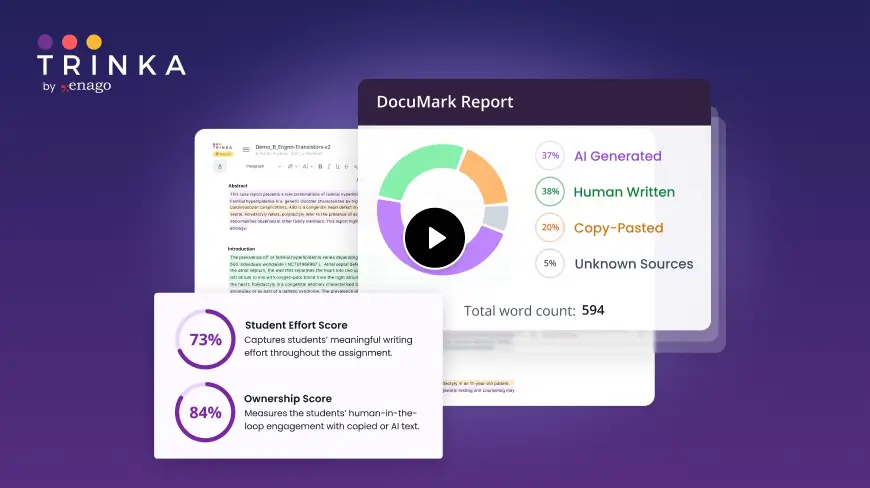
DocuMark: Responsible AI Use for Academic Integrity
Knowing your institution's AI policy is step one. DocuMark helps enforce it fairly by empowering universities to manage AI-generated content, prevent cheating, and support student writing through responsible AI use.
Common Questions About University of Maryland-College Park's AI Policies
University of Maryland-College Park has defined AI policies in 12 of 12 categories, with an overall coverage score of 100%.
UMD’s GenAI guidelines state that users should disclose and, when applicable, provide proper attribution for GenAI use across teaching, learning, research, scholarship, and administrative activities. For students, when GenAI use is permitted by an instructor, students should acknowledge and cite their GenAI use. UMD student conduct guidance also notes that plagiarism can include not properly attributing ChatGPT when instructors expressly permit its use.
UMD states that allegations of unauthorized GenAI use will be treated similarly to cheating or plagiarism and investigated by the Office of Student Conduct. UMD’s academic integrity code describes sanctioning (including that attempts may be sanctioned similarly to completed violations) and provides examples of sanctions such as suspension, with notes on transcript notation and review/approval requirements; it does not provide GenAI-specific detection tool guidance in the provided sources.
UMD instructs faculty, staff, and student-employees to use UMD-approved GenAI tools (e.g., TerpAI) when working and teaching on behalf of UMD and strongly recommends students use UMD-approved tools for study. UMD privacy guidance states that Low Risk (Level 1) data may be uploaded to generative AI tools, but for data above Low Risk the AI tool must be approved through UMD procurement and security review processes, and it states that no GenAI tools have been approved for use with data greater than Low Risk. UMD also provides examples of data that should never be put into AI prompts for research/administration, and indicates that TerpAI is approved for up to Level 2 data (Moderate).