Teaching & Learning
- Course-level policy is left to instructor discretion
- Faculty are recommended to state in the syllabus either that AI is prohibited for submitted coursework or that AI is permitted only for certain assignments with attribution
- When AI is prohibited, students must produce the work themselves; when AI is allowed, the course must specify where it is allowed and students must cite AI-generated material
Faculty determine their own policy for generative AI use in their course.
1. Prohibiting AI-based cheating: The use of AI or any other automated system for cheating purposes is strictly prohibited in this course. This includes the use of AI tools for generating papers, presentations, or any other assignments. Any such use will be considered a violation of the academic integrity policy and appropriate action will be taken.
At its October 2023 meeting, the Faculty Council recommended that all syllabi include one of two statements concerning the use or restriction of Artificial Intelligence (AI) tools in courses.
1. AI is prohibited: In this class, all work submitted by students must be generated by the students themselves, whether working individually or in groups. Students should not have another person or entity do the writing of any portion of an assignment; this includes hiring a person or a company to write assignments and using AI tools like ChatGPT.
2. AI is allowed with attribution: Use of AI tools, including ChatGPT, is permitted in this course on certain assignments [either detail assignments or types of assignments here, or clarify how they will know which].
- The university does not provide a distinct university-wide AI rule specifically for exams or quizzes in the provided sources
- Instead, instructors are told to set their own course AI policy and may prohibit AI-based cheating or design assessments to reduce opportunities for misconduct
Faculty determine their own policy for generative AI use in their course.
1. Prohibiting AI-based cheating: The use of AI or any other automated system for cheating purposes is strictly prohibited in this course.
Design assessments and assignments in a way that minimizes opportunities for academic dishonesty.
- Course-specific limits may still apply because faculty set their own AI policies
- The guidance frames AI as a tutor or learning partner, but students are told to verify information and accuracy
- Students may use Microsoft Copilot Chat or similar AI tools for learning support, such as asking questions and getting help understanding course material
Students can benefit from Microsoft Copilot Chat or other AI Generative technologies by using the tool as a tutor or learning partner.
1. Answering questions: Students can ask any questions they may have related to their coursework or the subject matter being taught. It can pool multiple resources and provide efficient answers, helping students to better understand the material.
2. Generating content: Students can use it to generate content for deliverables by helping them develop their ideas, structure their arguments, and identify relevant sources. It’s important to further research any information collected by a generative AI tool to ensure accuracy of content and sources provided.
Faculty determine their own policy for generative AI use in their course.
Research
- Guidance also notes that instructors can use Copilot to identify research topics, but information gathered through AI should be further researched for accuracy
- The provided sources do not set a specific research-data AI policy, but they do tell users not to enter certain sensitive or unpublished material into generative AI tools and to verify outputs
Do not use Copilot to process personal information that could violate HIPAA or other data protection laws.
Identifying research topics: Instructors can prompt Microsoft Copilot Chat or another Generative AI tool to explore potential research topics for themselves or student deliverables. It’s important to further research all information collected by a generative AI tool to ensure accuracy of content and sources provided.
Generative AI language tools learn from the material they are exposed to from the users. We recommend that you use these tools to collect general information for your educational needs, but not provide the AI tool with materials unpublished or proprietary educational materials, as they could then be used to answer another person’s question.
Academic Integrity
- When a course allows AI use, students are required to disclose and cite any AI-generated material that informed their work
- AI-generated content shared with others should also be clearly labeled, and failure to attribute AI use is treated as academic dishonesty
- The required attribution includes in-text citations, references, and the full text of the cited ChatGPT or other LLM output as an appendix
students must cite any AI-generated material that informed their work; citations should include not only in-text citations and listing in the references, but also the full text of cited ChatGPT (or other Large Language Model (LLM) generator) as an appendix to the assignment. Using an AI tool to generate content without proper attribution qualifies as academic dishonesty.
This includes ensuring that any data used in AI systems is properly licensed, and that any AI-generated content is appropriately cited. Additionally, any AI-generated content that is shared with others should be clearly labeled as such to avoid misrepresentation.
- UMass Boston states that its Turnitin service does not include AI detection, and its AI guidance warns that free AI-detection tools are not always accurate
- Undisclosed or improper AI use can still be enforced as academic dishonesty under course and academic integrity policies, and instructors are told to use critical judgment rather than relying solely on detection tools
Please note that Turnitin at UMass Boston does not include AI detection services.
There are a number of free tools available, including GPTZero, which are programmed to detect a number of different AI models. However, these tools are not always accurate when it comes to distinguishing human-written from AI-generated content. If you're concerned about the authenticity of student content, always apply critical thinking, check the source, and if possible, verify information through multiple channels.
Using an AI tool to generate content without proper attribution qualifies as academic dishonesty.
Any such use will be considered a violation of the academic integrity policy and appropriate action will be taken.
Institutional & Administrative
- Faculty are additionally expected to set and communicate AI expectations for their courses
- The guidance also requires human oversight: users should fact-check outputs, ask for sources when accuracy matters, and not rely solely on AI for critical decisions
- Faculty and staff are encouraged to use Microsoft Copilot Chat and other generative AI tools for work and teaching support, including creating content, feedback, and planning
AI-powered platforms can assist instructors in creating customized content for courses, providing personalized feedback, and assessing student progress.
Microsoft Copilot Chat or other AI generative technologies can provide assistance to teachers in higher education in a number of ways.
Always fact-check the results before using them.
Ask for sources – request links or references when accuracy matters.
Use human oversight – never rely solely on AI for critical decisions.
Communicate the standards of academic honesty to their students, including the proper citation of sources and the expectations for individual and collaborative work.
- The guidance therefore allows use of an approved institutional platform while restricting sensitive data entry
- The university has licensed Microsoft Copilot Chat and directs users to sign in with their UMass Boston Microsoft 365 account
- Users are told not to use Copilot for personal information that could violate HIPAA or other data protection laws, and students and instructors are cautioned not to share unpublished, proprietary, personal, or professional data on AI platforms
The university has licensed Microsoft Copilot Chat.
Microsoft Copilot is an AI-powered assistant that boosts efficiency and creativity. At UMass Boston, the enterprise Copilot Chat is available on the web (not built into apps like Word or Excel).
Important: Sign in with your UMass Boston Microsoft 365 account and look for the enterprise shield icon.
Do not use Copilot to process personal information that could violate HIPAA or other data protection laws.
We recommend that you use these tools to collect general information for your educational needs, but not provide the AI tool with materials unpublished or proprietary educational materials, as they could then be used to answer another person’s question.
Students and instructors should be cautious about sharing novel ideas, personal, or professional data on AI-powered platforms that aren't previously published or copyrighted.
- UMass Boston has institution-level AI guidance and a Faculty Council recommendation that all syllabi include an AI statement
- The governance approach reflected in the provided sources is decentralized at the course level, with faculty determining AI policy for their own classes, while the Faculty Council recommends common syllabus language and plans to revisit the issue because the technology is evolving quickly
Faculty determine their own policy for generative AI use in their course.
At its October 2023 meeting, the Faculty Council recommended that all syllabi include one of two statements concerning the use or restriction of Artificial Intelligence (AI) tools in courses.
Whereas the policies for the use of AI tools will vary across university classrooms, depending on the course and the instructor;
Be it resolved that the Faculty Council recommends that all syllabi include some statement concerning the use of AI tools in the course.
Be it further resolved that, since this is a fast moving technology and a quickly evolving pedagogical question, the Faculty Council should revisit this resolution in a year’s time.
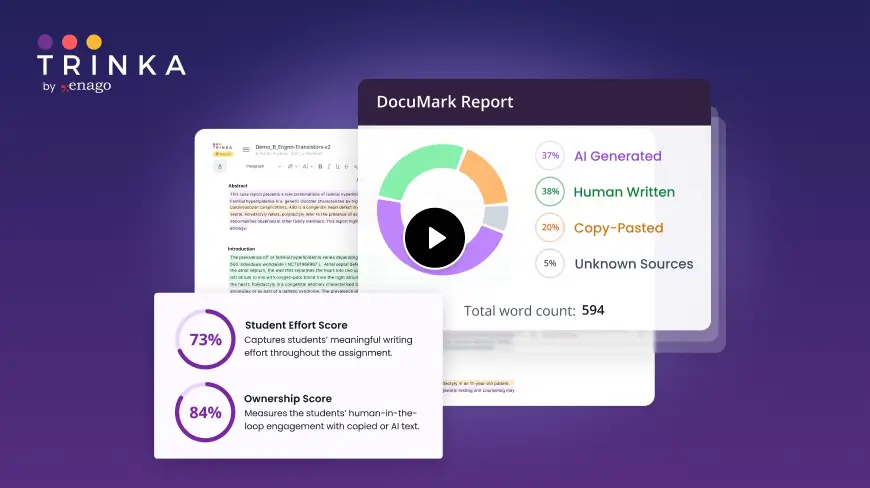
DocuMark: Responsible AI Use for Academic Integrity
Knowing your institution's AI policy is step one. DocuMark helps enforce it fairly by empowering universities to manage AI-generated content, prevent cheating, and support student writing through responsible AI use.
Common Questions About University of Massachusetts Boston's AI Policies
University of Massachusetts Boston has defined AI policies in 9 of 12 categories, with an overall coverage score of 75%.
When a course allows AI use, students are required to disclose and cite any AI-generated material that informed their work. The required attribution includes in-text citations, references, and the full text of the cited ChatGPT or other LLM output as an appendix. AI-generated content shared with others should also be clearly labeled, and failure to attribute AI use is treated as academic dishonesty.
UMass Boston states that its Turnitin service does not include AI detection, and its AI guidance warns that free AI-detection tools are not always accurate. Undisclosed or improper AI use can still be enforced as academic dishonesty under course and academic integrity policies, and instructors are told to use critical judgment rather than relying solely on detection tools.
The university has licensed Microsoft Copilot Chat and directs users to sign in with their UMass Boston Microsoft 365 account. Users are told not to use Copilot for personal information that could violate HIPAA or other data protection laws, and students and instructors are cautioned not to share unpublished, proprietary, personal, or professional data on AI platforms. The guidance therefore allows use of an approved institutional platform while restricting sensitive data entry.