Teaching & Learning
- Use of AI in graded coursework is governed primarily by instructor discretion
- The university states that submitting AI-generated work as one's own without authorization can violate academic integrity rules, and faculty are encouraged to specify permitted and prohibited uses in their syllabi
Where AI tools such as ChatGPT and DALL-E are not authorized, any use of these technologies and submission of the generated work as one’s own is considered an act of academic dishonesty and a violation of academic integrity.
If instructors permit students to use AI in one or more of the ways listed below, they should set clear boundaries and explain these clearly in the syllabus. Students should use AI only in the ways that are authorized.
Instructors should clearly explain if and where AI use is allowed in their course and on assignments and exams.
- Faculty are told to state clearly whether AI is allowed on assignments and exams
- AI use in exams and assessments is left to instructor direction, but unauthorized use is treated as academic dishonesty
The unauthorized use of artificial intelligence technologies, including but not limited to ChatGPT and DALL-E, for the completion of coursework or formal assessments may constitute academic dishonesty under this policy.
Instructors should clearly explain if and where AI use is allowed in their course and on assignments and exams.
Where AI tools such as ChatGPT and DALL-E are not authorized, any use of these technologies and submission of the generated work as one’s own is considered an act of academic dishonesty and a violation of academic integrity.
- Use depends on course-level authorization and boundaries set by the instructor
- The university encourages faculty to communicate when AI may be used for learning support, such as brainstorming, explanation, tutoring, or study help, but it does not impose a single university-wide student entitlement to use AI for study assistance
If instructors permit students to use AI in one or more of the ways listed below, they should set clear boundaries and explain these clearly in the syllabus. Students should use AI only in the ways that are authorized.
Specific ways to describe the use of AI in your class include (but are not limited to) one or more of the following:
• Brainstorming and refining ideas
• Fine-tuning drafts and editing
• Debugging code, creating sample code, and suggesting test cases
• Exploring relevant principles and concepts
• Creating diagrams and visualizations
• Practice and review activities
• Tutoring and personalized learning support
• Other uses specified by the instructor
Instructors should clearly explain if and where AI use is allowed in their course and on assignments and exams.
- AI-assisted coding is not uniformly allowed or banned across the university; it is handled through instructor discretion
- Faculty guidance specifically identifies debugging code, generating sample code, and suggesting test cases as uses that may be permitted if the instructor authorizes them and defines the limits
If instructors permit students to use AI in one or more of the ways listed below, they should set clear boundaries and explain these clearly in the syllabus. Students should use AI only in the ways that are authorized.
• Debugging code, creating sample code, and suggesting test cases
Instructors should clearly explain if and where AI use is allowed in their course and on assignments and exams.
Research
- It also says AI tools should not be listed as authors and that researchers remain responsible for accuracy, originality, and proper attribution
- The university states that researchers must follow sponsor, publisher, and disciplinary rules when using AI in research writing, and AI use may require disclosure
Researchers should review and comply with sponsor requirements, publisher policies, and disciplinary norms regarding the use of generative AI in proposal writing, manuscript preparation, editing, and related scholarly activities.
When use of AI tools is permitted, researchers are responsible for ensuring the accuracy, originality, and appropriate attribution of all submitted work.
Researchers should disclose the use of generative AI in manuscripts, proposals, or other scholarly outputs when required by publishers, sponsors, or university guidance.
AI tools may not be listed as authors on scholarly works.
- The university requires researchers to use caution with AI in data-related research activity and to comply with legal, sponsor, and university controls
- Sensitive, confidential, proprietary, export-controlled, or regulated data must not be entered into public AI systems unless specifically authorized and protected, and researchers remain responsible for validating AI-generated outputs
Researchers must not input confidential, proprietary, personally identifiable, protected health, export-controlled, or otherwise restricted data into publicly available AI tools unless expressly authorized and protected by appropriate agreements and security controls.
Researchers are responsible for verifying the accuracy, validity, and bias of AI-generated analyses, summaries, code, images, or other outputs used in research.
Use of generative AI in data analysis, coding, literature review, or content generation must comply with applicable laws, sponsor requirements, university policies, and disciplinary standards.
- The university explicitly connects AI use in research to ethics, integrity, and compliance oversight
- Researchers must follow sponsor and publisher requirements, may need disclosure, cannot name AI as an author, and must consult ORI and other compliance offices when AI implicates research integrity, human subjects, or regulated research processes
Researchers should review and comply with sponsor requirements, publisher policies, and disciplinary norms regarding the use of generative AI in proposal writing, manuscript preparation, editing, and related scholarly activities.
Researchers should disclose the use of generative AI in manuscripts, proposals, or other scholarly outputs when required by publishers, sponsors, or university guidance.
AI tools may not be listed as authors on scholarly works.
Questions related to research integrity, authorship, data management, or other compliance matters should be directed to the Office of Research Integrity and other appropriate university offices.
Investigators should consult the IRB, IACUC, ORI, or other relevant compliance office when proposed AI use affects human subjects research, animal research, data security, or research misconduct risk.
Academic Integrity
- In research contexts, disclosure is required when publishers, sponsors, or university guidance require it
- When AI use is allowed, the university expects transparency about that use and encourages faculty to require disclosure in course policies
Instructors may wish to require students to disclose any AI tools used in completing assignments.
If you permit students to use AI, you should explain any disclosure or citation expectations.
Researchers should disclose the use of generative AI in manuscripts, proposals, or other scholarly outputs when required by publishers, sponsors, or university guidance.
- Unauthorized AI use may be pursued as academic dishonesty under the university's academic integrity process
- While sanctions pathways are defined, the university explicitly cautions instructors against relying solely on AI detection software due to accuracy concerns
The unauthorized use of artificial intelligence tools may be considered academic dishonesty, a violation of the Academic Integrity Policy. Violations of this policy shall be subject to the procedures and sanctions set forth by the university. The Office of the Provost does not recommend that instructors rely solely on AI detection software, such as Turnitin's AI writing indicator, to determine whether a student has used AI to complete their assignments.
Institutional & Administrative
- The university provides faculty guidance on using AI in teaching and requires faculty to communicate course-specific AI rules clearly
- It also directs employees to use AI tools consistently with university policy and cautions that human judgment remains necessary, especially where outputs affect university work or official decisions
Instructors should clearly explain if and where AI use is allowed in their course and on assignments and exams.
If instructors permit students to use AI in one or more of the ways listed below, they should set clear boundaries and explain these clearly in the syllabus.
Faculty and staff using generative AI tools must do so in accordance with university policy, applicable law, and data security requirements.
Users are responsible for reviewing and validating AI-generated content before relying on it for university business.
- The university imposes data protection limits on AI use and distinguishes restricted university information from material that may be used more safely
- It warns users not to enter confidential, regulated, or otherwise sensitive university data into public AI systems unless approved safeguards are in place, and it identifies institutionally supported AI tooling through university IT guidance
Do not enter confidential, sensitive, or protected university data into public generative AI tools.
Examples of data that should not be entered include personally identifiable information, student education records, protected health information, confidential research data, and other non-public university information.
Use only university-approved tools and services when available, and follow all applicable information security requirements.
- The university has established a coordinated institutional effort around AI through faculty-development resources, evolving guidance, and faculty governance discussion
- The sources show that AI policy and practice are being developed through institutional guidance pages, senate review, and requests for community comment rather than a single final comprehensive policy document
Exploring AI at UMass Lowell
This site is intended to support faculty, staff, and researchers as they navigate the rapidly changing landscape of artificial intelligence.
Faculty Senate Call for Comment
Language Regarding Artificial Intelligence
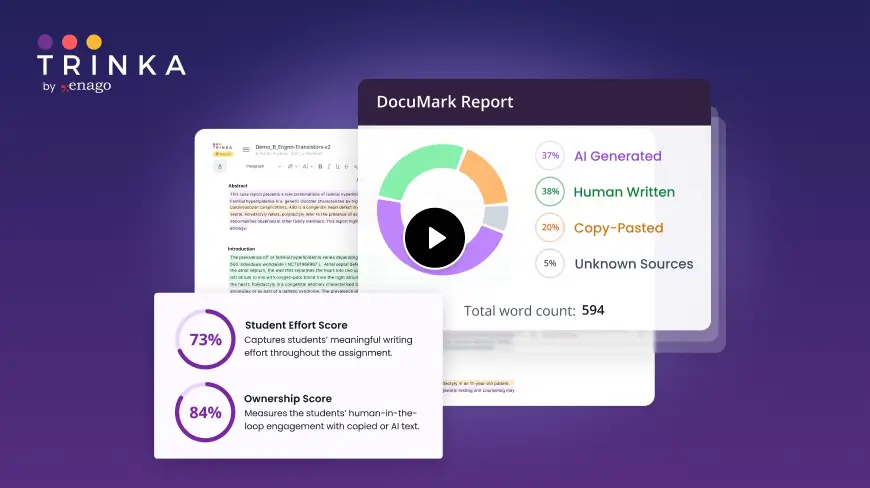
DocuMark: Responsible AI Use for Academic Integrity
Knowing your institution's AI policy is step one. DocuMark helps enforce it fairly by empowering universities to manage AI-generated content, prevent cheating, and support student writing through responsible AI use.
Common Questions About University of Massachusetts Lowell's AI Policies
University of Massachusetts Lowell has defined AI policies in 12 of 12 categories, with an overall coverage score of 100%.
When AI use is allowed, the university expects transparency about that use and encourages faculty to require disclosure in course policies. In research contexts, disclosure is required when publishers, sponsors, or university guidance require it.
Unauthorized AI use may be pursued as academic dishonesty under the university's academic integrity process. While sanctions pathways are defined, the university explicitly cautions instructors against relying solely on AI detection software due to accuracy concerns.
The university imposes data protection limits on AI use and distinguishes restricted university information from material that may be used more safely. It warns users not to enter confidential, regulated, or otherwise sensitive university data into public AI systems unless approved safeguards are in place, and it identifies institutionally supported AI tooling through university IT guidance.