Teaching & Learning
- The university provides instructor-facing guidance that course-level generative AI rules should be set by the instructor (e.g., permitted, permitted with disclosure, or forbidden), typically via syllabus statements
- Example syllabus language includes allowing AI for parts of the writing process (e.g., brainstorming, outlining, grammar/style checking) and also includes examples where AI use is explicitly forbidden and violations are reported through academic misconduct processes
## Example Syllabi Statements
### Use-permitted
### Use permitted depending on activity type:
The use of generative AI tools (e.g. U-M GPT, ChatGPT, Dall-e, etc.) is permitted in this course for the following activities:
* Brainstorming and refining your ideas;
* Fine tuning your research questions;
* Finding information on your topic;
* Drafting an outline to organize your thoughts; and
* Checking grammar and style.
The use of generative AI tools is not permitted in this course for the following activities:
### Use-forbidden:
The use of AI tools is explicitly forbidden. Any indication of use will be reported to [School/College] name for investigation as academic misconduct, and subject to consequences like failing the assignment or failing the course depending on the scope and severity of the actions taken.
- This guidance is presented as an example course policy rather than a single university-wide rule
- The university provides example syllabus language indicating students may be encouraged to use AI tools to study, but they are expected to be open about and document their AI use when required by the course
Openness. We encourage you to use AI tools to explore the field, play with knowledge, and help you study. But you need to be open about this, and document your use.
Documentation. A portion of your term grade will evaluate your documentation of AI use throughout the course.
- Separately, the university’s safe computing guidance states that AI-generated code should not be used for institutional IT systems and services unless it is reviewed by a human and meets secure coding requirements
- Example course policy language allows submission of AI-generated or AI-derived code as long as it is properly documented (including prompts and significant parts of the AI response) and the student remains responsible for testing and identifying logic errors
In principle you may submit AI-generated code, or code that is based on or derived from AI-generated code, as long as this use is properly documented in the comments: you need to include the prompt and the significant parts of the response. AI tools may help you avoid syntax errors, but there is no guarantee that the generated code is correct. It is your responsibility to identify errors in program logic through comprehensive, documented testing.
AI-generated code should not be used for institutional IT systems and services unless it is reviewed by a human, as well as meets the requirements of Secure Coding and Application Security (DS-18).
Research
- The same research guidance also directs researchers to follow the university’s sensitive data guidance for storing, handling, and securing sensitive information when working with GenAI tools
- The university’s research guidance discusses generative AI as having potential to assist researchers with data analysis tasks (e.g., cleaning data, running tests, interpreting results, and visualizations), but it does so as descriptive guidance rather than a formal permission/prohibition policy
Recently, it has been demonstrated that GPT-4 can act as a data analyst, capable of autonomously handling datasets, developing analytical strategies, cleaning data, running tests, and interpreting results.
In addition, it can also conduct visualizations, descriptive analyses, regression analyses, and even write sections of academic papers based on findings, showcasing its potential in revolutionizing academic publishing and data analysis.
Please refer to the U-M Sensitive Data Guide for comprehensive guidance on storing, handling, and securing sensitive information.
- The same page highlights bias as a major issue to be understood and mitigated, especially when applying outputs to research involving human participants or using data from such studies
- The university’s research guidance states researchers should not input personal, private, or regulated/protected data (including HIPAA, FERPA, Common Rule, and Export Control-protected information) into an unsecure GenAI system, and it instructs researchers to follow university guidelines and policies
Bias in AI systems is understood to be a major problem that should be understood, quantified, described, and mitigated. This is especially true with applying outputs to research involving human participants or using data from such studies.
Researchers should not input personal, private, or HIPAA, FERPA, Common Rule, and Export Control-protected information into an unsecure GenAI system. Researchers should follow University of Michigan Guidelines and Policies, which should be immediately updated to address changes brought on by GenAI.
Academic Integrity
- Other example syllabus language indicates some instructors may not require disclosure; overall, the guidance presents disclosure expectations as course/instructor-defined via syllabus policy
- Example syllabus language provided in university guidance includes requirements to document and/or cite generative AI use as part of submitted work, including making the process transparent and meeting attribution and validation standards
But you need to be open about this, and document your use.
A portion of your term grade will evaluate your documentation of AI use throughout the course.
In principle you may submit material that contains AI-generated content, or is based on or derived from it, as long as this use is properly documented.
Your documentation should make the process transparent – the submission itself should meet our standards of attribution and validation.
We do ask that you cite the technologies used as part of your submission so that we’re all engaging in a dialogue around the role and efficacy of these tools.
GenAI-use: Permitted, no disclosure needed
- The provided sources do not define a university-wide position on use of AI-detection tools
- Example syllabus language in university guidance states that when AI tool use is explicitly forbidden, any indication of use will be reported for investigation as academic misconduct and may lead to assignment or course failure depending on severity
The use of AI tools is explicitly forbidden. Any indication of use will be reported to [School/College] name for investigation as academic misconduct, and subject to consequences like failing the assignment or failing the course depending on the scope and severity of the actions taken.
Institutional & Administrative
- This is framed as advisory guidance rather than a mandatory requirement
- University guidance for online teaching recommends that instructors be transparent with students about instructor use of AI and to review AI-generated content carefully before sharing it with students
Consider being transparent about your use of AI to help build trust with your students, and be sure to review all AI-generated content carefully before sharing it with students.
- Separately, ITS AI services documentation states ITS AI Services include safeguards required by HIPAA and that users may use these services with PHI, with permitted data types referenced via the Sensitive Data Guide
- The university’s safe computing guidance states that U-M sensitive data may be used only with approved AI services and prohibits placing sensitive data into an AI service unless a U-M contract or data agreement permits it; AI services without a U-M contract/data agreement should only be used with LOW classified institutional data
Use only approved AI services with U-M sensitive data.
Do not place sensitive data in an AI service unless there is a U-M contract or data agreement in place that permits it.
AI services that do not have a contract or data agreement with U-M should only be used with institutional data classified as LOW.
Note: ITS AI Services include the safeguards required by HIPAA. Accordingly, you may use these services with Protected Health Information (PHI).
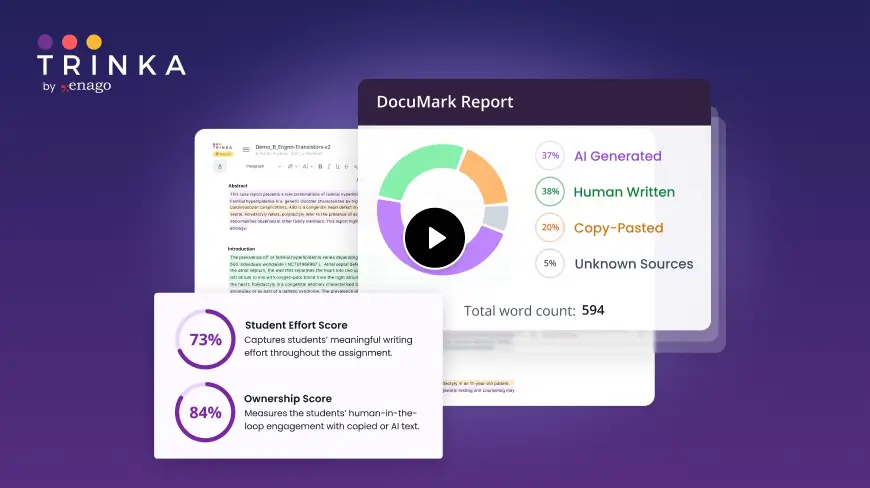
DocuMark: Responsible AI Use for Academic Integrity
Knowing your institution's AI policy is step one. DocuMark helps enforce it fairly by empowering universities to manage AI-generated content, prevent cheating, and support student writing through responsible AI use.
Common Questions About University of Michigan-Ann Arbor's AI Policies
University of Michigan-Ann Arbor has defined AI policies in 9 of 12 categories, with an overall coverage score of 75%.
Example syllabus language provided in university guidance includes requirements to document and/or cite generative AI use as part of submitted work, including making the process transparent and meeting attribution and validation standards. Other example syllabus language indicates some instructors may not require disclosure; overall, the guidance presents disclosure expectations as course/instructor-defined via syllabus policy.
Example syllabus language in university guidance states that when AI tool use is explicitly forbidden, any indication of use will be reported for investigation as academic misconduct and may lead to assignment or course failure depending on severity. The provided sources do not define a university-wide position on use of AI-detection tools.
The university’s safe computing guidance states that U-M sensitive data may be used only with approved AI services and prohibits placing sensitive data into an AI service unless a U-M contract or data agreement permits it; AI services without a U-M contract/data agreement should only be used with LOW classified institutional data. Separately, ITS AI services documentation states ITS AI Services include safeguards required by HIPAA and that users may use these services with PHI, with permitted data types referenced via the Sensitive Data Guide.