Teaching & Learning
- Course-level policy is left to instructor discretion
- Students are told to follow the syllabus and ask the instructor when unsure
- UM provides model syllabus language ranging from encouraged use with transparency, to allowed use only for specific tasks with documentation, to prior-approval-only use, to discouraged use treated as an academic integrity violation
“This course explores how AI can be a tool in the learning process. You will be encouraged to use generative AI tools to draft, brainstorm, research, revise, and reflect—but always with transparency. We will discuss how to use these tools critically and ethically in academic and professional contexts.”
“You may use generative AI tools for specific tasks in this course (e.g., summarizing texts, finding sources, generating initial coding ideas), but you must clearly document what tools you used and how. You are responsible for verifying the accuracy of any AI-generated content and ensuring that your work meets course standards.”
“Use of generative AI tools (e.g., ChatGPT, DALL·E, etc.) is permitted only with prior instructor approval. If you wish to use these tools to brainstorm ideas, locate sources, generate content, or get feedback, please consult with me first. Unauthorized use may be considered a violation of academic honesty.”
“Use of generative AI tools (e.g., ChatGPT, Claude, Gemini) is discouraged for any assignment or activity in this course. All submitted work must be your own original effort. Use of these tools will be treated as a violation of academic integrity policies.”
“You’ll see a short statement in the syllabus about how I expect you to use—or not use—AI in this class. It’s okay if you’re unsure what that means right now. I’m happy to talk more about it.”
“The most important thing is that we have an open line of communication. If you’re ever not sure what’s allowed, just ask me. Part of my job is to help you navigate it and understand its role in your learning.”
- UM treats unauthorized AI use during examinations or academic exercises as academic misconduct under the Student Code of Conduct
- The code also defines content derived directly from a generative AI tool as plagiarism when presented as the student's own original work
1. Plagiarism: Representing words, ideas, data, or materials of another person as one’s own, the student’s own previous work as if it were the student’s own original work, or content derived directly from a generative artificial intelligence tool as if it were the student’s own original work.
2. Misconduct during an examination or academic exercise: Copying from another student, consulting unauthorized
- UM provides AI learning resources and study support, but whether students may use generative AI in a class is determined at the course level
- Some instructor models explicitly allow brainstorming, research, summarizing, and source-finding, while students are expected to follow syllabus guidance and ask if uncertain
“This course explores how AI can be a tool in the learning process. You will be encouraged to use generative AI tools to draft, brainstorm, research, revise, and reflect—but always with transparency. We will discuss how to use these tools critically and ethically in academic and professional contexts.”
“You may use generative AI tools for specific tasks in this course (e.g., summarizing texts, finding sources, generating initial coding ideas), but you must clearly document what tools you used and how. You are responsible for verifying the accuracy of any AI-generated content and ensuring that your work meets course standards.”
“The most important thing is that we have an open line of communication. If you’re ever not sure what’s allowed, just ask me. Part of my job is to help you navigate it and understand its role in your learning.”
Follow curated, step-by-step learning paths designed for your experience level and goals. Each path combines the best free resources with University of Montana guidance.
- UM does not set a single university-wide rule for AI coding assistance in coursework; it is addressed through instructor-controlled course policies
- The university's sample guidance allows instructors to permit AI for "generating initial coding ideas" if students clearly document tool use and verify accuracy
“You may use generative AI tools for specific tasks in this course (e.g., summarizing texts, finding sources, generating initial coding ideas), but you must clearly document what tools you used and how. You are responsible for verifying the accuracy of any AI-generated content and ensuring that your work meets course standards.”
“Use of generative AI tools (e.g., ChatGPT, DALL·E, etc.) is permitted only with prior instructor approval. If you wish to use these tools to brainstorm ideas, locate sources, generate content, or get feedback, please consult with me first. Unauthorized use may be considered a violation of academic honesty.”
Research
- The research guidance also states that funder and publisher rules vary and must be checked carefully
- UM allows AI-assisted drafting or refinement in proposal development when the funder permits it, but requires researchers to review and edit AI-generated text and to disclose use when required
If allowed by the funder, researchers may choose to use AI tools (e.g., language models) to draft or refine parts of grant proposals. If doing so: Review and edit all AI-generated text for accuracy, tone, and alignment with the funder’s expectations.
Be transparent if the funder requires disclosure.
Policies on AI use vary widely. Most funders prohibit AI use in peer review. Some allow AI-assisted drafting with disclosure. Researchers must review agency-specific guidance carefully and document AI use where required.
- The university also warns against using AI to generate data, citations, or other content that cannot be fully validated or attributed, and warns that uploading sensitive data to AI tools can create privacy violations
- UM acknowledges that AI is being integrated into research workflows including data analysis, but places responsibility on the researcher to ensure compliance with university, funder, publisher, and accepted research practices
Artificial Intelligence (AI) tools are evolving rapidly and are increasingly integrated into research workflows—from grant writing to data analysis. These tools offer significant potential but also pose ethical, legal, and practical risks. The researcher is responsible for verifying compliance with University of Montana policies, funder and publisher guidelines, and generally accepted research practices.
Avoid using AI to generate data, citations, or any content that you cannot fully validate or attribute.
Using AI tools—especially cloud-based or public-facing platforms—can inadvertently expose sensitive, proprietary, or personally identifiable information. Uploading confidential data without proper safeguards may violate university policy and federal regulations. In some cases, such misuse may rise to the level of research misconduct.
- The university notes that most funders prohibit AI use in peer review and warns that misuse involving confidential data may rise to research misconduct
- UM requires researchers to follow funder- and publisher-specific AI rules, document AI use when required, and be transparent where disclosure is required
Policies on AI use vary widely. Most funders prohibit AI use in peer review. Some allow AI-assisted drafting with disclosure. Researchers must review agency-specific guidance carefully and document AI use where required.
Be transparent if the funder requires disclosure.
Using AI tools—especially cloud-based or public-facing platforms—can inadvertently expose sensitive, proprietary, or personally identifiable information. Uploading confidential data without proper safeguards may violate university policy and federal regulations. In some cases, such misuse may rise to the level of research misconduct.
Artificial Intelligence (AI) tools are evolving rapidly and are increasingly integrated into research workflows—from grant writing to data analysis. These tools offer significant potential but also pose ethical, legal, and practical risks. The researcher is responsible for verifying compliance with University of Montana policies, funder and publisher guidelines, and generally accepted research practices.
Academic Integrity
- UM's disclosure expectations depend on context
- In coursework, instructors may require students to clearly document what AI tools were used and how; in research and proposal development, researchers must be transparent and document AI use when a funder requires it
“You may use generative AI tools for specific tasks in this course (e.g., summarizing texts, finding sources, generating initial coding ideas), but you must clearly document what tools you used and how. You are responsible for verifying the accuracy of any AI-generated content and ensuring that your work meets course standards.”
Be transparent if the funder requires disclosure.
Policies on AI use vary widely. Most funders prohibit AI use in peer review. Some allow AI-assisted drafting with disclosure. Researchers must review agency-specific guidance carefully and document AI use where required.
- The university does not provide or endorse AI detection tools, citing concerns about their inaccuracy and bias
- Faculty guidance distinguishes between unintentional and intentional misuse, with only the latter proceeding to the formal integrity process
- UM treats AI-generated content submitted as original work as plagiarism under the Student Code of Conduct, with enforcement handled through the academic misconduct process
1. Plagiarism: Representing words, ideas, data, or materials of another person as one’s own... or content derived directly from a generative artificial intelligence tool as if it were the student’s own original work.
* Intentional misuse = Proceed with the academic integrity process described in UM’s Student Conduct Code
Because AI detection software is inaccurate and biased, UM does not provide or endorse any AI detection tools. Instead, we recommend that instructors focus on assignment design and open communication.
Institutional & Administrative
- UM explicitly supports faculty and staff use of AI and provides guidance, training, and examples for teaching and institutional work
- The university is piloting its own platform to support teaching, learning, research, and operations, and it offers faculty conversations and syllabus guidance for classroom use
Draft Resources for Faculty, Staff and Students
* UM Course on AI: A UM faculty and student-designed course to help everyone build the skills and insights they need to lead ethically and responsibly in an AI-integrated world;
* Teaching and Learning with AI: UM's guide to teaching in the age of generative AI;
* umontana.ai website: A central hub for AI information, guidelines, and training, designed for all members of our campus community; and
* Amplify GenAI: UM is currently piloting our own generative AI platform that will support teaching, learning, research, and operations, as well as ensure equitable access to quality AI tools for our campus community.
Navigating AI in the Classroom: Faculty discussion on creating generative AI statements for syllabi and assignments
As AI reshapes how people teach, learn, work, and live, UM approaches this transformation with integrity, urgency, and care. We are equipping students, faculty, and staff to act not merely as users of AI, but as ethical and innovative creators who apply it with discernment.
- UM prohibits using ChatGPT or other AI tools with FERPA-covered student information, human subject research information, health information, HR records, and other protected data
- At the same time, UM is offering institutionally supported options, including a hosted Amplify GenAI platform and a guide to vetted AI tools described as security reviewed, privacy compliant, and FERPA compliant
Do not use ChatGPT or other AI with information such as student information regulated by FERPA, human subject research information, health information, HR records, etc.
Comprehensive list of vetted AI tools with security, privacy, and cost analysis.
* Security reviewed
* Privacy compliant
* Cost breakdown
* Usage guidelines
UM's hosted AI platform providing secure access to multiple AI models.
* Multiple AI models
* University hosted
* FERPA compliant
* Free for UM users
Engage directly with AI through chat.umontana.ai. Experience our Amplify GenAI platform, where you can interact with cutting-edge generative AI models designed to enhance learning and foster innovation.
- UM has an institution-wide AI strategy centered on the Future Project, an AI commitment statement, campus-wide resources, and cross-departmental working groups
- Its stated approach emphasizes integrity, urgency, care, critical inquiry, intellectual rigor, transparency, human dignity, and alignment of AI with learning, scholarship, and the public good
Early last spring, we shared with you the launch of the Future Project, a university-wide effort to thoughtfully explore the role of artificial intelligence (AI) in how we teach, what we teach, and how we work.
As AI reshapes how people teach, learn, work, and live, UM approaches this transformation with integrity, urgency, and care. We are equipping students, faculty, and staff to act not merely as users of AI, but as ethical and innovative creators who apply it with discernment.
Our strategy is anchored in the enduring commitments of higher education: critical inquiry, intellectual rigor, transparency, and respect for human dignity. Guided by these values, we will demonstrate how a public flagship university can lead the nation in aligning artificial intelligence with the public good. At UM, the promise of AI is clear: when it strengthens human creativity, it strengthens our mission.
AI is a powerful extension of human intent and capacity. Our responsibility is to ensure that this technology advances learning, scholarship, and community well-being rather than diminishing them. We are committed to ensuring that AI advances inclusive prosperity, expands access to opportunity, and strengthens both academic freedom and human dignity.
Cross-departmental working groups formed to explore AI applications
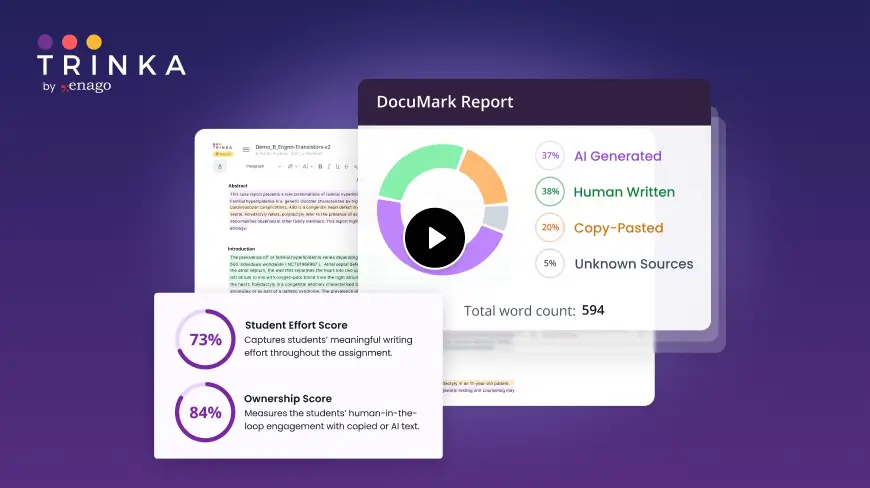
DocuMark: Responsible AI Use for Academic Integrity
Knowing your institution's AI policy is step one. DocuMark helps enforce it fairly by empowering universities to manage AI-generated content, prevent cheating, and support student writing through responsible AI use.
Common Questions About University of Montana's AI Policies
University of Montana has defined AI policies in 12 of 12 categories, with an overall coverage score of 100%.
UM's disclosure expectations depend on context. In coursework, instructors may require students to clearly document what AI tools were used and how; in research and proposal development, researchers must be transparent and document AI use when a funder requires it.
UM treats AI-generated content submitted as original work as plagiarism under the Student Code of Conduct, with enforcement handled through the academic misconduct process. Faculty guidance distinguishes between unintentional and intentional misuse, with only the latter proceeding to the formal integrity process. The university does not provide or endorse AI detection tools, citing concerns about their inaccuracy and bias.
UM prohibits using ChatGPT or other AI tools with FERPA-covered student information, human subject research information, health information, HR records, and other protected data. At the same time, UM is offering institutionally supported options, including a hosted Amplify GenAI platform and a guide to vetted AI tools described as security reviewed, privacy compliant, and FERPA compliant.