Teaching & Learning
- In Faculty 06 and some units, generative AI is generally allowed for coursework if key principles are followed, including student responsibility and disclosure
- University-wide guidance says there is no single rule across all disciplines; acceptable use depends on the discipline, the examination regulations, and the examiner
- Several departments or programs impose stricter local rules: instructors may prohibit AI use, the Language Centre leaves permission decisions to lecturers, Career Service reflections may use AI only for supporting sub-steps, and Book Studies does not permit generative AI in submitted assignments unless the instructor explicitly authorizes it
It is not feasible to draw such a line in a way that applies universally to all academic disciplines at the university. The cultures within the various disciplines are too diverse, and they are engaging with the use of text-generating AI in different ways and at different paces.
Die Verwendung generativer KI im Studium sowie in Studien- und Prüfungsleistungen ist grundsätzlich erlaubt, muss aber einige wichtige Grundsätze einhalten.
Lehrende sind berechtigt, die Verwendung generativer KI bei der Bearbeitung von Prüfungsleistungen zu untersagen. Dies muss den Studierenden entsprechend kommuniziert und angekündigt werden.
Lehrende entscheiden darüber, ob der Einsatz von KI-Werkzeugen in Prüfungsleistungen ihrem Kurs grundsätzlich erlaubt oder verboten ist, und informieren ausdrücklich darüber.
Die Reflexion muss inhaltlich vollständig von mir selbst verfasst sein.
Generative KI darf nur unterstützend für Teilschritte genutzt werden (z. B. Ideenfindung, Gliederung, sprachliche Überarbeitung), nicht für das Verfassen ganzer Absätze oder Seiten.
At the Chair of Book Studies, the use of generative AI in submitted assignments is not permitted unless the instructor has explicitly authorized its use.
- Unauthorized use or failure to disclose AI where disclosure is required is treated as attempted deception and can be sanctioned
- The Language Centre and Faculty 06 explicitly allow lecturers to decide whether AI is allowed or forbidden in assessment tasks, with prior communication required
- Use of generative AI in examinations and assessed work is determined by the competence being assessed, the examination regulations, and the examiner; it is generally not permitted where expression, language, or code creation is itself being examined
Whether generative AI systems are permitted for the purpose of completing examination tasks depends on the specific competence being assessed and is determined by the examination regulations and the examiners. For example, in the case of tasks where the form of expression, linguistic expression or the creation of computer code is the subject of the examination, the use of such systems is generally not permitted.
Lehrende sind berechtigt, die Verwendung generativer KI bei der Bearbeitung von Prüfungsleistungen zu untersagen. Dies muss den Studierenden entsprechend kommuniziert und angekündigt werden.
Lehrende entscheiden darüber, ob der Einsatz von KI-Werkzeugen in Prüfungsleistungen ihrem Kurs grundsätzlich erlaubt oder verboten ist, und informieren ausdrücklich darüber.
Unerlaubte Nutzung von KI-Werkzeugen bei Prüfungsleistungen bzw. Nicht-Kenntlichmachen von mit KI-Werkzeugen erstellten Texten bei erlaubter Nutzung wird als Täuschungsversuch gemäß § 11 Abs. 3 der Prüfungsordnung gewertet und entsprechend sanktioniert.
In serious cases, cheating can lead to expulsion and/or permanent failure of the (partial) degree programme.
- Students remain responsible for submitted content, including AI-generated output
- The university states that AI can be sensible and helpful across study, teaching, research, and transfer
- Some unit-level guidance expressly encourages supportive learning uses such as idea generation, structuring, grammar/style review, and literature finding, while requiring critical checking of outputs and preserving the student's own intellectual contribution
We assume that the use of AI can be sensible and helpful in all areas – study and teaching, research and knowledge transfer. This also applies to all disciplines.
Generative KI darf nur unterstützend für Teilschritte genutzt werden (z. B. Ideenfindung, Gliederung, sprachliche Überarbeitung), nicht für das Verfassen ganzer Absätze oder Seiten.
KI-gestützte Tools können helfen, relevante Literatur und wissenschaftliche Artikel zu finden (z. B. Google Scholar).
KI als „Gesprächspartner“ bei der Themenfindung und -formulierung (z. B. ChatGPT).
Wenn Studierende ein KI-Werkzeug verwenden wollen, sollten sie sich vorab gründlich über die Leistungsfähigkeit und die Grenzen des jeweiligen KI-Werkzeug informieren.
Studierende sind für ihre eingereichten Texte verantwortlich – auch für den mit einem KI-Werkzeug generierten Output.
- The university does not publish a blanket permission rule for code generation
- Instead, university-wide guidance says AI is generally not permitted when code creation is itself the subject of the examination
- Some department forms also explicitly contemplate AI use in software source texts or statistical code, but always with disclosure and student responsibility for the final work
For example, in the case of tasks where the form of expression, linguistic expression or the creation of computer code is the subject of the examination, the use of such systems is generally not permitted.
Wenn die Arbeit Inhalte (z. B. Texte / Textpassagen, Abbildungen, Tabellen, statistische Codes) enthält, die durch den Einsatz generativer KI entstanden sind, wurde dies in der mit den Prüfenden vereinbarten Form kenntlich gemacht.
__ in the development/optimization/finalization of software source texts
Research
- Other units similarly allow proofreading, stylistic support, brainstorming, or language correction, while banning complete or largely AI-written passages in academic work
- For theses, term papers, and other scholarly writing, some units explicitly allow generative AI as a support tool, but not as a substitute for the student's own scientific contribution
- Psychology guidance says AI use in theses and papers is expressly permitted if all tools are named, the work remains the student's own scientific achievement, and AI output is never inserted unchecked
Der Einsatz generativer KI ist daher bei der Erstellung von Abschlussarbeiten und Hausarbeiten ausdrücklich erlaubt und in vielen Fällen hilfreich. Um dabei die in der Eigenständigkeitserklärung bestätigte eigenständige Leistung sicherzustellen, müssen Studierende (a) alle genutzten Tools der generativen KI benennen und (b) absichern, dass alle Teile der Arbeit die eigene wissenschaftliche Leistung darstellen.
Dies bedeutet, dass KI-Tools zwar für beliebige Zwecke unterstützend genutzt werden dürfen, aber dass Output der KI niemals ungeprüft in die Arbeit übernommen werden darf, und dass der / die Studierende die volle Verantwortung für den gesamten Inhalt der Arbeit (= die Grundlage der Bewertung durch die Prüfenden) übernimmt.
KI-basierte Schreibassistenten (z. B. ChatGPT) können Inspiration für einzelne Formulierungen liefern, dürfen aber nicht für komplette Textpassagen verwendet werden.
Ein komplett bzw. zu großen Teilen vom Chatbot verfasster Text ist im wissenschaftlichen Kontext unzulässig und wird als Plagiat gewertet.
… AI systems were used for stylistic improvement and language correction
- The Psychology declaration also covers AI-generated tables and statistical code, with responsibility remaining with the student
- Explicit institution-wide rules for AI in research data and analysis are not uniformly defined, but Psychology guidance does address the issue within theses and papers
- It permits supportive use of generative AI while requiring disclosure of tools and verification of any information incorporated into the work through original-source checking and conventional literature research
Werden KI-Tools z. B. im Rahmen der Literaturrecherche genutzt, um sich einen Überblick über den aktuellen Forschungsstand zu einem Thema zu verschaffen, so müssen alle in die Arbeit übernommenen Informationen durch Lesen der Original-Artikel geprüft, sowie die Vollständigkeit der Darstellung durch eine eigene Literaturrecherche mit „herkömmlichen“ Methoden sichergestellt werden.
Wenn die Arbeit Inhalte (z. B. Texte / Textpassagen, Abbildungen, Tabellen, statistische Codes) enthält, die durch den Einsatz generativer KI entstanden sind, wurde dies in der mit den Prüfenden vereinbarten Form kenntlich gemacht.
- Research-facing ethics pages and good scientific practice pages are referenced as the broader framework rather than providing AI-specific procedural rules
- Faculty and department materials emphasize that AI outputs may be erroneous, incomplete, misleading, copyright-problematic, or opaque, and that students or authors are accountable for quality, integrity, and compliance
- The university's provided sources do not set a specific AI rule for grant proposals or IRB applications, but they do require responsible use of AI in research-related academic work and place full responsibility on the human author
In any case, the Statute "Securing good scientific practice" provides a framework for guidance.
Zu diesen Grundsätzen gehört, dass Sie selbst für die Richtigkeit und Integrität der in Ihren Leistungen verwendeten generierten Inhalte verantwortlich sind
Aktuelle KI-Programme und -Systeme können die Anforderungen und Grundsätze wissenschaftlichen Arbeitens nicht erfüllen, weil die generierten Informationen fehlerhaft, unvollständig, irreführend, urheberrechtlich fragwürdig oder intransparent sein können.
I am fully responsible for the adoption of any machine-generated passages used by me and bear the responsibility for any erroneous or distorted content, faulty references, violations of data protection and copyright law or plagiarism generated by the AI.
Academic Integrity
- Disclosure of AI use is required wherever AI use is allowed under local rules
- Some units require a separate declaration form or appendix table, and Psychology requires AI-generated parts to be marked in the form agreed with examiners
- Requirements vary by unit, but the recurring pattern is that students must identify the tools used, the purpose, extent, prompts in some cases, the passages or work steps affected, and their own contribution or revision
Wenn die Arbeit Inhalte (z. B. Texte / Textpassagen, Abbildungen, Tabellen, statistische Codes) enthält, die durch den Einsatz generativer KI entstanden sind, wurde dies in der mit den Prüfenden vereinbarten Form kenntlich gemacht.
Diese Kennzeichnung umfasst die Markierung oder Benennung der Textpassagen oder Arbeitsschritte, die an ein KI-Werkzeug abgegeben wurden, den Umfang des übernommenen Outputs, sowie den Umfang der eigenen Überarbeitung, die Nennung des verwendeten KI-Werkzeugs und ggf. Angabe des verwendeten Prompts (vgl. Formular des Sprachenzentrums).
Ich erkläre weiterhin, dass ich die aus den oben genannten KI-Werkzeugen übernommenen Passagen markiert habe.
Ich versichere, alle Nutzungen von KI-Werkzeugen vollständig angegeben zu haben.
Where the use of generative AI was permitted to compose this work, I have acknowledged its use in a separate table included in the appendix to this work. This table acknowledges any use of generative AI in this work accordingly, including but not limited to a) the specific AI tools or technologies used, b) what the AI tools or technologies were used for, c) the prompts I have used in the AI tools or technologies and d) an explanation of how the output from the AI tools or technologies was used in my work.
Ich dokumentiere meine Nutzung am Ende der Reflexion durch diese Erklärung, nicht durch das Beilegen von KI-Ausgaben oder Zitaten.
- The university's sources emphasize enforcement through academic misconduct procedures rather than AI-detection software rules
- Some units also say lecturers may verify declared AI use through spot checks or questioning, and Psychology notes storage in a database for plagiarism control
- Several units state that undisclosed or prohibited AI use is treated as deception or plagiarism; sanctions include a failing grade, documentation with the examinations office, and in serious or repeated cases exclusion from further assessments or even expulsion/permanent failure of the program
Unerlaubte Nutzung von KI-Werkzeugen bei Prüfungsleistungen bzw. Nicht-Kenntlichmachen von mit KI-Werkzeugen erstellten Texten bei erlaubter Nutzung wird als Täuschungsversuch gemäß § 11 Abs. 3 der Prüfungsordnung gewertet und entsprechend sanktioniert.
Lehrende können die angegebene Verwendung durch Stichproben oder Nachfragen überprüfen. Studierende sollten darauf vorbereitet sein, ggf. die Einzelheiten der Verwendung von KI-Werkzeugen zu diskutieren und die Zwischenschritte im Arbeitsprozess aufzuzeigen.
Please note: if your instructor indicates that no use is allowed, use will be counted as plagiarism and the paper will receive a failing grade.
Finally, I am fully aware that any failure to observe the aforementioned points may lead to the classification of this work as deception (= 5.0, failed). Attempted deception in submitted assignments is documented by the examinations offices (Prüfungsamt); repeated and/or severe attempts to deceive may also lead to an exclusion from further assessments in my degree programme.
In serious cases, cheating can lead to expulsion and/or permanent failure of the (partial) degree programme.
Ich erkläre hiermit, dass ich Kenntnis von einer zum Zweck der Plagiatskontrolle vorzunehmenden Speicherung der Arbeit in einer Datenbank sowie von ihrem Abgleich mit anderen Texten zwecks Auffindung von Übereinstimmungen habe.
Institutional & Administrative
- Faculty use is addressed in several unit-level sources rather than one single university-wide policy
- No explicit source in the provided set addresses staff use for grading, recommendation letters, or administrative communications beyond these teaching-related roles
- Lecturers may use AI tools for classroom demonstration, may require UniGPT in teaching, and may adapt documentation/citation requirements or decide whether AI use is allowed in assessments, provided they communicate this to students
Lehrende können KI-Werkzeuge wie ChatGPT (https://chat.openai.com/), DeepL Write (https://www.deepl.com/en/write), DeepL Translate (https://www.deepl.com/translator), Grammarly (https://www.grammarly.com/) etc. zur Demonstration im Unterricht einsetzen, sofern sie dies für sinnvoll erachten und die Nutzung vorstellen wollen.
Da die Universität Münster seit dem 08.05.2024 mit UniGPT einen eigenen, DSGVO-konformen Zugang zu LLM-Modellen bereitstellt, können Lehrende für alle verpflichtend UniGPT im Unterricht einsetzen.
Lehrende entscheiden darüber, ob der Einsatz von KI-Werkzeugen in Prüfungsleistungen ihrem Kurs grundsätzlich erlaubt oder verboten ist, und informieren ausdrücklich darüber.
Lehrende sind berechtigt, die oben beschriebenen Dokumentations- und Zitationspflichten im Rahmen einzelner Prüfungen und Lehrveranstaltung anzupassen oder zu reduzieren. Dies muss den Studierenden entsprechend kommuniziert und angekündigt werden.
- The university provides an approved institutional platform, UniGPT, for study, teaching, and research
- University materials also repeatedly warn users to pay attention to data protection and not assume external AI tools handle personal or prompt data safely
- UniGPT is open to students, employees, and researchers with a university account, is restricted to university-related purposes, and is presented as GDPR-compliant with internal models whose data do not leave the university
Der Dienst ist offen für Studierende, Mitarbeitende und Forschende mit einem Nutzer-Account an der Universität Münster.
Der Dienst darf nur für Zwecke verwendet werden, die in direktem Zusammenhang mit Arbeit, Studium, Lehre oder Forschung an der Universität Münster stehen.
UniGPT ermöglicht die Nutzung von konversationeller künstlicher Intelligenz zu Zwecken von Studium, Lehre und Forschung.
GDPR-compliant: Internal models run entirely on university infrastructure — your data never leaves the university.
First time?
We recommend starting with one of the internal models (e.g., Mistral Small, Llama-3.3-70B, gemma-3-27b-it, medgemma-1.5-4b-it for medical use cases, or Qwen3.5-35B-A3B) — they are fast, free of external cost, and fully GDPR-compliant.
Da die Universität Münster seit dem 08.05.2024 mit UniGPT einen eigenen, DSGVO-konformen Zugang zu LLM-Modellen bereitstellt
Ganz allgemein sollten Sie auf den Schutz Ihrer Daten achten – seien es persönliche Daten wie Mailadressen oder Daten, die Sie durch die Eingabe von Prompts abgeben.
- The university also supports institutional adoption through UniGPT as an official service for all university members
- Governance is decentralized in the provided sources: disciplinary cultures differ, units issue their own recommendations, and faculty or instructors may adapt rules and disclosure practices
- The university has an overarching institutional position that AI can be useful across study, teaching, research, and knowledge transfer, but it does not impose one uniform operational rule across all disciplines
We assume that the use of AI can be sensible and helpful in all areas – study and teaching, research and knowledge transfer. This also applies to all disciplines.
It is not feasible to draw such a line in a way that applies universally to all academic disciplines at the university. The cultures within the various disciplines are too diverse, and they are engaging with the use of text-generating AI in different ways and at different paces.
Zur Nutzung von generativer KI (z.B. textgenerierender Anwendungen wie ChatGPT oder UniGPT) im Studium und in Prüfungsleistungen hat der Fachbereich 06 bereits Empfehlungen veröffentlicht. Diese Empfehlungen gelten grundsätzlich auch in den Studiengängen der Erziehungswissenschaft. Einzelne Empfehlungen können aber durch die Lehrenden angepasst werden.
Der Dienst ist offen für Studierende, Mitarbeitende und Forschende mit einem Nutzer-Account an der Universität Münster.
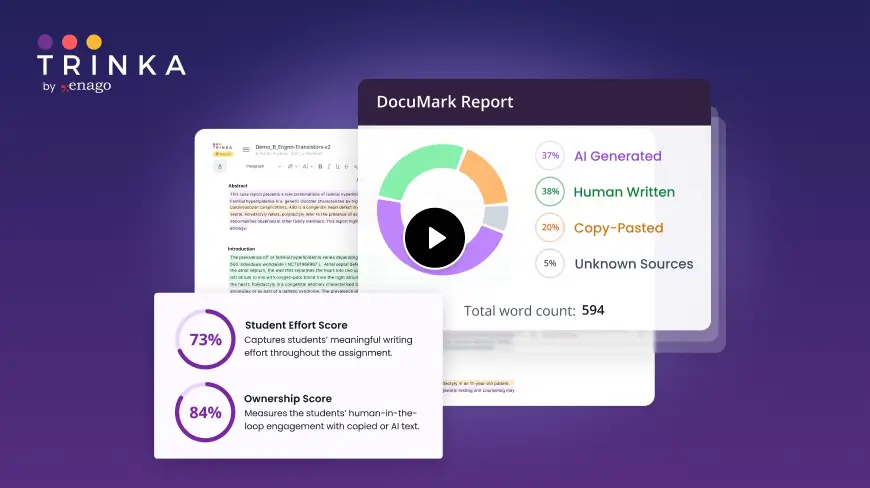
DocuMark: Responsible AI Use for Academic Integrity
Knowing your institution's AI policy is step one. DocuMark helps enforce it fairly by empowering universities to manage AI-generated content, prevent cheating, and support student writing through responsible AI use.
Common Questions About University of Munster's AI Policies
University of Munster has defined AI policies in 12 of 12 categories, with an overall coverage score of 100%.
Disclosure of AI use is required wherever AI use is allowed under local rules. Requirements vary by unit, but the recurring pattern is that students must identify the tools used, the purpose, extent, prompts in some cases, the passages or work steps affected, and their own contribution or revision. Some units require a separate declaration form or appendix table, and Psychology requires AI-generated parts to be marked in the form agreed with examiners.
The university's sources emphasize enforcement through academic misconduct procedures rather than AI-detection software rules. Several units state that undisclosed or prohibited AI use is treated as deception or plagiarism; sanctions include a failing grade, documentation with the examinations office, and in serious or repeated cases exclusion from further assessments or even expulsion/permanent failure of the program. Some units also say lecturers may verify declared AI use through spot checks or questioning, and Psychology notes storage in a database for plagiarism control.
The university provides an approved institutional platform, UniGPT, for study, teaching, and research. UniGPT is open to students, employees, and researchers with a university account, is restricted to university-related purposes, and is presented as GDPR-compliant with internal models whose data do not leave the university. University materials also repeatedly warn users to pay attention to data protection and not assume external AI tools handle personal or prompt data safely.