Teaching & Learning
- It also requires honesty about how and why AI was used in academic contexts and assigns the user final responsibility for the integrity of AI-assisted content
- The university states that generative AI should be used as support for learning rather than as a substitute for a student's own thinking, effort, or creativity
- Its strategic materials also describe AI as a tool students should be able to use while preserving judgment and ethical sense
- The university allows AI to be used as a learning support tool, but says it must not replace critical thinking, effort, or creativity
Research
- For doctoral theses, the university requires disclosure when generative AI is used as a supporting tool at any stage of thesis development
- More broadly, the library's research guidance says AI should be integrated into research rigorously and responsibly across the scientific workflow
- It also requires compliance with ethical and legal standards, mandates originality in all phases of thesis work, and warns that misuse of AI could be treated as fraud
- The university's doctoral code requires compliance with legal principles for data collection and management and with confidentiality
- Its library guidance also frames AI use in research as something to be done ethically and responsibly throughout each phase of scientific work, but it does not set specific AI rules for analysis methods or synthetic data
- It states that AI use must comply with ethical and legal standards, that thesis work must remain original in all phases, and that misuse of AI could be considered fraud
- The university requires doctoral researchers to follow standards of honest scientific conduct and to disclose, where applicable, the use of generative AI in thesis development
Academic Integrity
- It also states that AI should not be cited as an author
- For doctoral theses, use of generative AI as a supporting tool must be explained if applicable
- The university requires honest disclosure of how and why generative AI was used, especially in academic, teaching, or research contexts
- The provided sources do not define any AI detection tools or detection procedures
- It also places final responsibility for the integrity of AI-assisted content on the user
- The university states that misuse of AI in doctoral thesis work could be considered fraud
Institutional & Administrative
- The university's guidance requires honest disclosure of AI use in teaching contexts
- The provided sources do not set more specific rules for faculty or staff uses such as grading, feedback, lesson planning, recommendation letters, or administrative communications
- It also emphasizes data privacy and protection and requires lawful data management and confidentiality in doctoral research
- The university instructs users to prioritize university-approved AI platforms and avoid tools that lack privacy, security, or legal guarantees
- The university states in its 2025-2030 strategy that it aims to be a leader in integrating AI into teaching and research and to function as a living lab for AI application
- It also frames AI use around critical thinking, creativity, ethics, and the university's values, and the library notes that its AI guidance is based on a university AI use policy
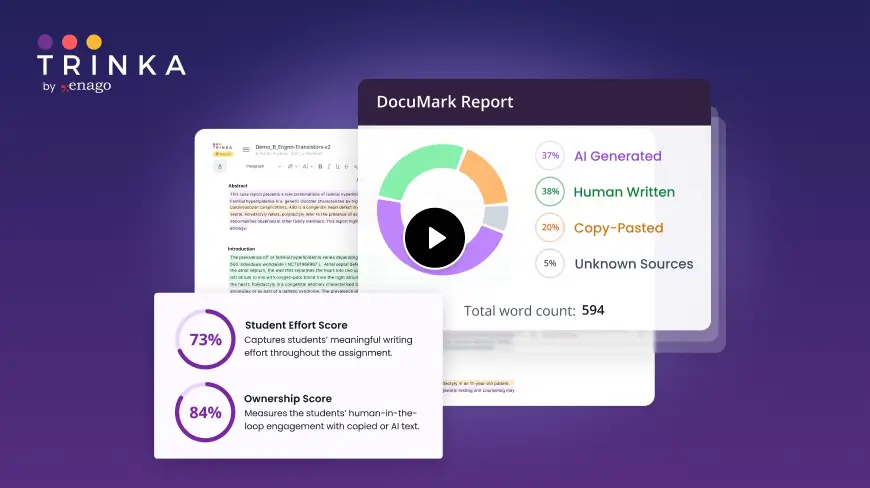
DocuMark: Responsible AI Use for Academic Integrity
Knowing your institution's AI policy is step one. DocuMark helps enforce it fairly by empowering universities to manage AI-generated content, prevent cheating, and support student writing through responsible AI use.
Common Questions About University of Navarre's AI Policies
University of Navarre has defined AI policies in 10 of 12 categories, with an overall coverage score of 83%.
The university requires honest disclosure of how and why generative AI was used, especially in academic, teaching, or research contexts. It also states that AI should not be cited as an author. For doctoral theses, use of generative AI as a supporting tool must be explained if applicable.
The university states that misuse of AI in doctoral thesis work could be considered fraud. It also places final responsibility for the integrity of AI-assisted content on the user. The provided sources do not define any AI detection tools or detection procedures.
The university instructs users to prioritize university-approved AI platforms and avoid tools that lack privacy, security, or legal guarantees. It also emphasizes data privacy and protection and requires lawful data management and confidentiality in doctoral research.