Teaching & Learning
- UNH's academic integrity policy treats use of AI tools without authorization as cheating
- For student coursework and graded academic work, use of AI tools is prohibited unless authorized
- Additional university guidance says expectations should be set by instructors in syllabi, and the writing center defers to course syllabus guidance on acceptable AI use for assignments
Use or attempted use of any academic exercise materials, information, study aids, electronic data, AI tools, assignment/exam surrogate, or other forms of assistance without authorization.
While faculty are encouraged to include AI statements in their syllabi, students are not provided general information regarding what to expect/ask of their teachers.
We also recognize that these advancements have caused concern about academic honesty, originality, and critical thinking, and we will always defer to the syllabus of the course for guidance from the instructor on the acceptable level of AI usage for assignments.
- For exams and academic assessments, AI use is prohibited unless expressly authorized
- No separate AI-specific exam rule beyond authorization requirements is defined in the provided sources
- UNH's academic integrity policy includes exam-related unauthorized assistance within cheating, and unauthorized collaboration on an examination is also prohibited
Use or attempted use of any academic exercise materials, information, study aids, electronic data, AI tools, assignment/exam surrogate, or other forms of assistance without authorization.
Consulting with one or more individuals on an academic exercise or examination without the express permission of the course instructor.
- This is guidance and training, not a uniform student entitlement rule
- UNH provides non-punitive guidance that AI may be used as a learning support tool, but emphasizes critical engagement rather than blind reliance
- University teaching materials encourage instructors to integrate AI thoughtfully to support pedagogical goals and describe student seminars focused on digital literacy, ethical use, and critical evaluation of AI-generated content
There are other AI-based tools that are not supported at UNH, but students have access to them, such as Grammarly and ChatGPT.
To better integrate AI-based tools in your class, it's important to go beyond simply banning or allowing them.
1. Familiarize yourself with these tools and consider how they can be used to support your pedagogical goals. For instance, ChatGPT can be leveraged as an idea generator to spark
Students: The university offers student-facing seminars on AI tools, focusing on digital literacy, ethical use, and how to critically assess AI-generated content in academic work.
- That source presents a best-practice example rather than a binding university-wide requirement
- UNH does not set a single university-wide rule specifically for code generation in coursework, but the academic integrity policy still prohibits unauthorized AI use
- The Faculty Senate report gives a classroom example in which code-generating AI may be used for initial drafts if students also provide detailed annotations explaining their modifications
Use or attempted use of any academic exercise materials, information, study aids, electronic data, AI tools, assignment/exam surrogate, or other forms of assistance without authorization.
Example: In a computer science course, students use a code-generating AI tool for initial drafts but must submit detailed annotations explaining how and why they modified the output.
Research
- The document is framed as guidance for research and scholarship rather than a formal central policy
- UNH permits use of AI writing tools in research and scholarship in some contexts, but requires honesty, transparency, and disclosure of how they were used
- The guidance states that researchers must disclose the tool, prompt, date used, and output, and it warns that some uses may be inappropriate or banned, including submitting AI-generated output as one's own original work
If researchers use AI writing tools in their research, they must be honest about such use and disclose it so that any effects (negative or positive) can be assessed by others who review or utilize the research.
Researchers need to disclose how AI writing tools were used in the conduct of the research (e.g., name of the tool, the prompt, the date used) as well as the output.
In some contexts, such as developing an initial template for a lab procedure, use of AI writing tools may be entirely appropriate; in others, however, use of AI writing tools may be inappropriate (such as generating output that is submitted as one’s own original work) or even banned
- No formal university-wide rule specifically authorizing or prohibiting AI data analysis is defined in the provided sources
- UNH guidance addresses AI use in research methods and analysis by requiring transparency and caution rather than banning it outright
- Researchers are told to disclose AI use in methods and analysis, and the Faculty Senate report identifies AI use for data analysis and citation management as a training topic while also calling for continuous assessment of AI tools for reliability and bias
Openness includes full disclosure of methods, analysis, and conclusions, as well as sharing the resultant data (where appropriate). Researchers need to disclose how AI writing tools were used in the conduct of the research (e.g., name of the tool, the prompt, the date used) as well as the output.
Faculty (Research Setting): A faculty member attends workshops on using AI for data analysis and citation management, gaining awareness of both the methodological benefits and the ethical limitations of AI in academic research.
AI in Academic Research
Regular Monitoring and Evaluation: Continuously assess AI tools for reliability and bias.
- UNH's research guidance links AI use to research integrity values of honesty, openness, and accountability
- The broader research workshop materials also frame AI use in research around ethical considerations across the research lifecycle
- It requires disclosure of AI writing tool use in research, states that some uses may be inappropriate or banned, and specifically identifies listing an AI tool as an author or using such a tool in peer review as banned examples
If researchers use AI writing tools in their research, they must be honest about such use and disclose it so that any effects (negative or positive) can be assessed by others who review or utilize the research.
Researchers need to disclose how AI writing tools were used in the conduct of the research (e.g., name of the tool, the prompt, the date used) as well as the output.
In some contexts, such as developing an initial template for a lab procedure, use of AI writing tools may be entirely appropriate; in others, however, use of AI writing tools may be inappropriate (such as generating output that is submitted as one’s own original work) or even banned (e.g., listing such a tool as an author [Thorp, 2023] or using such a tool when conducting a peer review [Lauer,
Join us for an engaging workshop featuring a panel of UNH researchers who will share how they use generative AI tools in their scholarly work. Panelists will discuss practical applications across the research lifecycle and will highlight real-world examples, benefits and limitations, and ethical considerations about integrating AI into research practice.
Academic Integrity
- UNH requires disclosure of AI writing tool use in research contexts, including specific details about the tool and prompts
- The Faculty Senate report also recommends that faculty clarify and communicate when AI use is not appropriate for certain assignments, classes, or research tasks
- For coursework, the sources do not establish a uniform university-wide citation or disclosure rule; instead, expectations are left to instructors and course syllabi
If researchers use AI writing tools in their research, they must be honest about such use and disclose it so that any effects (negative or positive) can be assessed by others who review or utilize the research.
Researchers need to disclose how AI writing tools were used in the conduct of the research (e.g., name of the tool, the prompt, the date used) as well as the output.
We also recognize that these advancements have caused concern about academic honesty, originality, and critical thinking, and we will always defer to the syllabus of the course for guidance from the instructor on the acceptable level of AI usage for assignments.
Such core training for faculty should include how to identify tools that include AI (e.g., citation generators, Grammarly, etc.) and clarify and communicate to students when AI usage is not appropriate for certain assignments, classes, or research tasks.
- The provided sources do not define a university stance on AI detection tools such as Turnitin or GPTZero
- UNH enforces unauthorized AI use through its academic misconduct process rather than through an AI-detection-specific rule in the provided sources
- The academic integrity policy defines unauthorized AI use as cheating, and resolution of violations is left to instructor discretion within the misconduct process
Use or attempted use of any academic exercise materials, information, study aids, electronic data, AI tools, assignment/exam surrogate, or other forms of assistance without authorization.
The instructor of the course has discretion for determining the appropriate resolution of an academic misconduct violation.
This information, along with the assignment in question, will also be sent to the faculty's department chair or program director, the assistant/associate dean of the student’s college or graduate school, and Community Standards for the purposes of monitoring and recordkeeping.
Institutional & Administrative
- UNH provides faculty development and training resources for classroom AI use, including programming on AI in teaching and syllabus language
- The provided sources do not state a binding university-wide rule specifically governing grading, feedback, recommendation letters, or administrative communications
- The Faculty Senate report also notes that faculty, staff, and administrators may already be using AI in service and administrative work without sufficient transparency or guidance, and recommends role-based training and secure-use guidance
For programming to support AI in the classroom, please go to the Generative Artificial Intelligence page of the Teaching and Learning Hub to register. For sample language for your syllabus, see section 1.5 of the syllabus guidelines.
There are also resources on this page that include syllabus language and case examples.
This means that faculty, staff, and administrators may be using AI tools in service and administration activities such as annual evaluations, promotion and tenure practices, accreditation reviews, etc., without transparency or guidance at the department or college levels.
All university stakeholders (faculty, staff, students, and administrators) should engage in ongoing professional development to build the skills and knowledge necessary for understanding AI and for the ethical, responsible, and effective use of AI.
- It also references enterprise-licensed AI programs and notes that some AI-based tools are not supported at UNH
- The same report calls for harmonizing AI guidance with the USNH AI Standard, the USNH Information Classification Policy, and intellectual property policy, and recommends guidance on secure use
- UNH's Faculty Senate report states that AI use must comply with institutional data privacy policies and applicable legal requirements, and it says confidential, sensitive, or personally identifiable information requires protection
All members of the academic community (faculty, staff, students, and administrators) must ensure that any use of AI tools complies with institutional data privacy policies and applicable regulations such as the Family Educational Rights and Privacy Act (FERPA), the Children's Online Privacy Protection Act (COPPA), and Health Insurance Portability and Accountability Act (HIPAA). Confidential, sensitive, or personally identifiable information
Clear legal guidance should be shared regarding how our use of AI tools is (and is not) compliant with policies related to privacy, intellectual property, security, etc.
Such guidance should include harmonization of the USNH AI Standard with the USNH Information Classification Policy and the USNH Intellectual Property Policy.
Basic AI training should be offered based on users’ roles (students, faculty, staff, administrators) and customized to our USNH enterprise-licensed programs that offer or incorporate AI tools.
There are other AI-based tools that are not supported at UNH, but students have access to them, such as Grammarly and ChatGPT.
- The sources show active governance and strategic planning rather than a finalized single comprehensive AI policy
- This work builds on the Faculty Senate committee effort and includes developing principles, practical steps, professional development, and guidance materials
- UNH has an institution-wide AI governance effort centered on the AI Task Force, which was formed to guide the university's next phase of AI engagement across teaching, research, operations, and policy
The University of New Hampshire is taking a coordinated, institution-wide approach to artificial intelligence, bringing together faculty, staff, and students to shape how AI is used responsibly and creatively across teaching, research, and operations.
At the center of this effort is a newly formed AI Task Force that includes representatives from each college and major administrative division, as well as student leadership.
The Task Force builds on a spring 2025 Faculty Senate report and is charged with guiding the university’s next phase of engagement. Its work includes:
* gathering input from across campus about current and emerging uses of AI;
* examining implications for teaching, learning, research, and university operations;
* recommending principles and practical steps for responsible adoption; and
* identifying professional development needs and strategies to strengthen AI literacy among students, faculty, and staff.
Within each area, the group will assess current campus practices, outline opportunities and challenges, consider implementation and policy implications, and recommend concrete action steps.
UNH should create a website/portal from which users (students, faculty, staff, administrators) can find and share the information relevant to their questions about AI tools and policies, best practices, resources, and cutting-edge AI work happening at UNH.
DocuMark: Responsible AI Use for Academic Integrity
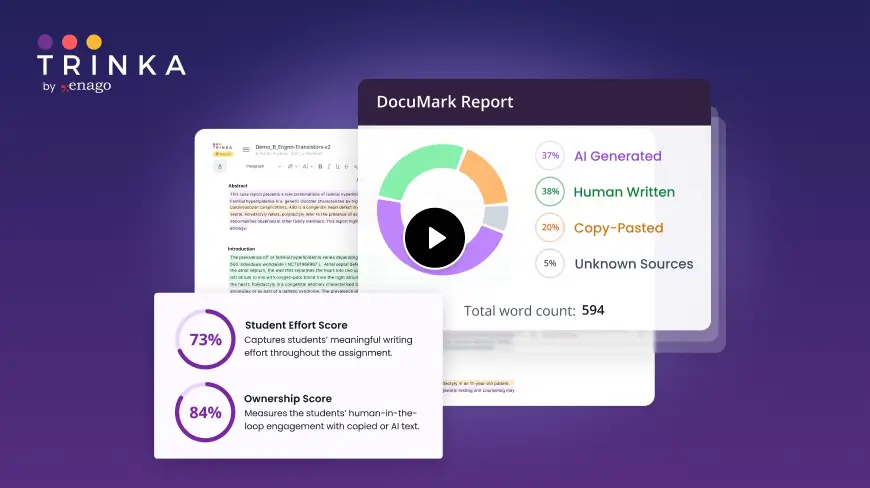
Knowing your institution's AI policy is step one. DocuMark helps enforce it fairly by empowering universities to manage AI-generated content, prevent cheating, and support student writing through responsible AI use.
Common Questions About University of New Hampshire's AI Policies
University of New Hampshire has defined AI policies in 12 of 12 categories, with an overall coverage score of 100%.
UNH requires disclosure of AI writing tool use in research contexts, including specific details about the tool and prompts. For coursework, the sources do not establish a uniform university-wide citation or disclosure rule; instead, expectations are left to instructors and course syllabi. The Faculty Senate report also recommends that faculty clarify and communicate when AI use is not appropriate for certain assignments, classes, or research tasks.
UNH enforces unauthorized AI use through its academic misconduct process rather than through an AI-detection-specific rule in the provided sources. The academic integrity policy defines unauthorized AI use as cheating, and resolution of violations is left to instructor discretion within the misconduct process. The provided sources do not define a university stance on AI detection tools such as Turnitin or GPTZero.
UNH's Faculty Senate report states that AI use must comply with institutional data privacy policies and applicable legal requirements, and it says confidential, sensitive, or personally identifiable information requires protection. The same report calls for harmonizing AI guidance with the USNH AI Standard, the USNH Information Classification Policy, and intellectual property policy, and recommends guidance on secure use. It also references enterprise-licensed AI programs and notes that some AI-based tools are not supported at UNH.