Teaching & Learning
- Access to these pilot services is limited to OU affiliates and may require onboarding through OU Libraries, workshop participation, or submitting a request for access
- OU Libraries describes LibreChat and the AI Sandbox as resources intended for research and learning purposes and as tools to support instruction, workshops, and learning activities
LibreChat is a generative AI tool that allows users to interact with Generative AI Models, including Large Language Models (LLM), for research and learning purposes.
The LibreChat pilot is available only to University of Oklahoma faculty, staff, and students.
Access requires onboarding through OU Libraries or participation in an OU Libraries workshop.
The LibreChat pilot is an experimental service operated by OU Libraries (“the Library”) to:
Gauge the usefulness of generative AI tools for research and learning.
Support workshops, instruction, and learning activities.
The AI Sandbox supports both no-code and API-based platforms, enabling you to learn, experiment with, and integrate AI into your research, teaching, and creative work.
The pilot is currently open to Library AI Workshop attendees, and by request, current OU Faculty, Staff, and Students for research and learning purposes.
Research
- The OU IT AI Resource Center also states that public versions of generative AI tools are not appropriate for OU institutional or sensitive data
- OU Libraries' LibreChat pilot policy prohibits users from submitting or processing protected or sensitive data (including confidential or proprietary research data) and notes that prompts and outputs may be transmitted to third-party large language model providers for processing
Users must:
Not submit or process protected or sensitive data, including but not limited to:
FERPA-protected student information
HIPAA-regulated health information
Social Security Numbers
Confidential or proprietary research data
Data may be transmitted to third-party Large Language Model providers (e.g., AWS Bedrock, NRP) for processing.
Public versions of generative AI tools are not appropriate for OU institutional or sensitive data.
Academic Integrity
- OU's faculty academic integrity guidance states that, at the time of writing, it is OU's understanding that there is no established AI detection software and that available AI detectors have extremely high false positive rates
- The Office of Academic Integrity Programs indicates it can accept cases where improper AI use is a concern, but asks instructors to explain how the work departs from the expected response so that information can be shared with the student
At this point in time, it is our understanding that there is no established Artificial Intelligence (AI) detection software. The available AI detectors have demonstrated extremely high rates of returning false positives (identifying information as AI-generated when that is not the case).
We can certainly accept cases in which the improper use of AI is of concern, but we rely on you to clarify exactly how the assignment in question departs from the expected response so that information can be conveyed to the student when they meet with our office.
Institutional & Administrative
- These statements describe availability and recommended/optional usage, but do not provide broader requirements about how faculty/staff must use AI for course administration beyond the listed tools
- OU IT identifies several AI-related services available to OU faculty and staff, including Microsoft Copilot for Web (recommended within the OU environment), Zoom AI Companion (optional activation by meeting hosts), and Gradescope’s AI-assisted grading features for instructors
Copilot is available for use by OU faculty and staff. It is the recommended way to use generative AI within the OU environment.
Faculty and staff have the option to activate this service for meetings they host on their OU Zoom account. Zoom Meeting Summary is available on a meeting-by-meeting basis if enabled by the meeting organizer.
Gradescope is a feedback and assessment tool that may reduce the time associated with grading exams, homework, and other assignments. AI-assisted Grading allows instructors to automatically group similar answers and grade all the answers in each group at once.
- OU IT states that public versions of generative AI tools are not appropriate for OU institutional or sensitive data and points users to the Acceptable Use Policy for University Data
- OU Libraries’ LibreChat pilot policy requires users to comply with university policies and prohibits submitting or processing protected or sensitive data (including FERPA, HIPAA, SSNs, and confidential/proprietary research data) and notes that data may be transmitted to third-party LLM providers for processing
Public versions of generative AI tools are not appropriate for OU institutional or sensitive data.
View the Acceptable Use Policy for University Data.
Users must:
Comply with all applicable laws, University policies, and University of Oklahoma IT acceptable use standards.
Not submit or process protected or sensitive data, including but not limited to:
FERPA-protected student information
HIPAA-regulated health information
Social Security Numbers
Confidential or proprietary research data
Data may be transmitted to third-party Large Language Model providers (e.g., AWS Bedrock, NRP) for processing.
- OU states it is advancing a comprehensive, university-wide AI strategy and that it developed a unified roadmap through five interdisciplinary working groups, including a "Governance and Policy" working group
- OU also states it created a Chief Artificial Intelligence Officer position to implement AI across education, research, and operations, and identifies an interim Chief AI Officer pending Board of Regents approval
The University of Oklahoma is advancing a comprehensive, university-wide strategy to lead in artificial intelligence (AI) innovation, research, education, and implementation. Under the direction of the former Interim Chief AI Officer and through the coordinated efforts of five interdisciplinary working groups, OU has developed a unified roadmap that aligns emerging AI capabilities with the university’s mission, strategic vision, and societal commitments.
The five working groups are:
5. Governance and Policy
The University of Oklahoma has created a new chief artificial intelligence officer position to implement AI to drive innovation in education, research and operations.
David Ebert, director of OU’s Data Institute for Societal Challenges (DISC) and associate vice president for research and partnerships, has been selected as the interim Chief AI Office, pending OU Board of Regents’ approval.
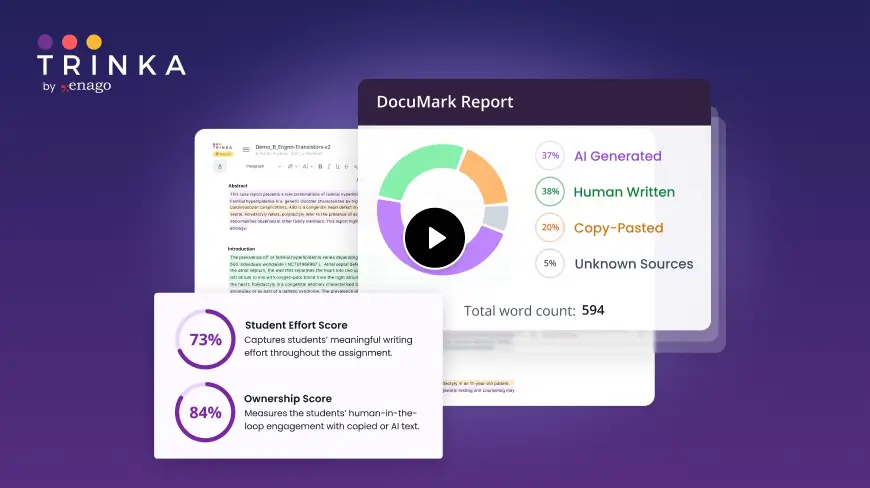
DocuMark: Responsible AI Use for Academic Integrity
Knowing your institution's AI policy is step one. DocuMark helps enforce it fairly by empowering universities to manage AI-generated content, prevent cheating, and support student writing through responsible AI use.
Common Questions About University of Oklahoma's AI Policies
University of Oklahoma has defined AI policies in 6 of 12 categories, with an overall coverage score of 50%.
No explicit disclosure requirement is currently defined in the available policy sources.
OU's faculty academic integrity guidance states that, at the time of writing, it is OU's understanding that there is no established AI detection software and that available AI detectors have extremely high false positive rates. The Office of Academic Integrity Programs indicates it can accept cases where improper AI use is a concern, but asks instructors to explain how the work departs from the expected response so that information can be shared with the student.
OU IT states that public versions of generative AI tools are not appropriate for OU institutional or sensitive data and points users to the Acceptable Use Policy for University Data. OU Libraries’ LibreChat pilot policy requires users to comply with university policies and prohibits submitting or processing protected or sensitive data (including FERPA, HIPAA, SSNs, and confidential/proprietary research data) and notes that data may be transmitted to third-party LLM providers for processing.