Teaching & Learning
- Use of AI in work submitted for assessment is prohibited by default
- It is only permitted when students receive prior written authorization for the specific assessment, and any permitted use must be formally declared in the format required by the assessment setter
Any use of AI in work submitted for assessment is unauthorised unless you are specifically told differently in writing, in advance of the assessment, in instructions from your faculty’s or department for the specific assessment in question.
For each specific assessment you will be given prior written notice of whether or not the use of AI is permitted. You are fully responsible for the accuracy, originality, and quality of work you submit for assessment, and you must follow the rules on AI use for each specific assessment you are taking. You must make a formal declaration of any permitted AI-use in the format prescribed by your assessment setter.
- Oxford applies a university-wide assessment rule that AI use is not allowed unless a specific assessment explicitly authorizes it in writing in advance
- The University also treats unacknowledged AI-generated material in examinations as plagiarism, except where AI use has prior authorization such as a disability-related reasonable adjustment
For each specific assessment you will be given prior written notice of whether or not the use of AI is permitted. You are fully responsible for the accuracy, originality, and quality of work you submit for assessment, and you must follow the rules on AI use for each specific assessment you are taking. You must make a formal declaration of any permitted AI-use in the format prescribed by your assessment setter.
Please note that artificial intelligence (AI) can only be used within assessments where specific prior authorisation has been given, or when technology that uses AI has been agreed as reasonable adjustment for a student’s disability (such as voice recognition software for transcriptions, or spelling and grammar checkers). You should acknowledge your use of AI as part of the assessment submission and use a formal declaration in the format prescribed by the assessment setter.
“Presenting work or ideas from another source as your own, with or without consent of the original author, by incorporating it into your work without full acknowledgement. All published and unpublished material, whether in manuscript, printed or electronic form, is covered under this definition, as is the use of material generated wholly or in part through use of artificial intelligence (save when use of AI for assessment has received prior authorisation e.g. as a reasonable adjustment for a student’s disability). Plagiarism can also include re-using your own work without citation. Under the regulations for examinations, intentional or reckless plagiarism is a disciplinary offence.”
- Appropriate use varies by discipline, and students are told to follow the advice of tutors, supervisors, departments, faculties, and colleges
- Oxford permits students to use generative AI to support learning and study, but expects them to use it responsibly, verify outputs, and discuss outputs with academic staff where needed
The aim of this guidance is to help you use GenAI tools safely and responsibly, so you feel confident about exploring different ways of using this technology to support your learning.
Generative AI tools may be useful in supporting your academic studies, but be sure to discuss AI outputs with academic staff to confirm your understanding and to help verify them against established sources, to ensure their accuracy.
Appropriate use of GenAI tools to support the learning process varies across different academic disciplines. Always follow any advice and guidance of your tutors or supervisors, and of your department or faculty, and/or college, on what is appropriate in your subject area.
- The plagiarism guidance explicitly states that attribution requirements apply to computer code as well as text and data
- Oxford does not set a separate university-wide rule for student programming tasks; coding-related AI use in assessed work follows the same assessment-specific authorization model as other assessment use
For each specific assessment you will be given prior written notice of whether or not the use of AI is permitted. You are fully responsible for the accuracy, originality, and quality of work you submit for assessment, and you must follow the rules on AI use for each specific assessment you are taking. You must make a formal declaration of any permitted AI-use in the format prescribed by your assessment setter.
The necessity to acknowledge others’ work or ideas applies not only to text, but also to other media, such as computer code, illustrations, graphs etc. It applies equally to published text and data drawn from books and journals, and to unpublished text and data, whether from lectures, theses or other students’ essays. You must also attribute text, data, or other resources downloaded from websites.
Research
- Oxford allows some non-substantive use of generative AI in research writing, such as summarising, reducing word count, or improving readability of a researcher’s own writing
- Researchers remain accountable for the content, must validate outputs, should disclose AI use in methods, acknowledgements, or another required section, and substantive original AI-written thesis text is not permitted in MPLS graduate research guidance
Using GenAI to help you with your own written work would often not be considered substantive use, if the use could as easily apply to documents that are not research outputs, eg to construct summaries, to reduce word count, to improve readability or standard of one’s own English or foreign language. However, if use includes incorporating work authored by someone else, care needs to be taken not to infringe copyright (expectation 2).
Users of GenAI tools are accountable for the integrity of the content generated by, or with the support, of these tools, maintaining a critical approach to using the output produced by GenAI and an awareness of the tools’ limitations, such as hallucinations, or social biases that may be embedded in training data, which could perpetuate misrepresentation of social categories, protected groups, or historical inaccuracies.
Users should disclose or discuss in methods or acknowledgements, or an additional section determined by the guidelines or policies of the funder or publisher, the limitations of, and interactions with, the GenAI tools used and mitigation measures, e.g. validating outputs, iterative prompting by systematically refining and adjusting the prompts to improve the quality of outputs.
Substantive original writing by Gen AI, including either verbatim or closely paraphrased use of Gen AI content, for, e.g., chapters, or parts of chapters, including introduction or conclusion chapters or for a literature review, would fall under the definition of plagiarism or be otherwise a failure of research integrity and is therefore not permissible..
- Oxford permits generative AI in research data and analysis only with strong accountability, validation, and documentation requirements
- Researchers must document substantive use in research notebooks, validate outputs, protect personal and confidential data, obtain ethics approval when research processing involves personal data, and MPLS guidance prohibits AI-generated plots or visualisations directly from prompts
To ensure research quality, you should validate GenAI outputs similarly to how you would check other types of outputs in your field, eg work undertaken by other researchers, software code, instrument measurements, to satisfy yourself that the outputs can be trusted (expectation 4).
To establish an audit trail of how GenAI influenced the research process, substantive use of GenAI should be documented in research notebooks or equivalent, in line with good research practice. This would typically involve a complete transcript of the output without any editing, date of production, version of the tool and complete set of documents that were uploaded (not just links to documents) (expectation 4).
When using GenAI involves processing of personal data, you will be required to consult the data protection by design framework ; if this processing is part of undertaking research, you should obtain research ethics approval (OxIntranet).
Information that is commercially sensitive and where the Intellectual Property is unprotected, or is subject to a confidentiality agreement or export control, or personal data, should only be uploaded to a generative AI tool when confidentiality can be guaranteed.
The use of generative AI to produce plots or data visualisations directly from prompts is prohibited. Such tools can obscure the data-generation process, alter or invent data, and prevent verification or reproducibility. To ensure transparency and academic integrity, all plots and data visualisations must be created using approved, auditable methods rather than AI-generated outputs.
The restriction does not apply to the use of Gen AI for refining existing, verifiable plotting codes, where the underlying data and methods remain fully transparent and reproducible. In such cases, the code used should be made available to the examiners without reservation and without exception.
- Oxford requires research use of AI to align with its research AI policy and broader integrity expectations
- When research involves personal data, AI use must be specified in both the funding proposal and the research ethics application, and internal funding applications may use AI only if substantive use is declared; live interview response generation is not permitted in relevant university funding interviews
be aware of rapidly changing practices involving new and evolving technologies in research including large language models/generative AI and machine learning, and to ensure alignment with the Policy for using Generative AI in Research where applicable
When your research involves personal data, the use of GenAI must be specified both in the proposal and research ethics application, to ensure compliance with the University’s research ethics policy .
If you are applying to an internal fund, eg the John Fell Fund or funds run by your division and/or department, you are permitted to use GenAI in developing your application as long as its use is declared in the application. You are only required to declare substantive use (see policy on use of GenAI in research for definition of substantive use).
If you have an application interview at the University either for an internal fund, or as part of a selection process for an external fund that only permits a restricted number of applications from Oxford, you are permitted to use GenAI to prepare for interview, but not for generating responses in a live interview.
Academic Integrity
- Oxford requires acknowledgment and formal declaration of permitted AI use in assessed student work, according to course or assessment requirements
- In research, substantive AI use should be documented and declarations should identify the tool, version, publisher, URL, and context of use; MPLS doctoral guidance also requires a formal thesis declaration describing where and how GenAI was used
You should acknowledge your use of AI as part of the assessment submission and use a formal declaration in the format prescribed by the assessment setter.
You must make a formal declaration of any permitted AI-use in the format prescribed by your assessment setter.
Never present AI work as your own: Any use of AI must be properly acknowledged according to your course requirements. This includes paraphrased content, structural suggestions, and generated examples.
Declarations of use of GenAI should follow the same principles as transparency and openness around text, data, software, and other materials associated with research. As replication is often not possible with cloud-hosted third-party models, which are continuously being updated with new versions, and the inherently probabilistic nature of GenAI tools, declarations should at a minimum include:
* Name and version of the GenAI tool used; eg Microsoft Copilot (version GPT-4); ChatGPT-3.5;
* Publisher (company that made the GenAI tool); eg Microsoft; OpenAI;
* URL of the GenAI system;
* Brief description (single sentence) of context in which the tool was used
The statement must include a formal declaration that any Gen AI use complies with University, divisional and (where applicable) departmental guidance, where and how Gen AI has been used in preparation of the thesis and summarising how specific uses of Gen AI will be referenced in the text (this could simply amount to reference to a scientifically accepted standard in place at the time of submission of the thesis).
- Oxford states that submitted assessment work and open-book exam responses may be screened for matches to sources or other submissions, and such matches may indicate AI use
- Unacknowledged AI-generated material can fall within the university definition of plagiarism, and intentional or reckless plagiarism is a disciplinary offence under examination regulations
Work submitted for assessment and open book exam responses may be screened for matches either to published sources or to other submitted work. Any matches might indicate plagiarism, collusion or use of AI.
The University has the right to use software, and routinely does so, in order to screen submitted work for matches either to published sources or to other submitted work.
“Plagiarism is presenting work or ideas from another source as your own, with or without consent of the original author, by incorporating it into your work without full acknowledgement. All published and unpublished material, whether in manuscript, printed or electronic form, is covered under this definition, as is the use of material generated wholly or in part through use of artificial intelligence (save when use of Al for assessment has received prior authorisation e.g. as a reasonable adjustment for a student’s disability). Plagiarism can also include re-using your own work without citation. Under the regulations for examinations, intentional or reckless plagiarism is a disciplinary offence.”
Institutional & Administrative
- Oxford provides staff-facing guidance, training, and institutional support for using generative AI in teaching, learning, and professional services work
- It states that GenAI can enhance teaching and learning when used with professional judgement, and its research policy also recognizes professional staff use for operational efficiency, document production, and support for funding applicants
All staff and students can access free, ongoing training and support, delivered by in-house specialists from the Digital Capabilities team (see the new 'getting started' courses below), at the AI Competency Centre , the Centre for Teaching and Learning , the Bodleian Libraries , the Oxford Research Software Engineers Group , and by academic communication specialists at the Oxford University Language Centre .
GenAI offers opportunities to enhance teaching and learning in higher education when used with professional judgement. Appropriate use will vary across different academic disciplines and contexts. Read our guide for information on the University-supported tools now available, and how to approach their use.
Professional staff supporting researchers might be interested to use GenAI in order to simplify and improve the operational efficiency of processes, and the speed and quality of analysis; to accelerate the production of documents for different audiences, including summaries; to provide more accurate and targeted guidance to funding applicants.
- Oxford distinguishes between university-supported AI tools and third-party tools, emphasizing use of secure university provision where possible
- Students and researchers are told not to upload confidential, sensitive, unpublished, private, or confidential data into third-party AI tools, and the research policy recommends considering local or university-supported tools first; Oxford also provides institutionally supported access to ChatGPT Edu and support for Copilot and Google tools
Take care when inputting material into any third-party tools that are not provided by the University. These may not meet the University’s standards of information security and data protection. Never upload confidential, sensitive, or unpublished material into third-party AI tools.
Private or confidential data must not be entered into third-party AI tools. Such information may be stored, transmitted, or reused—either in its original or a processed form—for purposes such as training AI systems or for distribution to external parties.
Information that is commercially sensitive and where the Intellectual Property is unprotected, or is subject to a confidentiality agreement or export control, or personal data, should only be uploaded to a generative AI tool when confidentiality can be guaranteed.
In line with expectation 7, you are recommended to first consider the option of running a third-party tool locally or to download a model from a community platform such as Hugging Face . The advantages of running GenAI models locally are that they are less energy-intensive, the data stays within the University and use can be replicated by rebuilding the model, enhancing reproducibility.
If a large cloud-hosted model offers the best fit for purpose, you are strongly recommended to first investigate the suitability of GenAI tools supported by, or offered through, the University via the AI Competency Centre , especially those that protect data used and generated, and offer the ability to collaborate with other users across the University. All staff and students have free access to ChatGPT Edu , governed by an agreement between the University and OpenAI
ChatGPT Edu is available to all current staff and students with a Single Sign-On (SSO) account and University card, for free.
They can help you with ChatGPT Edu, Microsoft Copilot or the GenAI tools in the University's Google workspace (Gemini and NotebookLM).
- Oxford has an institution-level AI rollout, governance structure, and adopted principles for AI use in teaching and assessment
- Its Digital Governance Unit is responsible for GenAI provision for staff and students, this is overseen by an AI Governance Group reporting assurance to the Information and Digital Committee, and the university states it has adopted the Russell Group principles while expanding training and inclusive secure access
To support the rollout of GenAI tools across the University and Oxford Colleges, our AI training programme has been expanded.
By helping students to use and experience generative AI, we are preparing people for life in an AI-enabled world. Oxford was one of the leading contributors to the Russell Group Principles on generative AI and has adopted them for AI in teaching and assessment.
The University’s Digital Governance Unit (the DGU) is responsible for the governance of GenAI provision for staff and students. This is overseen by an AI Governance Group which brings together representatives from across the University and Oxford Colleges and provides assurance to the Information and Digital Committee (IDC), a committee of the University Council. The AI Governance Group is chaired by Professor Stuart Lee, Deputy Chief Digital & Information Officer and Director of the DGU.
Find out more about AI Governance (staff/student SSO login required).
Read our guiding principles for acceptable use of GenAI tools and agents (staff/student SSO login required).
DocuMark: Responsible AI Use for Academic Integrity
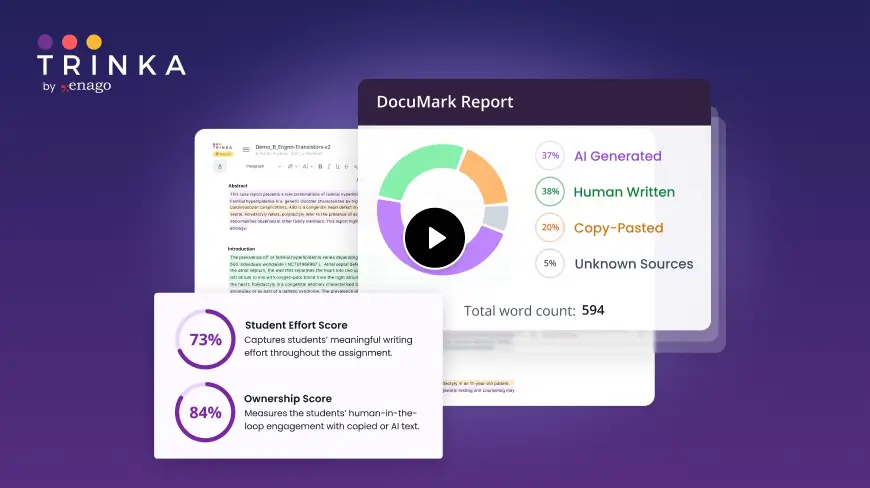
Knowing your institution's AI policy is step one. DocuMark helps enforce it fairly by empowering universities to manage AI-generated content, prevent cheating, and support student writing through responsible AI use.
Common Questions About University of Oxford's AI Policies
University of Oxford has defined AI policies in 12 of 12 categories, with an overall coverage score of 100%.
Oxford requires acknowledgment and formal declaration of permitted AI use in assessed student work, according to course or assessment requirements. In research, substantive AI use should be documented and declarations should identify the tool, version, publisher, URL, and context of use; MPLS doctoral guidance also requires a formal thesis declaration describing where and how GenAI was used.
Oxford states that submitted assessment work and open-book exam responses may be screened for matches to sources or other submissions, and such matches may indicate AI use. Unacknowledged AI-generated material can fall within the university definition of plagiarism, and intentional or reckless plagiarism is a disciplinary offence under examination regulations.
Oxford distinguishes between university-supported AI tools and third-party tools, emphasizing use of secure university provision where possible. Students and researchers are told not to upload confidential, sensitive, unpublished, private, or confidential data into third-party AI tools, and the research policy recommends considering local or university-supported tools first; Oxford also provides institutionally supported access to ChatGPT Edu and support for Copilot and Google tools.