Teaching & Learning
- Penn’s guidance indicates that AI use in coursework depends on course/instructor rules, and that students must not use unauthorized assistance
- In the absence of course-specific guidance, Penn advises treating AI assistance like assistance from another person (i.e., if it would be unacceptable for a person to substantially complete the task, it is also unacceptable for AI to do so)
"Individual courses may have different or more narrow guidance on the use of AI that should be adhered to within the context of that course."
"In the absence of other guidance, treat the use of AI as you would treat assistance from another person. For example, this means if it is unacceptable to have another person substantially complete a task like writing an essay, it is also unacceptable to have AI to complete the task."
"It is Penn’s policy that each instructor is responsible for setting their own guidelines."
"Under Penn’s Code of Academic Integrity, students may not use unauthorized assistance in their academic work. It is up to you to decide what that means and communicate that definition to students."
- Penn’s central AI guidance does not set a uniform exam rule, and indicates expectations may vary by class and instructor
- Penn’s Code of Academic Integrity prohibits cheating, defined as using unauthorized assistance in examinations or other academic work
"As expectations may vary between classes and instructors, it is important for instructors to provide students with clear guidelines similar to the guidelines on collaboration, on the use of AI within coursework, and when and how the use of AI within a course should be cited."
"Cheating: using or attempting to use unauthorized assistance, material, or study aids in examinations or other academic work or preventing, or attempting to prevent, another from using authorized assistance, material, or study aids."
- Penn also provides general guidance that users are accountable for validating AI outputs and should be wary of misinformation or “hallucinations.”
- Penn does not define a single university-wide rule permitting or prohibiting AI for study help, and instead emphasizes course/instructor-defined expectations for student use
"As expectations may vary between classes and instructors, it is important for instructors to provide students with clear guidelines similar to the guidelines on collaboration, on the use of AI within coursework, and when and how the use of AI within a course should be cited."
"The user of AI should endeavor to validate the accuracy of created content with trusted first party sources and monitor the reliability of that content. Users are accountable for their use of content created by AI and should be wary of misinformation or “hallucinations” by AI tools (e.g., citations to publications or source materials that do not exist or references that otherwise distort the truth)."
- Penn’s general AI guidance recognizes that generative AI can create code, and notes security risks when using AI to write computer code
- Penn also indicates that course-level guidance may be narrower and should be followed, and that in the absence of other guidance AI assistance should be treated like assistance from another person
"Generative AI describes algorithms, such as ChatGPT and other large language models, that can be used to create new content, including text, code, and simulations."
"When using AI to write computer code or when creating new technology that leverages AI it is important to be aware of the new kinds of cyberattacks that are being used against AI users."
"Individual courses may have different or more narrow guidance on the use of AI that should be adhered to within the context of that course."
"In the absence of other guidance, treat the use of AI as you would treat assistance from another person. For example, this means if it is unacceptable to have another person substantially complete a task like writing an essay, it is also unacceptable to have AI to complete the task."
Research
- Penn also references Grammarly as a writing-centric tool with AI-assisted outlining, citation, and revision, and provides data-protection constraints tied to Penn’s data risk levels when using enterprise AI tools
- Penn provides general community guidance to be transparent about AI use and to disclose when a work product was created wholly or partially using an AI tool, but does not define research-manuscript-specific rules in the provided sources
"Be transparent about the use of AI. Disclose when a work product was created wholly or partially using an AI tool and, if appropriate, how AI was used to create the work product."
"Grammarly"
"Writing-centric tool that provides writing assistance, expanding beyond grammar and spell-check with options including AI-assisted outlining, citation, and revision."
- Penn’s data classification includes unpublished research data as Moderate risk (at the data owner’s discretion), subject to any IRB restrictions
- Penn’s general AI guidance focuses on protecting Penn data and indicates users should not input moderate or high-risk Penn data into AI tools without specified protections (including contracts and review/consultation when moderate/high-risk data is involved)
"For this reason, users of AI should avoid sharing personal or sensitive data with the tool and should not input moderate or high-risk Penn data as defined by the Penn Data Risk Classification, or intellectual property, without:"
"A contract in place to protect Penn data;"
"Review by Penn’s Privacy Office and consultation with the Office of Information Security as coordinated by Procurement when moderate or high-risk data is involved."
"Unpublished research data (at data owner's discretion), subject to any IRB restrictions"
- The provided sources do not define specific rules for AI-generated content in grant proposals, IRB applications, or research ethics declarations beyond these general statements and data/privacy restrictions
- Penn’s general AI guidance states that use of AI should align with Penn’s Principles of Responsible Conduct, and emphasizes accountability for AI outputs (including the need to validate accuracy and beware of hallucinations)
"Use of AI should always be in alignment with Penn’s Principles of Responsible Conduct."
"The user of AI should endeavor to validate the accuracy of created content with trusted first party sources and monitor the reliability of that content. Users are accountable for their use of content created by AI and should be wary of misinformation or “hallucinations” by AI tools (e.g., citations to publications or source materials that do not exist or references that otherwise distort the truth)."
Academic Integrity
- Penn’s general AI guidance calls for transparency and disclosure when AI is used to create a work product
- Penn also notes that instructors should provide guidance on when and how AI use should be cited, and that educators may have requirements for citing and attributing AI-created content to the tool and parameters used
"Be transparent about the use of AI. Disclose when a work product was created wholly or partially using an AI tool and, if appropriate, how AI was used to create the work product."
"As expectations may vary between classes and instructors, it is important for instructors to provide students with clear guidelines similar to the guidelines on collaboration, on the use of AI within coursework, and when and how the use of AI within a course should be cited."
"Educators may have requirements and guidance for citing the use of generative AI output and for attributing AI created content to the specific AI tool and parameters used."
- CSA’s disciplinary data lists “Misuse of Artificial Intelligence” as an allegation type (new as of July 1, 2025)
- Penn’s AI guidance for educators indicates instructors should disclose to students when AI detection software will be used in a course
- Penn’s syllabus policy examples include a statement that failure to disclose generative AI use (and use of AI-produced material) will be considered violations of the University’s Policy on Academic Integrity and will be referred to the Center for Community Standards and Accountability (CSA) for adjudication
"Disclose to students when course materials have been created with the use of AI and when AI detection software will be used in the course."
"The use of material produced by generative AI or the failure to disclose such use will be considered violations of the University’s Policy on Academic Integrity and will be referred to the Center for Community Standards and Accountability (CSA) for adjudication."
"Misuse of Artificial Intelligence* 1 15"
"*New allegation type as of July 1, 2025"
Institutional & Administrative
- Penn also advises that for University business processes, oversight/review and verification of AI outputs should be in place to ensure reliability, consistency, and accuracy
- Penn’s AI guidance for educators includes expectations about instructor communication to students, including disclosing when course materials have been created with AI and when AI detection software will be used
"Disclose to students when course materials have been created with the use of AI and when AI detection software will be used in the course."
"While automating tasks using AI may improve operational efficiency for University Business processes, oversight and review of the use of AI and verification of its outputs for these University business processes should be in place to ensure reliability, consistency, and accuracy."
- Penn states HIPAA/patient or research participant data may not be shared with open or public AI tools like ChatGPT absent institutional approval
- Penn’s AI guidance instructs users to avoid sharing personal or sensitive data with AI tools and not to input moderate or high-risk Penn data without specific protections (including contracts and review/consultation for moderate/high-risk data)
- Penn also publishes enterprise AI tools and associated allowed data categories, including requirements that users be logged into a University account (not personal accounts) for protections, and tool-specific allowances by Penn Data Risk Classification
"For this reason, users of AI should avoid sharing personal or sensitive data with the tool and should not input moderate or high-risk Penn data as defined by the Penn Data Risk Classification, or intellectual property, without:"
"A contract in place to protect Penn data;"
"Review by Penn’s Privacy Office and consultation with the Office of Information Security as coordinated by Procurement when moderate or high-risk data is involved."
"It is not permissible under the Health Information Portability & Accountability Act (HIPAA) or Penn Medicine policy to share patient or research participant information in connection with open or public AI tools and services, such as ChatGPT."
"Therefore, individual patient data and patient data sets (even if deidentified) may not be exposed to open or public AI tools or services, absent institutional approval."
"For all of these tools, users must be logged into a University account for appropriate protections. Personal accounts on these services are not protected."
"Copilot Chat is self-service and available at this site. Low, Moderate, and most High Risk Data, except SSNs and credit card data."
"ChatGPT Edu"
"Low and Moderate Risk Data. Do not input sensitive data including HIPAA data, personal health information (PHI), financial account information, SSNs, and credit card data."
- Penn also notes that enterprise AI tool agreements were reviewed by representatives from Penn ISC, Procurement Services, and Privacy
- Penn’s Office of Information Security states that Penn embraces generative AI innovations across teaching, learning, research, and stewardship, and characterizes its AI guidance as not final policy and expected to be updated regularly as the field evolves
"Penn embraces innovations like generative artificial intelligence (“AI”) models in teaching, learning, research, and the effective stewardship of Penn’s resources."
"This statement is not intended as legal advice or an exhaustive set of best practices and should not be viewed as a final policy."
"It is anticipated that this document will be updated regularly and interact with other sources of policy, ethics, and governing legal authority."
"The agreements were reviewed by representatives from Penn ISC, Procurement Services, and Privacy, which review third-party AI technologies accessing personal data."
DocuMark: Responsible AI Use for Academic Integrity
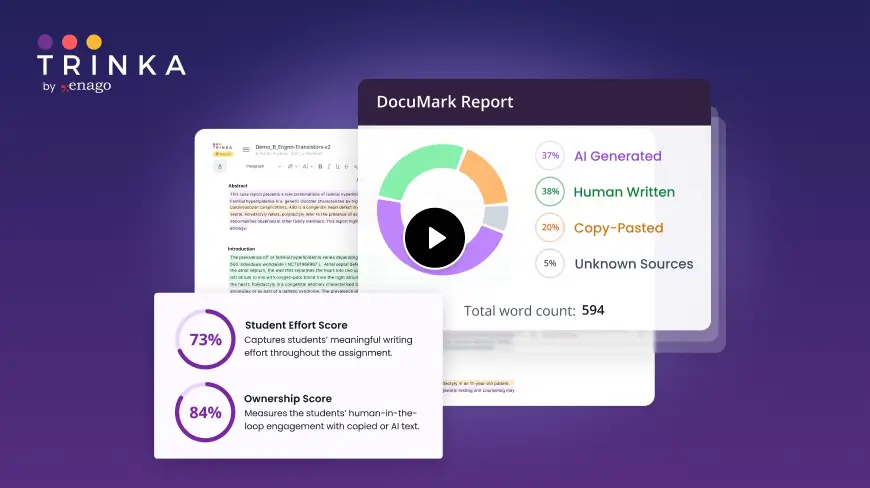
Knowing your institution's AI policy is step one. DocuMark helps enforce it fairly by empowering universities to manage AI-generated content, prevent cheating, and support student writing through responsible AI use.
Common Questions About University of Pennsylvania's AI Policies
University of Pennsylvania has defined AI policies in 12 of 12 categories, with an overall coverage score of 100%.
Penn’s general AI guidance calls for transparency and disclosure when AI is used to create a work product. Penn also notes that instructors should provide guidance on when and how AI use should be cited, and that educators may have requirements for citing and attributing AI-created content to the tool and parameters used.
Penn’s AI guidance for educators indicates instructors should disclose to students when AI detection software will be used in a course. Penn’s syllabus policy examples include a statement that failure to disclose generative AI use (and use of AI-produced material) will be considered violations of the University’s Policy on Academic Integrity and will be referred to the Center for Community Standards and Accountability (CSA) for adjudication. CSA’s disciplinary data lists “Misuse of Artificial Intelligence” as an allegation type (new as of July 1, 2025).
Penn’s AI guidance instructs users to avoid sharing personal or sensitive data with AI tools and not to input moderate or high-risk Penn data without specific protections (including contracts and review/consultation for moderate/high-risk data). Penn states HIPAA/patient or research participant data may not be shared with open or public AI tools like ChatGPT absent institutional approval. Penn also publishes enterprise AI tools and associated allowed data categories, including requirements that users be logged into a University account (not personal accounts) for protections, and tool-specific allowances by Penn Data Risk Classification.