Teaching & Learning
- AI use in coursework is permitted only within the limits set by the assessment design and brief
- For asynchronous coursework, AI acknowledgement is required and the requirement must be stated in coursework briefs
- Students must not use AI to write or complete assignments for them, and they must be able to demonstrate authorship, understanding, and mastery of submitted work
You must not AI if you have been told not to do so in the assessment brief. You must not use AI to write or complete your assignments for you. Claiming AI-generated work to be your own is academic misconduct. The principle is simple: you must be able to show mastery of what you submit. Your tutors may ask you to discuss your work in person to assess your understanding of what you submitted.
Our summative assessments should provide credible evidence that each student has achieved learning outcomes, authored their own work, and can demonstrate mastery of the work they submitted
This AI acknowledgement should be part of every asynchronous assessment submission (anything that students produce in their own time). This does not require a change to the Module Descriptor (it is not an assessment artefact), but this requirement must be clearly stated in all coursework briefs.
- The university does not set a blanket permission for AI in all assessments; instead, assessment types are to be designed either to embrace AI or to exclude it where appropriate
- In examinations and other formal assessments, cheating includes possession of unauthorised technology, and in-person assessments are permitted in line with the university's exam position
By the end of the 2027-28 academic year:
1. All colleagues are proficient in a range of AI tools and their pedagogical uses;
2. All assessments are of types that either embrace AI as a legitimate and ethical tool that contributes to learning, or exclude the use of AI, where appropriate, in line with Table 1;
Track B (in-person only): permitted where aligned with the University’s position on exams.
* Cheating in examinations (or other formal assessments), including possession of unauthorised material or technology during an examination, and attempting to access unseen assessment materials in advance of an examination;
- AI is permitted for personal learning support and study assistance
- The university explicitly encourages uses such as brainstorming, concept clarification, examples, and draft feedback, but requires students to apply their own judgement and retain ownership and full understanding of their work
AI can be a great study partner if used wisely. You might use it to:
* Generate ideas or brainstorm topics
* Clarify difficult concepts
* Check grammar or structure
* Explore examples or case studies
* Get feedback on drafts, with your own judgement applied. You may use this feedback to inform and enhance your work. Critically, the work must remain yours, and you should be able to demonstrate full understanding and ownership of what you submit.
Remember: AI should help you learn, not learn for you. Use it responsibly, stay curious, and keep your learning authentic.
Research
- Submitted work must include proper citation and clear indication of where AI was used
- The university permits AI to assist research-related idea generation, planning, and output, but any use in submitted work must follow academic integrity rules
1.1.12. Artificial Intelligence: The University permits the use of AI as a tool to assist and inform research and generation of ideas, planning and output. The use of AI in submitted work must adhere to principles of academic integrity, with proper citation and clear indication of where AI has been utilised. Failure to do so will be considered for academic misconduct action. Guidance can be found in the University’s use of AI statement document.
- General staff guidance prohibits uploading personally identifiable or sensitive data into generative AI tools and requires data to be kept out of the public domain
- AI use for data analysis is explicitly anticipated in assessment declarations, but the university does not provide a research-specific AI policy for research data collection, analysis, synthetic data, or result interpretation in the provided sources
* Data analysis – using AI to analyse data sets or interpret results.
Maintain data privacy: do not upload personally identifiable information or sensitive data (eg: financial or confidential) into generative AI tools.
Keep data secure: when using generative AI tools for work, ensure that university business information and data are not placed into the public domain. For example, Copilot is a tool that will not allow data to move outside of UoP infrastructure.
- The provided sources do not set AI-specific rules for grant proposals or IRB/ethics applications
- The university's research integrity framework applies to staff, research students, and others conducting research under the university's auspices
- It requires reporting and investigation of research misconduct, and treats breaches of legal, ethical, and professional research requirements, including proceeding without ethics review, as misconduct
This Policy provides a framework for professional practice and decision-making on ethical issues as they arise in the work of the University within research, innovation, learning and teaching. It also relates to how the University handles research misconduct.
Staff, research students and all others conducting research under the auspices of the University (e.g. University owned spinouts, industrial partners using University facilities etc.) are required to report misconduct in research where they have good reason to believe it is occurring. The University will investigate allegations or complaints about misconduct in research.
• Breaching legal, ethical and professional requirements needed for research, for example those needed for human research participants, animals, or human organs or tissue used in research, or for the protection of the environment. An example of this includes proceeding with research without ethics review or not obtaining informed consent.
• Proceeding with research without necessary permissions and approvals in place.
Academic Integrity
- Disclosure of AI use is required for asynchronous assessment submissions through the Moodle acknowledgement process
- The university distinguishes acknowledgement from referencing for student assessment submissions, while the academic misconduct policy also requires proper citation and clear indication of AI use in submitted work
Students must acknowledge, not reference, AI use in submissions.
An acknowledgement on AI use is required with each asynchronous assessment submission.
You must acknowledge whenever you use AI to help with an assessment that you complete in your own time. Each summative assessment dropbox in Moodle will allow you to acknowledge if and how you have used AI to help with your assessment.
The dropbox in Moodle allows students to declare whether generative AI was used and how. Declarations are recorded in Moodle and linked to the submission, so staff can report on AI use and selected categories. Students must select the relevant option before submitting. Submissions are not blocked if it is skipped, but no declaration will be recorded and this can be reported.
1.1.12. Artificial Intelligence: The University permits the use of AI as a tool to assist and inform research and generation of ideas, planning and output. The use of AI in submitted work must adhere to principles of academic integrity, with proper citation and clear indication of where AI has been utilised.
- Tutors may also ask students to discuss their work in person to assess understanding
- The university prohibits staff from using AI detection tools because they are considered unreliable and misleading
- Undisclosed or improperly disclosed AI use may lead to academic misconduct action, and improper use of generative AI is explicitly listed as academic misconduct
AI detection tools must not be used, as they are currently unreliable and often misleading.
1.1.12. Artificial Intelligence: The University permits the use of AI as a tool to assist and inform research and generation of ideas, planning and output. The use of AI in submitted work must adhere to principles of academic integrity, with proper citation and clear indication of where AI has been utilised. Failure to do so will be considered for academic misconduct action.
* Improper use of generative AI
Your tutors may ask you to discuss your work in person to assess your understanding of what you submitted.
Institutional & Administrative
- Staff are encouraged to learn and use AI, but with clear limits
- AI must not currently be used to upload student work, for marking and feedback, or for critical decisions such as recruitment, promotion, or disciplinary action
- Staff may use AI for personal productivity and idea generation, and are encouraged to experiment with the university's secure Copilot tool, while maintaining disclosure, fact-checking, human judgement, and oversight
This guidance sets out the University of Portsmouth’s position on generative AI in learning, teaching and assessment. It encourages staff to educate themselves about and embrace AI rather than attempt to police or ban its use.
AI tools must not currently be used to upload student work.
AI detection tools must not be used, as they are currently unreliable and often misleading.
AI tools must not currently be used for the purposes of marking and feedback.
Staff can use AI for personal productivity, idea generation, etc., but not with identifiable student data.6
Be transparent: maintain professional integrity by disclosing when content is AI-generated.
Check facts: even with the best prompt, AI can make mistakes; verify AI-generated content and linked sources, ensuring it reflects reality and avoids ‘hallucination’.
Evaluate language and tone: ensure responses are free from language or assumption that could marginalise any group and use individual judgement to review appropriateness for work.
Avoid AI for critical decision-making: AI should not be used for making decisions that significantly impact people, such as recruitment, promotion, or disciplinary action.
Maintain IP oversight: ensure human oversight and refinement of AI produced content to track and verify source provenance and meet copyright requirements
AI is here to help. Used well, it saves time, cuts down on mundane work, and allows staff to focus on what really matters. The key is getting used to using it and learning how to use it most effectively and ethically. This step-by-step journey starts with experimentation, so staff are encouraged to try it out using our secure, Microsoft AI tool, Copilot.
- For staff, identifiable student data must not be used with AI tools
- The university identifies Copilot as a secure Microsoft AI tool and states that it does not allow data to move outside UoP infrastructure
- The university prohibits entering personally identifiable and sensitive data into generative AI tools and requires university business information to be kept out of the public domain
Maintain data privacy: do not upload personally identifiable information or sensitive data (eg: financial or confidential) into generative AI tools.
Keep data secure: when using generative AI tools for work, ensure that university business information and data are not placed into the public domain. For example, Copilot is a tool that will not allow data to move outside of UoP infrastructure.
Staff can use AI for personal productivity, idea generation, etc., but not with identifiable student data.6
This step-by-step journey starts with experimentation, so staff are encouraged to try it out using our secure, Microsoft AI tool, Copilot.
- Its staff AI guidance also says the university will establish clear guidelines and training to ensure transparency, fairness, and accountability, and will select technology and companies with responsible environmental policies
- The university has an institutional AI direction for learning and teaching that emphasizes embracing AI, integrating it transparently and ethically, and building staff and student capability by the end of the 2027-28 academic year
Statement of intent
By the end of the 2027-28 academic year:
1. All colleagues are proficient in a range of AI tools and their pedagogical uses;
2. All assessments are of types that either embrace AI as a legitimate and ethical tool that contributes to learning, or exclude the use of AI, where appropriate, in line with Table 1;
3. Students are confident in their use of AI;
4. The University has an academic conduct environment that supports student development and understanding of the use of AI tools.
Core principles:
1. Educate and embrace AI use – don’t police or ban it
2. AI should enhance, not replace academic practices or roles
3. Focus on learning and authenticity, not detection or suspicion
4. (Co-)design assessments to integrate AI transparently and ethically
UoP is committed to sustainable practices and will select technology and companies with responsible environmental policies and will establish clear guidelines and training relating to standards and practices in the use of AI, to ensure transparency, fairness, and accountability.
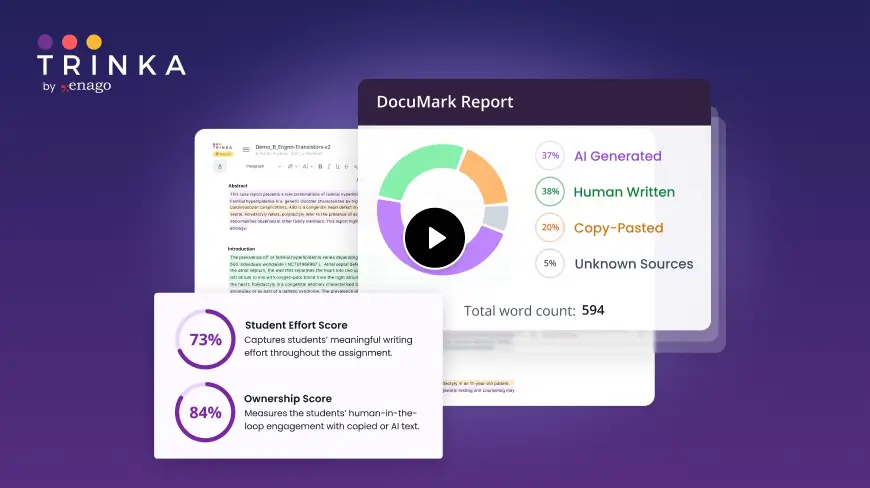
DocuMark: Responsible AI Use for Academic Integrity
Knowing your institution's AI policy is step one. DocuMark helps enforce it fairly by empowering universities to manage AI-generated content, prevent cheating, and support student writing through responsible AI use.
Common Questions About University of Portsmouth's AI Policies
University of Portsmouth has defined AI policies in 11 of 12 categories, with an overall coverage score of 92%.
Disclosure of AI use is required for asynchronous assessment submissions through the Moodle acknowledgement process. The university distinguishes acknowledgement from referencing for student assessment submissions, while the academic misconduct policy also requires proper citation and clear indication of AI use in submitted work.
The university prohibits staff from using AI detection tools because they are considered unreliable and misleading. Undisclosed or improperly disclosed AI use may lead to academic misconduct action, and improper use of generative AI is explicitly listed as academic misconduct. Tutors may also ask students to discuss their work in person to assess understanding.
The university prohibits entering personally identifiable and sensitive data into generative AI tools and requires university business information to be kept out of the public domain. For staff, identifiable student data must not be used with AI tools. The university identifies Copilot as a secure Microsoft AI tool and states that it does not allow data to move outside UoP infrastructure.