Teaching & Learning
- Coursework AI use is primarily at instructor discretion and should be specified per assignment or course
- The academic honesty policy explicitly lists use of AI-generated material that is not allowed by the instructor as an academic honesty violation
- Students are told to assume GenAI is not allowed for an assignment unless the instructor explicitly permits it, and using GenAI to complete assignments without explicit permission is identified as cheating/academic misconduct
Instructors should use course learning outcomes to determine when students must, may, or cannot use GenAI.
Instructors should create and communicate student GenAI course policies. For each assignment, the policy should state when students must, may, or cannot use GenAI and how they should verify, disclose, document, and attribute any GenAI use.
If an instructor has not explicitly stated that GenAI is allowed for an assignment, assume it isn’t.
Unauthorized GenAI use may be considered academic misconduct, similar to plagiarism or other unauthorized assistance.
Cheating: Don’t use GenAI to complete assignments unless you have explicit permission.
Usage of material generated by AI tools (Grammarly, ChatGPT, DALL-E, translation software, or similar) that is not allowed by the instructor.
- The university’s academic honesty policy prohibits using unauthorized technology during an examination, which would apply to AI tools when not authorized
- The generative AI education guidance does not give exam-specific rules, but it frames GenAI use as governed by instructor policies and applicable academic integrity standards
Using unauthorized technology during an examination.
Instructors should use course learning outcomes to determine when students must, may, or cannot use GenAI.
All GenAI use must align with the applicable academic integrity standards [9] [10] [11].
- The guidance emphasizes using GenAI to enhance—not replace—learning and cautions against overreliance
- Students are encouraged to use GenAI to support learning (e.g., as a “personal tutor” and for study guides), but they are told to critically evaluate outputs and double-check accuracy
Potential uses for students include using GenAI as a personal tutor, summarizing information, generating ideas, drafting documents, and self-testing for understanding [3] [4] [5] [6].
Use GenAI to Support Learning
GenAI can be a valuable tool, but remember that university studies are about building students’ own skills and knowledge.
Students should use GenAI to enhance—not replace—their learning.
GenAI can make mistakes or introduce biases. Students should always double-check GenAI-generated information for accuracy before using it in their work. For instance, if they ask GenAI to create a study guide, they should cross-reference its answers with their course materials or ask a teaching assistant or instructor to be sure it is accurate.
- For coding and programming work, AI use is governed by instructor permission and the academic honesty policy
- The GenAI education guidelines direct instructors to specify when students must/may/cannot use GenAI for each assignment
- The academic honesty policy treats using AI-generated material that is not allowed by the instructor as a violation and includes computer programs/coding among example work types where copying/submission issues can arise
Instructors should create and communicate student GenAI course policies. For each assignment, the policy should state when students must, may, or cannot use GenAI and how they should verify, disclose, document, and attribute any GenAI use.
Usage of material generated by AI tools (Grammarly, ChatGPT, DALL-E, translation software, or similar) that is not allowed by the instructor.
Submission of work such as laboratory reports, computer programs or coding, journals, reflections, or other types of papers, which have been copied from work done by other students, either in whole or in part, with or without these students’ knowledge or consent.
Research
- In research dissemination (including reporting and publishing), the university’s research guidance states GenAI use should be disclosed/identified consistent with disciplinary and publishing norms
- It also states that where final work contains more than de minimis AI-generated content (as defined by the field), the nature and use of GenAI should be disclosed and the human- vs AI-created parts should be distinguished and described
Consistent with disciplinary and publishing norms, the use of GenAI should be disclosed/identified at the time of proposing, reporting, publishing or when engaging in other dissemination activities.
While the norms around authorship are evolving, if the final work contains more than de minimis AI-generated content as defined by your field, the nature and use of GenAI should be disclosed, and the parts of the work created by the author and by the GenAI should be distinguished and described.
- In the education guidance (teaching/learning context), the university also explicitly warns against using GenAI for data falsification (generating or altering data to misrepresent findings)
- The research guidance emphasizes verification obligations when using GenAI, including a duty to verify outputs to avoid introducing inaccuracies or biases, and states that interpretation remains an act of authorship with the researcher responsible for integrity
Researchers have a duty to verify the output of GenAI systems to ensure that they have not introduced inaccuracies or biases into the research process.
Interpretation is an act of authorship: consider your discipline’s standards when GenAI is used to develop interpretations, and be aware that you are responsible for the integrity of the interpretation (e.g., how theory connects to the data, limitations for discussion, etc.).
Data Falsification: Don’t use GenAI to generate or alter data in ways that misrepresent your findings.
- The university’s research advisory notes NSF’s prohibition for reviewers uploading proposal/review content to non-approved GenAI tools
- It also states GenAI use should be disclosed at proposing/reporting/publishing, and references adherence to existing policies when reporting such use
- The university’s research guidance frames responsible GenAI use in research around three duties: data protection, verification, and transparency, and states researchers should follow external-entity policies (e.g., funders, publishers) regarding GenAI
Three key duties of data protection, verification, and transparency frame appropriate use of GenAI in research.
Beyond the short list above, researchers may also be obligated to follow the policies of external entities regarding GenAI, including funding agencies, publishers, suppliers, or other institutions where collaborating researchers reside.
Consistent with disciplinary and publishing norms, the use of GenAI should be disclosed/identified at the time of proposing, reporting, publishing or when engaging in other dissemination activities. In reporting such use, the following existing policies should be adhered to:
More recently (December, 2023), NSF issued a very similar Policy Memo to its extramural research community, indicating that “NSF reviewers are prohibited from uploading any content from proposals, review information and related records to non-approved generative AI tools”.
Academic Integrity
- The academic honesty policy requires credit to “source technologies” like DALL-E/ChatGPT and requires verbatim quotes be clearly identified within the text
- The university states that people should disclose when work has been created in whole or part with GenAI tools, and that course-level GenAI policies should specify how students must disclose, document, and attribute use
- Research guidance also requires disclosure/identification of GenAI use in proposing/reporting/publishing, and for more than de minimis AI-generated content the AI-created and author-created parts should be distinguished and described
Transparency: Faculty, staff, peer educators, and students should disclose when their work has been created, whole or in part, with a GenAI tool. Disclosures should specify how GenAI was used and, when appropriate, reflect on potential biases.
Instructors should create and communicate student GenAI course policies. For each assignment, the policy should state when students must, may, or cannot use GenAI and how they should verify, disclose, document, and attribute any GenAI use.
Credit to source material or source technologies (DALL-E, ChatGPT, or similar) must be given regardless of whether the idea, phrase or other material is quoted directly, or whether a student subsequently paraphrases or summarizes into their own words. In addition to any and all other citation information required (e.g., page numbers), verbatim quotes must always be clearly identified as such within the text.
Consistent with disciplinary and publishing norms, the use of GenAI should be disclosed/identified at the time of proposing, reporting, publishing or when engaging in other dissemination activities.
While the norms around authorship are evolving, if the final work contains more than de minimis AI-generated content as defined by your field, the nature and use of GenAI should be disclosed, and the parts of the work created by the author and by the GenAI should be distinguished and described.
- It also states unauthorized GenAI use may be considered academic misconduct
- The academic honesty policy defines academic dishonesty categories and includes use of AI-generated material not allowed by the instructor as an example of plagiarism-related misconduct
- The GenAI education guidance cautions instructors against relying on GenAI detection tools, describing them as unreliable and advising they not be used as the sole basis for an academic honesty violation; if used, instructors should disclose to students when/how they will be used
GenAI detection tools are unreliable, biased, easily defeated, and unable to provide definitive evidence of academic honesty policy violations. If instructors use GenAI detection tools in a course, they should disclose to students when and how the software will be used. Instructors should avoid using GenAI detection software as the sole basis for an academic honesty policy violation; instead, they should use it to converse with the student and conduct further investigation as needed.
Unauthorized GenAI use may be considered academic misconduct, similar to plagiarism or other unauthorized assistance.
Usage of material generated by AI tools (Grammarly, ChatGPT, DALL-E, translation software, or similar) that is not allowed by the instructor.
Institutional & Administrative
- For peer educator roles, students should seek instructor guidance and should assume GenAI use in those roles is not permitted unless the instructor says otherwise
- The guidance states instructors and course staff should maintain human oversight in grading and feedback and that instructors should not delegate core course responsibilities to GenAI
- Instructors using GenAI for teaching materials are advised to disclose and document use, and they are responsible for materials created, including reviewing for accuracy and bias and revising as needed before use
When instructors use GenAI tools to develop teaching materials, they should disclose and document their GenAI use to model professionalism, transparency, and academic honesty within the classroom. Instructors are responsible and accountable for all materials created. As such, they should thoroughly review all materials for accuracy and bias and revise as necessary before use with students and course staff.
Instructors and course staff should maintain oversight of grading and feedback for student work. Grading and feedback are core teaching responsibilities that require human oversight.
Instructors should refrain from delegating core course responsibilities to GenAI.
If students are working as teaching assistants or in other peer educator roles, they should talk to the instructor about expectations for using GenAI. They should ask about GenAI’s role in their duties, such as grading, feedback, or instruction. Unless the instructor says otherwise, assume that using GenAI in these roles is not permitted.
- The provost’s institutional data security message encourages use of a secure university GenAI chatbot (chat.rochester.edu) designed to handle medium- and high-risk institutional data
- The data security classification policy states high-risk information must be protected and limits disclosure to third-party agents/vendors unless they assume a legally binding obligation to safeguard it
- The university advises that confidential/sensitive university information should not be uploaded to public GenAI tools unless there is a university agreement with the vendor approved by AI governance groups, and it instructs users not to upload confidential/proprietary information or PHI/PII/personal data (in the MarCom guidance)
Users should not upload to public GenAI platforms confidential and/or proprietary information, including moderate or high-risk data from the University of Rochester.
Non-public or sensitive University information should never be uploaded into public GenAI tools—whether free or paid—unless there is a university agreement with the vendor approved by one of the various AI governance groups.
I encourage you to take advantage of our secure version of a generative AI chatbot, designed to securely handle medium- and high-risk institutional data. Accessible at chat.rochester.edu, this advanced AI tool is exclusively for our faculty, staff, and students, providing a reliable and secure platform for managing a variety of inquiries and tasks.
Never enter…
Confidential, proprietary, or competitive information
PHI, PII, patient, or personal data
High Risk information must be protected even if the data are allowed to be shared outside the University. Disclosure of High Risk Information to a third party agent or vendor is permitted only if the agent or vendor assumes a legally binding obligation to safeguard the use and disclosure of the information (unless applicable law or regulation expressly allows for the disclosure without such a safeguard).
- University IT lists an “AI Governance Council” with the Provost as Chair and the University CIO as Co-Chair
- It also references “various AI governance groups” in relation to approving vendor agreements for public GenAI tools
- The university describes university-level guidelines for responsible GenAI use in teaching and learning built around guiding principles and notes the need for regular review and updates
This document establishes guiding principles for the responsible use of GenAI in teaching and learning at our university.
As the technology matures, risks may evolve, and new mitigation strategies may emerge, underscoring the need for regular review and updates to ensure our guidelines remain relevant and practical.
Non-public or sensitive University information should never be uploaded into public GenAI tools—whether free or paid—unless there is a university agreement with the vendor approved by one of the various AI governance groups.
### AI Governance Council
Chair: Nicole Sampson, Provost
Co-Chair: Julie Myers, University CIO
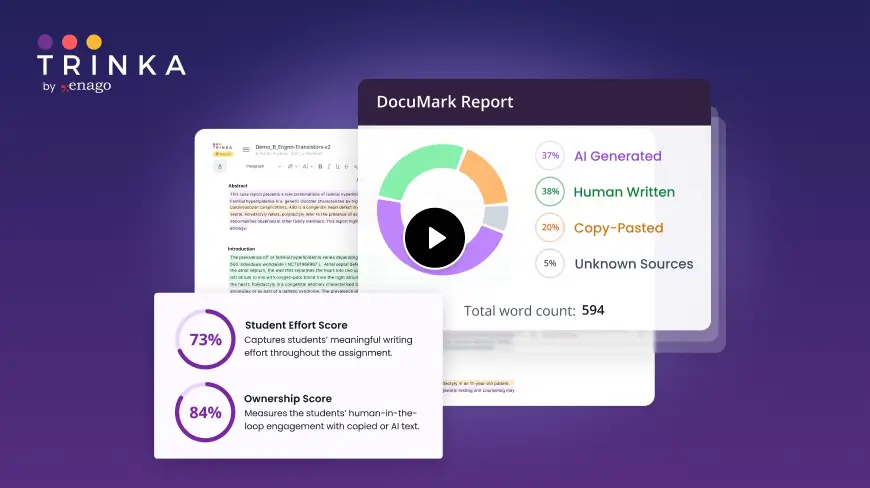
DocuMark: Responsible AI Use for Academic Integrity
Knowing your institution's AI policy is step one. DocuMark helps enforce it fairly by empowering universities to manage AI-generated content, prevent cheating, and support student writing through responsible AI use.
Common Questions About University of Rochester's AI Policies
University of Rochester has defined AI policies in 12 of 12 categories, with an overall coverage score of 100%.
The university states that people should disclose when work has been created in whole or part with GenAI tools, and that course-level GenAI policies should specify how students must disclose, document, and attribute use. The academic honesty policy requires credit to “source technologies” like DALL-E/ChatGPT and requires verbatim quotes be clearly identified within the text. Research guidance also requires disclosure/identification of GenAI use in proposing/reporting/publishing, and for more than de minimis AI-generated content the AI-created and author-created parts should be distinguished and described.
The GenAI education guidance cautions instructors against relying on GenAI detection tools, describing them as unreliable and advising they not be used as the sole basis for an academic honesty violation; if used, instructors should disclose to students when/how they will be used. It also states unauthorized GenAI use may be considered academic misconduct. The academic honesty policy defines academic dishonesty categories and includes use of AI-generated material not allowed by the instructor as an example of plagiarism-related misconduct.
The university advises that confidential/sensitive university information should not be uploaded to public GenAI tools unless there is a university agreement with the vendor approved by AI governance groups, and it instructs users not to upload confidential/proprietary information or PHI/PII/personal data (in the MarCom guidance). The provost’s institutional data security message encourages use of a secure university GenAI chatbot (chat.rochester.edu) designed to handle medium- and high-risk institutional data. The data security classification policy states high-risk information must be protected and limits disclosure to third-party agents/vendors unless they assume a legally binding obligation to safeguard it.