Teaching & Learning
- Use of generative AI in assessed coursework is allowed only within the permissions set in the assessment brief
- Students must submit work that is their own, although assistive use before submission is acceptable, and any use outside the permitted guidance is treated as academic misconduct
Your assessment brief should include a section on ‘Using Generative Artificial Intelligence (GenAI) Tools’. This provides guidance on the permitted use of GenAI in your assessment. Check this carefully before you begin working on your assessment. Get clarification from your lecturer if you're unsure about anything.
Follow the guidance you've been given to ensure you avoid academic misconduct. This can arise from:
* Inappropriate use of GenAI
* Any use of GenAI that falls outside the permitted use outlined in your assessment brief
For this assessment you may use tools, software, or features of software which use artificial intelligence to generate content such as text, images or data, in an assistive and supportive capacity. This means you may use the tool to explore the topic, generate or process data, or suggest draft structures and refine the wording or your work. However, the final work you submit must be your own. Use of AI to generate content to misrepresent your own abilities or mislead your assessor is academic misconduct.
Require students to submit work that is their own; however, use of assistive technology to help with preparation of work prior to submission is acceptable.
- In examinations, taking unauthorised material including electronic devices is prohibited under the examination rules
- For formal assessments, AI use depends on the assessment brief, and students are told to follow the specific guidance provided for each assessment
When submitting work for assessment, always follow the guidance on using GenAI provided.
Your assessment brief should include a section on ‘Using Generative Artificial Intelligence (GenAI) Tools’. This provides guidance on the permitted use of GenAI in your assessment. Check this carefully before you begin working on your assessment. Get clarification from your lecturer if you're unsure about anything.
vi) Breaching the University Examination Rules, which includes:
a. Taking unauthorised material (including electronic devices) into an examination.
- Students are expected to check AI output for accuracy, protect privacy, and use university-supported tools where possible
- The university supports student use of generative AI for studying and skill development, with guidance to use it responsibly
The University recognises the transformative potential of GAI tools and models and seeks to establish clear guidelines for their use in all university activities including learning, teaching and assessment.
Skill Development: Provide opportunities to embed AI in teaching and
assessment activities to develop the AI literacy of
students and colleagues to prepare them to use AI tools
both during and after their time with the University.
How much do you really understand about using GenAI while you’re studying at the University of Salford? We have a few fundamental guiding principles when it comes to using GenAI while you’re:
* studying
* note-taking
* completing your assessments.
We have six guiding principles for the use of GenAI at Salford:
3. Be mindful of data privacy when inputting your own work or the work of others into GenAI tools.
4. GenAI is a tool, not a replacement for your own judgement. Always check GenAI content for accuracy and relevance.
5. Use University-supported tools for their enhanced data protection features.
- Any use for coding in assessed work is governed by the assessment brief and the requirement that submitted work be the student's own
- The university acknowledges that generative AI can create code and applies its general assessment rules to that use, but it does not set a separate university-wide rule specifically for programming assignments
Generative AI (GAI) is a powerful, rapidly developing technology that can create original and
diverse content, such as text, images, music, code, and more, based on a given input or
prompt.
Your assessment brief should include a section on ‘Using Generative Artificial Intelligence (GenAI) Tools’. This provides guidance on the permitted use of GenAI in your assessment. Check this carefully before you begin working on your assessment. Get clarification from your lecturer if you're unsure about anything.
Require students to submit work that is their own; however, use of assistive technology to help with preparation of work prior to submission is acceptable.
Research
- The university’s AI policy references a separate research AI principles document, but the provided sources do not state the content of that AI-specific research standard
- The research ethics sources do require ethics review before data collection for research involving human participants, animals, tissue, or sensitive data, and warn that failure to obtain approval may be treated as research or academic misconduct
Principles Statement of Principles for the Responsible and Ethical
use of AI in Research (RKE)
The University requires all research involving human participants, animals, human or animal tissue, or sensitive data conducted by its academic staff, research degree candidates and taught UG and PG students be subjected to ethics panel scrutiny. This means that most researchers within the University are required to apply for ethics approval from the relevant Ethics Panel before commencing data collection.
Failure to gain the appropriate approval could be viewed as research or academic misconduct and may have serious repercussions
Academic Integrity
- Students are required to acknowledge and document their use of generative AI and to distinguish their own ideas from AI-generated content
- The policy also says students must reflect on their AI use, and assessment guidance directs them to the university’s acknowledgement guidance
We have six guiding principles for the use of GenAI at Salford:
2. Clearly acknowledge and document how you've used GenAI tools.
Require students to reflect on and acknowledge their
use of GAI tools, and to clearly distinguish between
their own ideas and those from generated content.
* Referencing
* Referencing Overview
* APA 7th
* OSCOLA
* Chicago
* Endnote reference management software
* Academic integrity
* GenAI
* GenAI Overview
* Using GenAI in your assessments
* Acknowledging GenAI use in your assessments
- Undisclosed or unauthorised AI use in assessed work is handled as academic misconduct under the student integrity procedure
- The university says it will use appropriate detection and prevention methods, may use text-matching tools in investigations, and states that a Turnitin-style matching report alone is not sufficient evidence of misconduct
Use appropriate methods to detect and prevent
academic misconduct involving GAI, and use the
Student Academic Integrity and Academic Misconduct
Procedure to consider such cases.
b. Unauthorised use of Generative Artificial Intelligence
Using Generative Artificial Intelligence (Gen AI) or other computer-based
process to generate work which is then submitted in whole or in part towards
credit or award.
This could include work which is written using Gen AI where that use is not
permitted even when subsequently edited by the student. It could include the
use of paraphrasing software and technology that rewrites text even when
subsequently edited by the student (these are also covered in c. below).
A matching report from a text matching service (for example Turnitin) is not, on its own,
evidence of academic misconduct, even where the proportion of matching text is high.
Where submission by the student via the text matching tool is not required in cases of
suspected academic misconduct, the University may submit such work through the text
matching tool to aid any investigation.
When a member of staff suspects academic misconduct in a piece of assessed work a
student may be interviewed by an appropriate member of academic staff, for example
see guidance on “Bought Work” and “unauthorised use of GenAI” (available for the QMO
pages on the staff hub). A written note of this interview may be submitted as part of the
evidence for consideration by a hearing.
Institutional & Administrative
- The generative AI policy applies to colleagues as well as students in teaching, learning, assessment, and feedback activity
- The university states it will embed AI in teaching and assessment to develop AI literacy for colleagues, but the provided sources do not set detailed rules on grading, feedback generation, recommendation letters, or administrative communications
This Policy applies to all students and colleagues within teaching, learning, assessment and
feedback activity, including students and colleagues at partner institutions.
Skill Development: Provide opportunities to embed AI in teaching and
assessment activities to develop the AI literacy of
students and colleagues to prepare them to use AI tools
both during and after their time with the University.
All students and colleagues.
- University, staff, or student data must not be entered into AI systems unless they are specifically approved by Digital IT
- The policy indicates Microsoft Copilot is the typical approved tool for such purposes, and any AI use involving personally identifiable data requires a Data Privacy Impact Assessment and prior Digital IT approval on a case-by-case basis
Not enter university, staff or student data into Artificial Intelligence systems not
specifically approved by the University (Digital IT). This typically means using the
University’s Microsoft Co-Pilot subscription for such purposes. All use of Artificial
Intelligence solutions that involve personally identifiable data require a Data Privacy
Impact Assessment and prior approval from Digital IT. Approval will be granted on a
case-by-case basis and cannot be assumed.
Use University-supported tools for their enhanced data protection features.
Copilot is Microsoft’s conversational Generative AI (GenAI) assistant. It's the University’s recommended GenAI tool.
Signing in to Copilot with your University email address protects your personal data.
- The policy assigns ownership to the PVC Student Education, states it was developed through university committee approval and consultation with staff and students, and sets a review date
- The university has an institution-wide generative AI policy that takes a positive and ethical approach and sets guiding principles around skill development, equitable access, academic integrity, and GDPR compliance
The University will take a positive and ethical approach to use of GAI, and will
Skill Development: Provide opportunities to embed AI in teaching and
assessment activities to develop the AI literacy of
students and colleagues to prepare them to use AI tools
both during and after their time with the University.
Equitable Access: Ensure equitable access for all students and colleagues
to access a base level of essential AI tools and training
which are institutionally procured and provided.
Transparency and
Academic Integrity
Educate students and colleagues about what
constitutes academic integrity including fair and ethical
use of GAI tools, and provide guidance on all forms of
academic misconduct including falsification of
authorship, especially unauthorised use of GAI, and
provide clarity within assessment information about how
GAI can contribute to or detract from achieving intended
outcomes.
Owner: This Policy is issued by the PVC Student Education, who has the authority to
issue and communicate policy on GAI.
Development of University Policy V1.0 Considered and authorised by
Quality and Standards Committee
and Education and Student
Experience Committee. 19 March
2025 with amends approved by
Chair’s Action on 27 March 2025
Consultation:
Staff Trades Unions via HR
Students via USSU
Relevant external bodies (specify)
1. Union representative on Steering Group.
Review due: September 2026
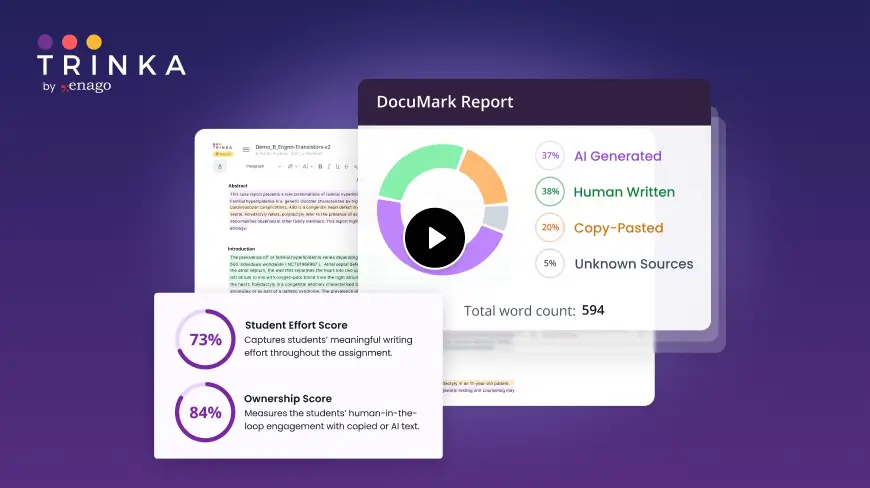
DocuMark: Responsible AI Use for Academic Integrity
Knowing your institution's AI policy is step one. DocuMark helps enforce it fairly by empowering universities to manage AI-generated content, prevent cheating, and support student writing through responsible AI use.
Common Questions About University of Salford's AI Policies
University of Salford has defined AI policies in 10 of 12 categories, with an overall coverage score of 83%.
Students are required to acknowledge and document their use of generative AI and to distinguish their own ideas from AI-generated content. The policy also says students must reflect on their AI use, and assessment guidance directs them to the university’s acknowledgement guidance.
Undisclosed or unauthorised AI use in assessed work is handled as academic misconduct under the student integrity procedure. The university says it will use appropriate detection and prevention methods, may use text-matching tools in investigations, and states that a Turnitin-style matching report alone is not sufficient evidence of misconduct.
University, staff, or student data must not be entered into AI systems unless they are specifically approved by Digital IT. The policy indicates Microsoft Copilot is the typical approved tool for such purposes, and any AI use involving personally identifiable data requires a Data Privacy Impact Assessment and prior Digital IT approval on a case-by-case basis.