Teaching & Learning
- Use of GenAI in coursework varies by assignment, school, department, and module
- Directly pasting AI output into submitted work is prohibited, and allowed use may require disclosure
- Some assignments require AI use, some are AI-free, and in other cases students must check local guidance and assessment criteria; using AI beyond what is permitted can be treated as academic misconduct
Some assignments may be AI-required, in which case you will need to engage with GenAI in your work on them.
Other assignments may be AI free, with no use of GenAI allowed, recognising the importance of foregrounding your own views, knowledge and experience.
For all other assignments, you will need to use your judgement to decide how, when and whether to ue GenAI as a tool to support your learning.
* The golden rule: always check your school / department’s guidance and the specific module assessment criteria as the use of GenAI may be specifically prohibited on certain modules or assessments. If you have any doubt at all about this, always ask the module tutor for clarification.
* Do not copy and paste content from an output produced by a GenAI tool directly into your work. Instead, you should use an output as a way to inform your further research and thinking.
Note: You won't be penalised for declaring use of AI where this is in line with assessment guidance. However, even if you make a full disclosure of your use of GenAI, if this is not specifically permitted in your assessment criteria and guidance, or extends beyond what is permitted, there is a risk of this use being considered an unfair advantage, and therefore academic misconduct. It is therefore important to check your assessment guidance before you use any AI tools within your assessments.
- AI use in assessments is determined by the specific module or assessment guidance rather than a single blanket permission
- Some assessments may prohibit GenAI entirely, and students are told to check school, handbook, module, and assessment guidance or ask staff if unsure
* The golden rule: always check your school / department’s guidance and the specific module assessment criteria as the use of GenAI may be specifically prohibited on certain modules or assessments. If you have any doubt at all about this, always ask the module tutor for clarification.
Before using an AI tool to support your studies, it's important to be aware of any limitations on AI use within particular modules or assessments. Some modules or assessments may not allow the use of GenAI, so check your school handbook and module and assessment guidance. If you're unsure, contact your department for clarification on what's permitted.
- The university supports responsible use of GenAI as a learning aid and aims to develop student AI literacy
- It frames AI as a tool that can support learning, revision, and critical engagement, while warning students to check whether any local restrictions apply and to treat learning as a human process
Responsible and ethical use of GenAI is a skill that has the potential to be transformative across all academic disciplines. It is also a skill that is increasingly valued by employers within a wide range of professional contexts.
Our understanding of how GenAI can be used effectively as a tool for learning is still evolving, but we are committed to ensuring that you are supported to develop AI literacy without compromising the principles of academic rigour and integrity.
The following guidance will help you to use GenAI tools appropriately and ethically in your studies.
Foregrounding the primacy of learning as a human process; taking a considered approach to how AI can be used as a tool to support learning, whilst also recognising when it might hinder the acquisition of key skills, knowledge and critical thinking.
All students will have the opportunity to develop their AI literacy during their time with the University.
- For taught assessments, code-related AI use falls under the same assessment-specific rules that require checking module and assessment guidance
- The university recognizes that GenAI tools can generate code, but it does not provide a separate university-wide student programming policy in the provided sources
GenAI refers to a subset of AI tools that create content, including but not limited to text, images, code and audio in response to user prompts.
* The golden rule: always check your school / department’s guidance and the specific module assessment criteria as the use of GenAI may be specifically prohibited on certain modules or assessments. If you have any doubt at all about this, always ask the module tutor for clarification.
Research
- Use in manuscripts and theses must be transparently acknowledged, and thesis use beyond the permitted guidance may breach the Academic Misconduct Policy
- For research and PGR thesis writing, GenAI may be used for assistance such as technical writing, but researchers must maintain rigour, integrity, and primary intellectual ownership
* Attribution – You must transparently acknowledge the use of GenAI at any point in the research or writing process. For example, ‘this manuscript was prepared with the assistance of Generative AI <cite the tool>’. Where there is verbatim reproduction of GenAI output in a section, this should be explicitly indicated. For example, ‘the Abstract and Introduction were produced by Generative AI <cite the tool>’.
Researchers must use Generative AI effectively whilst maintaining rigour and integrity in the research process.
Research assistance activities such as code development, technical writing, and literature analysis are generally permitted with appropriate declaration. More substantial intellectual contributions, such as drawing research conclusions or developing theoretical frameworks, require careful validation and supervisor discussion to ensure the researcher maintains primary intellectual ownership and understanding at a doctoral level.
Should your use of GenAI tools in your thesis writing exceed the circumstances permitted by this guidance, you will risk breaching the Academic Misconduct Policy.
- The university allows AI use in research data analysis when it is properly described in the methods, follows research integrity principles, and undergoes ethical review where appropriate
- Researchers and PGRs must be cautious with sensitive, personal, confidential, or embargoed data and should not upload such material if doing so would breach privacy, confidentiality, IP, or contractual rules
The use of AI tools as part of the research process – to analyse and draw insights from data, for example – would, like any other element of research design, need to be clearly outlined in a ‘Methods’ section, subject to ethical review where appropriate, and conducted in accordance with principles of research integrity as well as disciplinary norms. Examiners will scrutinise such aspects of the research design as they would any other element of a project.
Understand data privacy implications: Be cautious about the information input into AI tools, especially when dealing with sensitive research data or personal data/information . Checking the Terms and Conditions that are associated with such tools is the best way to understand how information input into them may be used and what you are committing to.
Always be sure that you have the authority to commit to such terms before using the tool. If you upload private, sensitive, confidential or embargoed data to a generative AI tool you are likely to breach privacy and confidentiality rules (e.g. student survey data/ participant data) or intellectual property rules, or breach a contractual or licensing agreement.
- Research use of GenAI must comply with responsible research, academic integrity, GRIP, and relevant funder and publisher policies
- Researchers must be able to justify the appropriateness of GenAI use, ensure it complements rather than replaces human expertise and judgement, and remain accountable for the research
Your use of generative AI must align with the University’s expectations for responsible research and academic integrity.
* Appropriateness – Is this an appropriate use of GenAI? You must be able to explain and justify the use of GenAI in your research. Does the GenAI tool(s) complement human expertise, critical thinking and judgement in the research process, rather than replacing it?
* Accountability – You must ensure that the use of GenAI, whether in the results of research or work presented for assessment, complies with ethical standards and the tenets of research integrity in line with the Good Research and Innovation Practice (GRIP) policy, as well as the policies of relevant funders and publishers. You remain accountable for your research when using GenAI and must, given the fast-moving nature of GenAI, keep up to date with developments of the tools you are using.
Academic Integrity
- Disclosure of GenAI use is required or may be required when AI is used in assessed work or research writing
- For taught assignments, students may need to provide full disclosure using the university’s acknowledgment process; for research and theses, researchers must transparently acknowledge GenAI use and should not cite GenAI outputs as sources
* A full disclosure of any content produced by GenAI should always be acknowledged in your work. Attempts to pass off content as your own work is counted as unfair means (see below) and may lead to action being taken against you.
In assignments where you are sure that you are allowed to use GenAI, you may be asked to provide a full disclosure of how you have done so. This will ensure that your tutor can see how your thinking has intersected with and developed any content that you may have generated.
You can provide this information by completing an Acknowledge, Describe, Evidence template which you may be asked to submit as an appendix to your assignment. Please note: some schools may use a different template for acknowledging GenAI use. Check with your school or tutor to ensure you are following the correct process for your programme or module
* Attribution – You must transparently acknowledge the use of GenAI at any point in the research or writing process. For example, ‘this manuscript was prepared with the assistance of Generative AI <cite the tool>’. Where there is verbatim reproduction of GenAI output in a section, this should be explicitly indicated. For example, ‘the Abstract and Introduction were produced by Generative AI <cite the tool>’.
Acknowledging the use of Generative AI can take the following steps:
* a pre-defined statement that indicates whether you have used Generative AI tools.
* a reflective component detailing how Generative AI has been used and the experience of engaging with it.
* sharing prompts used, the outputs produced, or the modifications made because of using the tools.
* using appropriate referencing.
No. GenAI outputs should never be used as a source in your thesis and you should never cite from the output of a GenAI tool. Content generated by AI tools is not peer-reviewed, cannot be independently verified, and is usually non-recoverable and non-reproducible.
- The university states that it does not use AI detection tools
- Undisclosed or impermissible AI use can still be treated as unfair means or academic misconduct, and students who pass off AI-generated content as their own may face action under academic misconduct processes
AI detection tools are not used at the University of Sheffield. This is due to concerns over their error rates and the potential for both false positives and false negatives when scanning for potential use of AI.
* A full disclosure of any content produced by GenAI should always be acknowledged in your work. Attempts to pass off content as your own work is counted as unfair means (see below) and may lead to action being taken against you.
Note: You won't be penalised for declaring use of AI where this is in line with assessment guidance. However, even if you make a full disclosure of your use of GenAI, if this is not specifically permitted in your assessment criteria and guidance, or extends beyond what is permitted, there is a risk of this use being considered an unfair advantage, and therefore academic misconduct. It is therefore important to check your assessment guidance before you use any AI tools within your assessments.
3. Severe offences: more serious cases of academic misconduct that would significantly undermine the assessment process and give a clear advantage to the student.
Institutional & Administrative
- The provided sources state that staff will receive training and that the university aims to give clear expectations for staff and students around GenAI use
- However, they do not define a specific policy in these sources for staff use in grading, feedback, recommendation letters, or administrative communications
clear expectations for staff and students around GenAI use
Staff will be provided with appropriate development and training opportunities to support the embedding of AI literacy within the curriculum, taking a student-centric approach and engaging students in this process.
- It also identifies Google Gemini as the institutionally supported GenAI tool for staff and students and says it should be used where possible in learning and teaching
- The university directs users not to enter personal, private, or confidential information into GenAI prompts, and research guidance warns against uploading sensitive or embargoed data if that would breach privacy, confidentiality, IP, or contractual rules
* You should not provide any personal, private or confidential information in your prompts.
Understand data privacy implications: Be cautious about the information input into AI tools, especially when dealing with sensitive research data or personal data/information . Checking the Terms and Conditions that are associated with such tools is the best way to understand how information input into them may be used and what you are committing to.
Always be sure that you have the authority to commit to such terms before using the tool. If you upload private, sensitive, confidential or embargoed data to a generative AI tool you are likely to breach privacy and confidentiality rules (e.g. student survey data/ participant data) or intellectual property rules, or breach a contractual or licensing agreement.
* All students and staff have access to Google Gemini (university login required) as the institutionally supported GenAI tool. Where possible, Gemini should be used to support learning and teaching activities.
- The university has an overarching principles-based approach for GenAI in education and a parallel set of principles for research and innovation
- In education, the principles guide schools, programmes, and modules while providing institutional expectations but respecting disciplinary expertise; the stated goals include clear expectations, AI literacy development, maintained academic standards, and institutional consistency
The following principles are the University’s response to generative AI in education. They inform the approach to GenAI within schools, programmes and modules.
Our approach is grounded in harmonisation, not homogenisation. We provide institutional expectations while respecting disciplinary expertise.
These include:
* clear expectations for staff and students around GenAI use
* structured development of GenAI literacy skills for all students
* preparation of graduates for an AI-enabled future
* maintained academic standards and integrity
* consistency and equity across the institution.
Your use of generative AI must align with the University’s expectations for responsible research and academic integrity.
This page sets out some overarching principles to guide the evaluation and use of GenAI tools.
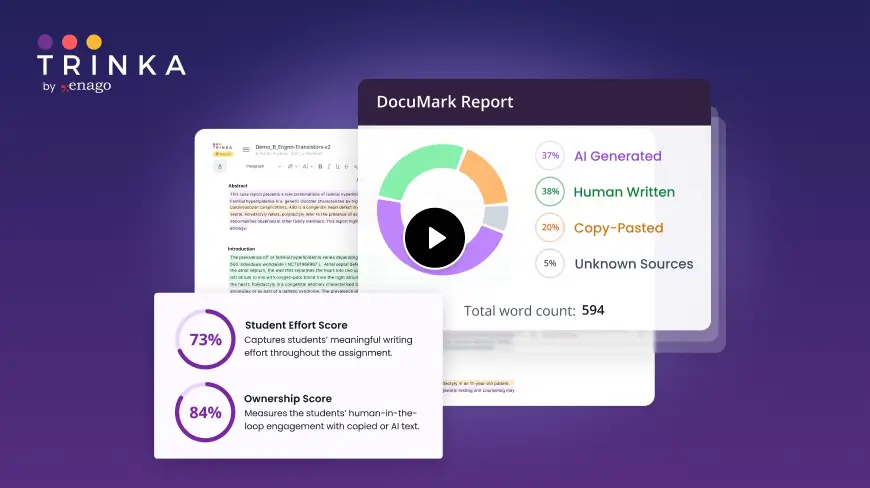
DocuMark: Responsible AI Use for Academic Integrity
Knowing your institution's AI policy is step one. DocuMark helps enforce it fairly by empowering universities to manage AI-generated content, prevent cheating, and support student writing through responsible AI use.
Common Questions About University of Sheffield's AI Policies
University of Sheffield has defined AI policies in 12 of 12 categories, with an overall coverage score of 100%.
Disclosure of GenAI use is required or may be required when AI is used in assessed work or research writing. For taught assignments, students may need to provide full disclosure using the university’s acknowledgment process; for research and theses, researchers must transparently acknowledge GenAI use and should not cite GenAI outputs as sources.
The university states that it does not use AI detection tools. Undisclosed or impermissible AI use can still be treated as unfair means or academic misconduct, and students who pass off AI-generated content as their own may face action under academic misconduct processes.
The university directs users not to enter personal, private, or confidential information into GenAI prompts, and research guidance warns against uploading sensitive or embargoed data if that would breach privacy, confidentiality, IP, or contractual rules. It also identifies Google Gemini as the institutionally supported GenAI tool for staff and students and says it should be used where possible in learning and teaching.