Teaching & Learning
- The university does not have a system-wide policy on generative AI in coursework, so its use is left to faculty discretion
- University guidance states that unauthorized use of generative AI in assignments is often considered a violation of academic integrity, and suspected misconduct is handled through the university's general academic misconduct process
Currently, the South Dakota Board of Regents has no specific system-wide policy regarding the usage of generative AI in class, therefore the usage of generative AI is up to faculty discretion. Always check your course syllabus or ask your instructor for their policy on the use of generative AI tools. The unauthorized use of generative AI in completing assignments is often considered a violation of academic integrity policies on campus, as it undermines the principles of originality, honest representation of one's work, and the learning process.
- The sources describe availability and functionality rather than a binding policy standard
- The provided sources identify AI tools that students, faculty, and staff may access for study support and research note-taking, but they do not set a university-wide rule governing student use of AI for personal studying
Google Notebook LM is an AI-powered research and note-taking tool that helps users interact with and understand their information. It allows users to upload documents, ask questions, generate summaries, and even listen to audio overviews of their sources. Essentially, it's designed to be a personalized AI assistant that can help with various tasks like summarizing complex documents, creating study guides, and generating briefing docs, all based on the user's uploaded content. Faculty, Staff, Students
Subscription options for ChatGPT (Individual) Faculty, Staff, Students
Generative AI tool made by Google offering a range of capabilities designed to enhance productivity and creativity. Faculty, Staff, Students
Research
- The university advises researchers to check with their instructor or publisher for guidelines on using generative AI
- Its guidance indicates that AI-assisted writing may be used when allowed by the relevant instructor or publisher and that the user remains responsible for the submitted content
If you use generative AI in your research, you may need to cite it. Always check with your instructor or publisher to see if they have any guidelines on using and citing generative AI. It is important to remember that you are responsible for the information that you submit in your assignments, including anything that is produced by generative AI.
- The university permits access to certain AI-enabled research tools, but when university data is involved it imposes data-handling controls
- Users may work with AI technologies on restricted data only if the AI technology is approved, and restricted USD data cannot be used with generative AI without prior authorization
Web of Science Research Intelligence is a transformational, AI-native software solution that empowers researchers to accelerate innovation and research institutions to better measure and demonstrate impact. Build better teams, win more funding, and tell the story of your impact with a next-generation platform built with the research community, for the research community. Faculty
Use only approved AI technologies when working with restricted data, ensuring compliance with data protection standards. The use of restricted data requires appropriate approval, inventory, and auditing.
We encourage the use and experimentation with generative AI; however use of restricted USD data is prohibited without prior authorization.
Academic Integrity
- The university provides guidance that users should disclose and cite generative AI in research when applicable
- It offers specific citation guidance and examples for APA, MLA, and Chicago styles, while advising users to check with their instructor or publisher for any additional requirements
Citing Generative AI. If you use generative AI in your research, you may need to cite it. ... Always check with your instructor or publisher to see if they have any guidelines on using and citing generative AI. ... APA Style: The official guidance from the APA Style Blog... MLA Style: The 9th edition of the MLA Handbook provides recommendations on how to cite generative AI. ... Chicago Style: The 17th edition of the Chicago Manual of Style has provided guidance on their Q&A page...
- The university has a formal enforcement process for suspected academic misconduct
- Instructors must use the reporting procedure, sanctions vary by student level and prior violations, and course-level penalties cannot be imposed until the case is resolved through the informal or formal process
If you are an instructor who suspects an instance of academic misconduct, please refer to the procedural flowchart below before completing the disposition form via DocuSign.
An academic consequence cannot be applied by the course instructor until the matter has been fully resolved through either the informal or formal resolution process. This includes course/assignment grade penalties and assignment re-takes.
First Violation: A first instance of academic misconduct typically results in a mandatory educational meeting with the Office of Student Rights and Responsibilities and an academic consequence, which is typically determined by the course instructor.
Second Violation: A second instance of academic misconduct will typically result in a disciplinary probation period of four years (not reflected on a transcript), a mandatory educational meeting with the Office of Student Rights and Responsibilities, and an additional academic consequence determined by the course instructor.
Third Violation: A third violation will result in a formal hearing to determine whether formal disciplinary action, up to and including suspension from the University, is warranted.
First Violation: A first instance of academic misconduct from a graduate or professional student will typically result in a disciplinary probation period of three years (not reflected on a transcript), a mandatory educational meeting with the Office of Student Rights and Responsibilities, and an additional academic consequence determined by the course instructor.*
Second Violation: A second allegation of academic misconduct or dishonesty will result in a formal hearing to determine whether formal disciplinary action, up to and including suspension from the University, is warranted.
Institutional & Administrative
- The provided sources show that faculty and staff have access to named AI tools and that the university encourages experimentation with generative AI
- However, faculty and staff must follow university data-security rules, especially when working with restricted data, and some AI tools are approved only for limited use cases
Subscription options for ChatGPT (Individual) Faculty, Staff, Students
Generative AI tool made by Google offering a range of capabilities designed to enhance productivity and creativity. Faculty, Staff, Students
Proof of concept testing. NebulaONE is Cloudforce’s groundbreaking multi-modal Generative AI platform, built exclusively on Azure. Seamlessly integrating with campus environments and enterprise ecosystems. Faculty, Staff, Students
We encourage the use and experimentation with generative AI; however use of restricted USD data is prohibited without prior authorization.
Use only approved AI technologies when working with restricted data, ensuring compliance with data protection standards. The use of restricted data requires appropriate approval, inventory, and auditing.
AI-powered clinical assessment, calibration, and training tool designed for the dental industry. Approved for classroom demonstration only using stock images and no patient data. Faculty, Staff, Students
- The university defines public, internal, and restricted data classifications and requires secure handling of sensitive information
- The software inventory also identifies institutionally recognized AI tools and, in at least one case, limits use to stock images and no patient data
- Restricted data may be used only with approved AI technologies and with approval, inventory, and auditing; generative AI use with restricted USD data is prohibited unless prior authorization is obtained
Data Classifications:
• Public Data: Information intended for public use or information that can be disclosed without significant risk to USD or the SDBOR.
• Internal Data: Information intended for use within the university that, if disclosed, would not result in significant harm but is not intended for public dissemination.
• Restricted Data: Sensitive information that requires strict controls due to legal, regulatory, or policy requirements.
By default, all university data is considered Internal unless classified otherwise.
Enter or access sensitive data only on, or with, employee-facing technologies that are properly secured with ITS security safeguards.
Store and share university data only in approved storage locations that meet the university's security requirements and only share via approved methods.
Use only approved AI technologies when working with restricted data, ensuring compliance with data protection standards. The use of restricted data requires appropriate approval, inventory, and auditing.
We encourage the use and experimentation with generative AI; however use of restricted USD data is prohibited without prior authorization.
Subscription options for ChatGPT (Individual) Faculty, Staff, Students
Generative AI tool made by Google offering a range of capabilities designed to enhance productivity and creativity. Faculty, Staff, Students
Proof of concept testing. NebulaONE is Cloudforce’s groundbreaking multi-modal Generative AI platform, built exclusively on Azure. Seamlessly integrating with campus environments and enterprise ecosystems. Faculty, Staff, Students
AI-powered clinical assessment, calibration, and training tool designed for the dental industry. Approved for classroom demonstration only using stock images and no patient data. Faculty, Staff, Students
- They do not define a broader university AI strategy, roadmap, or committee structure in the source text provided
- The provided sources establish an institutional information-security framework that includes AI security safeguards and a permissive-but-controlled stance toward generative AI experimentation
ITS Security Safeguards: A comprehensive set of security measures implemented by the Information Technology Services (ITS) department to safeguard university data and IT resources. These include, but are not limited to, Endpoint Detection and Response (EDR), DNS Security, Artificial Intelligence (AI) Security, Network Security, Data Loss Prevention (DLP), Encryption, Multi-Factor Authentication (MFA), Application Restrictions, Computer Administrator Restrictions, and Email Security.
We encourage the use and experimentation with generative AI; however use of restricted USD data is prohibited without prior authorization.
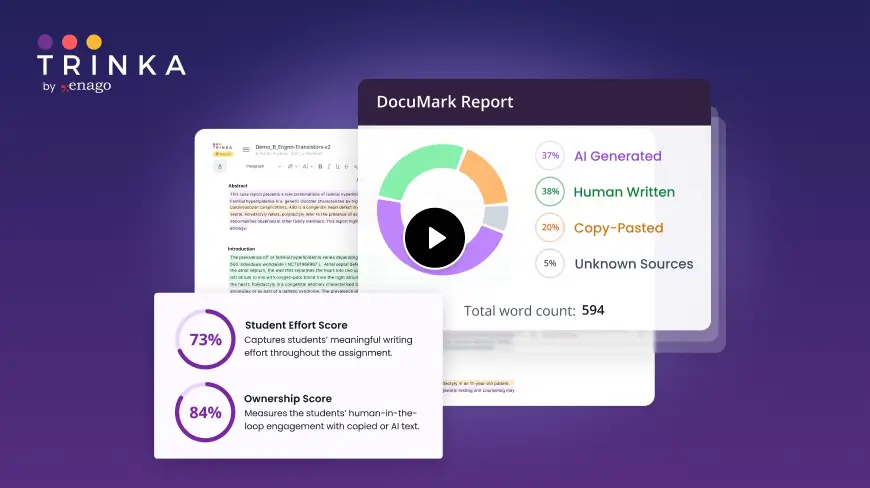
DocuMark: Responsible AI Use for Academic Integrity
Knowing your institution's AI policy is step one. DocuMark helps enforce it fairly by empowering universities to manage AI-generated content, prevent cheating, and support student writing through responsible AI use.
Common Questions About University of South Dakota's AI Policies
University of South Dakota has defined AI policies in 9 of 12 categories, with an overall coverage score of 75%.
The university provides guidance that users should disclose and cite generative AI in research when applicable. It offers specific citation guidance and examples for APA, MLA, and Chicago styles, while advising users to check with their instructor or publisher for any additional requirements.
The university has a formal enforcement process for suspected academic misconduct. Instructors must use the reporting procedure, sanctions vary by student level and prior violations, and course-level penalties cannot be imposed until the case is resolved through the informal or formal process.
The university defines public, internal, and restricted data classifications and requires secure handling of sensitive information. Restricted data may be used only with approved AI technologies and with approval, inventory, and auditing; generative AI use with restricted USD data is prohibited unless prior authorization is obtained. The software inventory also identifies institutionally recognized AI tools and, in at least one case, limits use to stock images and no patient data.