Teaching & Learning
- Students must follow the rules for each assessment, ensure submitted work is their own, and misuse can be treated as academic misconduct
- Use of Gen-AI in coursework is not uniformly allowed or banned across the university; it is determined at module, programme, or departmental level
Your module and/or programme leader will make it clear whether or not the use of Gen-AI in general and any Gen-AI tools or service in particular is permitted when they explain the task they are asking you to complete.
The work you submit for assessment should always be your own. Depending on the context, the use of Gen-AI may be permitted, but not always, so you should ensure that you know what is allowed. If you are not sure, ask your module or programme leader for guidance.
Make sure you understand the rules for each assessment. Check module and programme handbooks and Myplace, and ask module or programme leaders for guidance if you are still unsure.
Always ensure that the work you submit is your own, that it results from your own thinking and effort, regardless of whether or not any Gen-AI tool has been used
Where the misuse of Gen-AI has been identified, the University’s Academic Misconduct Procedure will be followed, which could lead to a range of penalties for any individual who is found to have committed academic misconduct.
- Rules on Gen-AI use in assessments are set per assessment rather than by a single university-wide permission rule
- Students are required to check assessment-specific instructions in handbooks and Myplace and comply with any module or programme leader guidance
Your module and/or programme leader will make it clear whether or not the use of Gen-AI in general and any Gen-AI tools or service in particular is permitted when they explain the task they are asking you to complete.
Not necessarily, but you should always ensure that you are aware of the expectations of the module or programme leader around the use of Gen-AI and understand what is required of you in any given learning or assessment task. Consult your module handbook and Myplace site for guidance and ask for clarification if you need it.
Make sure you understand the rules for each assessment. Check module and programme handbooks and Myplace, and ask module or programme leaders for guidance if you are still unsure.
You should also check the rules and guidance for each individual assessment as these may vary. Details will be published in programme and module handbooks and Myplace pages.
- Students are expected to fact-check outputs, avoid over-reliance, and follow any module or programme leader guidance about when such use is appropriate
- The university says Gen-AI may be used for personal learning support, such as understanding concepts, creating study materials, and summarising topics, but only with careful and critical use
Gen-AI tools, used carefully and responsibly, could be helpful in a wide range of learning contexts. Gen-AI tools may help you understand some concepts, or create study materials, summarise complex topics, and so on, but you should always be aware of the fact that Gen-AI tools can be biased, inaccurate and misleading in their outputs. Ensure that you are always thinking critically about information you know has been produced using Gen-AI and fact check anything you intended to rely on.
You also need to be sure that you are not undermining the learning process. Follow the guidance that your module or programme leader has provided for you, they will have thought carefully about the learning or assessment task and will know whether the use of Gen-AI is (or isn’t) appropriate in that context.
Do not simply accept Gen-AI outputs as fact or authority.
Research
- Researchers remain ultimately responsible for the scientific output
- The university permits generative AI in research and research outputs, including manuscript-related work, but requires transparent acknowledgement and prohibits presenting AI-generated material as the researcher's own original work
While the University does permit the use of generative AI in research and research outputs, Researchers must do so transparently by acknowledging its use, and must not claim work generated by AI as their own original work.
i. “Remain ultimately responsible for the scientific output.
ii. Use generative AI transparently.
- The university permits generative AI in research, but researchers must handle data carefully when using AI tools
- In particular, they must pay attention to privacy, confidentiality, and intellectual property, and they must not input personal data such as identifiable participant information into generative AI tools
While the University does permit the use of generative AI in research and research outputs, Researchers must do so transparently by acknowledging its use, and must not claim work generated by AI as their own original work.
iii. Pay particular attention to issues related to privacy, confidentiality and intellectual property rights when sharing sensitive or protected information with AI tools.
3.8.3.With regards to point 3.8.2.iii, Researchers must not input personal data, such as identifiable participant information, into generative AI tools, as tools may not be compliant with UK data protection legislation.
- The university requires researchers to use generative AI in line with research integrity principles
- AI use in research is allowed, but it must be transparent, lawful, and must not be claimed as original human work; the university also adopts external responsible-use guidelines and says researchers should avoid substantial use of generative AI in sensitive activities such as peer review or evaluation of research proposals
However, it is important that researchers use these tools in accordance with the principles of research integrity. While the University does permit the use of generative AI in research and research outputs, Researchers must do so transparently by acknowledging its use, and must not claim work generated by AI as their own original work.
To support Researchers in using Generative AI, the University has adopted the Living Guidelines on the Responsible Use of Generative AI in Research produced by the European Research Area (ERA) Forum stakeholders and published by the European Commission.
iv. When using generative AI, respect applicable national, EU and international legislation, as in their regular activities.
vi. Refrain from using generative AI tools substantially in sensitive activities that could impact other researchers or organisations (for example peer review, evaluation of research proposals, etc.).
Academic Integrity
- For research, researchers must transparently acknowledge AI use
- Disclosure requirements therefore apply, but the exact format may depend on department or research context
- For student assessment work, acknowledgement of Gen-AI use is expected in line with departmental requirements, and students must follow department and library guidance if references are required
If you use Gen-AI, you should acknowledge this in your submission in line with the expectations of your Department. Check your module or programme handbooks or Myplace for guidance on how to do this.
If you are required to reference Gen-AI outputs used in your work, follow the guidance on referencing supplied by your Department and the University Library.
Be transparent about when, where, and how Gen-AI has been used in the development and creation of work that is submitted for assessment and formally acknowledge this use where this is required
While the University does permit the use of generative AI in research and research outputs, Researchers must do so transparently by acknowledging its use, and must not claim work generated by AI as their own original work.
- The university states that misuse of Gen-AI is handled through its Academic Misconduct Procedure and may result in penalties
- The provided sources do not define a position on AI detection tools, but they do clearly state enforcement through academic misconduct processes
Where the misuse of Gen-AI has been identified, the University’s Academic Misconduct Procedure will be followed, which could lead to a range of penalties for any individual who is found to have committed academic misconduct.
Inform students of penalties for misconduct.
Institutional & Administrative
- The provided sources do not define specific rules for faculty use in grading, feedback, lesson planning, recommendation letters, or administrative communications
- The sources say staff, like students, should align their use of Gen-AI with the university's principles in learning and teaching contexts, and staff and students have access to certain university-supported AI tools
The University takes a principled approach to the use of Gen-AI in all Learning and Teaching contexts. These principles can be viewed below in the Principles document. All uses of Gen-AI by students (and staff) should align with these Principles.
The only Gen-AI tool that the University currently allows staff and students to sign-up to with their University credentials is Microsoft Copilot in Edge.
Staff and students will also have access to the in-built Zoom AI Assistant while using Zoom.
- It instructs users not to enter personal, sensitive, copyright-protected, restricted, or identifiable personal data into AI tools, and warns about privacy and legal risks
- The university identifies Microsoft Copilot in Edge as the only Gen-AI tool staff and students are currently allowed to sign up to with university credentials, and says Zoom AI Assistant is also available within Zoom
The only Gen-AI tool that the University currently allows staff and students to sign-up to with their University credentials is Microsoft Copilot in Edge. You can access this through the Edge browser when you are signed into to your University Microsoft account.
Staff and students will also have access to the in-built Zoom AI Assistant while using Zoom.
Gen-AI tools may collect user data. Read privacy policies carefully and avoid sharing Personal, sensitive or copyright protected information. Make sure you are not giving any tools or services access to restricted or copyright protected content including materials provided to you by the University (for example lecture slides, assessment questions or feedback on assessment, library resources or research papers).
Never put personal or copyright protected information into Gen-AI prompts. You often can’t control what happens to that information once it has been submitted.
3.8.3.With regards to point 3.8.2.iii, Researchers must not input personal data, such as identifiable participant information, into generative AI tools, as tools may not be compliant with UK data protection legislation.
- The university states that it takes a principled approach to Gen-AI in learning and teaching and requires student and staff uses in those contexts to align with those principles
- In research, it says it has adopted the European Commission-published Living Guidelines on the Responsible Use of Generative AI in Research and will continue monitoring developments to keep guidance current
The University takes a principled approach to the use of Gen-AI in all Learning and Teaching contexts. These principles can be viewed below in the Principles document. All uses of Gen-AI by students (and staff) should align with these Principles.
To support Researchers in using Generative AI, the University has adopted the Living Guidelines on the Responsible Use of Generative AI in Research produced by the European Research Area (ERA) Forum stakeholders and published by the European Commission.
The University will continue to monitor the development and use of generative AI in research to ensure guidance remains up to date.
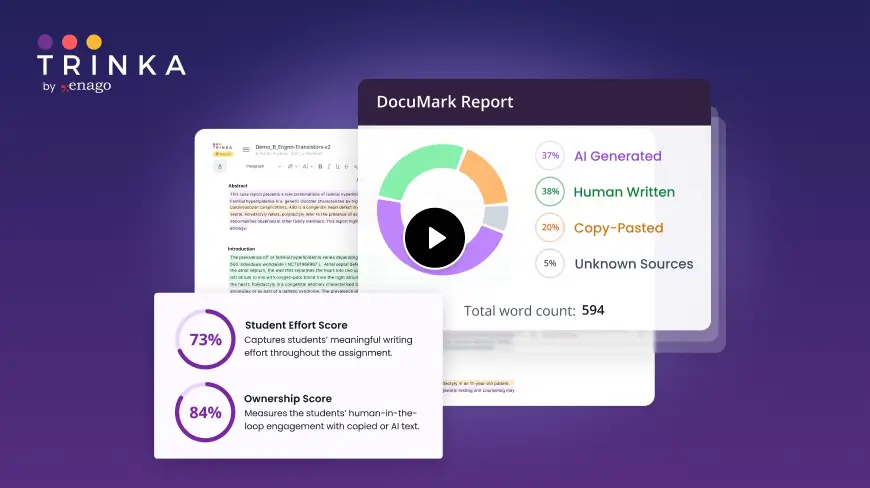
DocuMark: Responsible AI Use for Academic Integrity
Knowing your institution's AI policy is step one. DocuMark helps enforce it fairly by empowering universities to manage AI-generated content, prevent cheating, and support student writing through responsible AI use.
Common Questions About University of Strathclyde's AI Policies
University of Strathclyde has defined AI policies in 11 of 12 categories, with an overall coverage score of 92%.
For student assessment work, acknowledgement of Gen-AI use is expected in line with departmental requirements, and students must follow department and library guidance if references are required. For research, researchers must transparently acknowledge AI use. Disclosure requirements therefore apply, but the exact format may depend on department or research context.
The university states that misuse of Gen-AI is handled through its Academic Misconduct Procedure and may result in penalties. The provided sources do not define a position on AI detection tools, but they do clearly state enforcement through academic misconduct processes.
The university identifies Microsoft Copilot in Edge as the only Gen-AI tool staff and students are currently allowed to sign up to with university credentials, and says Zoom AI Assistant is also available within Zoom. It instructs users not to enter personal, sensitive, copyright-protected, restricted, or identifiable personal data into AI tools, and warns about privacy and legal risks.