Teaching & Learning
- AI use for graded coursework is permitted only within rules set by the relevant examiners or lecturers
- The university requires lecturers to define clearly whether and to what extent AI may be used in graded work such as term papers, project reports, theses, exercises, assignments, and group work, and to communicate those rules to students
The extent to which the use of AI systems is permitted or encouraged in examination performances is determined by the respective examiners. In case of doubt, I ask the examiners for clarification.
Lecturers must clearly and transparently define whether, and to what extent, the use of AI systems is permitted or prohibited in graded assessments (e.g., term papers, project reports, theses) and courses (e.g., exercises, assignments, group work).
These regulations should be communicated to students clearly and in a timely manner – for example, via ILIAS, during the course introduction, or in written form.
- The university does not impose a single blanket rule for AI use in examinations; examiners decide whether AI is permitted, encouraged, or prohibited in a given assessment
- The university’s examiner guidance also states that a uniform cross-disciplinary rule is not appropriate and that permitted aids, AI use, and related labeling are determined at the subject and module level
The extent to which the use of AI systems is permitted or encouraged in examination performances is determined by the respective examiners. In case of doubt, I ask the examiners for clarification.
Die unterschiedlichen Prüfungsinhalte und bevorzugten Prüfungsformen der verschiedenen Fachbereiche führen zu unterschiedlichen Auswirkungen von KI-Werkzeugen auf die Disziplinen. Diese Varianz unterstreicht die Unzweckmäßigkeit einer einheitlichen, fachübergreifenden Regelung hinsichtlich des erlaubten Einsatzes oder der Kennzeichnung der Nutzung oder der Inhalte von KI-Werkzeugen wie ChatGPT bei Prüfungen. Vor diesem Hintergrund obliegt es den Prüfenden und Modulverantwortlichen der fachlichen Lehreinheiten10, Entscheidungen über die Gestaltung von Prüfungen, die Zulassung von Hilfsmitteln wie KI-Werkzeugen sowie die Kennzeichnung der Nutzung von KI-Werkzeugen und der mit
Die Prüfenden und Modulverantwortlichen der Fachbereiche sind somit diejenigen, die fachspezifisch über Prüfungsinhalte, zulässige Hilfsmittel, Kennzeichnung der Nutzung von KI-Werkzeugen und der von KI-Werkzeugen generierten Inhalte, bestimmen.
Welche Hilfsmittel zulässig sind, variiert je nach Fach und Prüfung. Zulässige Hilfsmittel sollten vor einer Prüfung von den Prüfenden klar definiert und an alle Prüflinge kommuniziert werden.
- AI is permitted for students’ learning and study support, but it should support rather than replace students’ own engagement, independent thinking, and skill development
- Examiner guidance recognizes study-preparation uses such as organizing learning materials and generating practice questions, while noting risks to independent performance and recommending that examiners give guidance on use or non-use
I am allowed to use AI systems at the University of Stuttgart within the framework of these principles.
My use of AI should support – not replace – my personal engagement with course content, my independent thinking, and the development of my academic skills.
KI-Werkzeuge wie ChatGPT können vielfältig zur Prüfungsvorbereitung beitragen, von der Organisation von Lernmaterial bis hin zur Generierung von Übungsfragen. Sie können jedoch auch die Eigenleistung der Studierenden beeinträchtigen, indem sie übermäßige Abhängigkeit fördern und kritisches Denken sowie Problemlösungsfähigkeiten möglicherweise hemmen. Daher ist es für Prüflinge hilfreich, wenn Prüfende Empfehlungen zur Nutzung oder Nicht-Nutzung solcher Werkzeuge geben.
To strengthen my AI skills, I can take advantage of the University’s training and learning opportunities.
- For employees, programming assistants are subject to the university’s data-classification rules, and software AI functions must be disabled if those conditions are not met
- For student coding work in assessments, the university places decisions with examiners and warns that AI-generated or AI-reformulated code can reduce or distort the student’s own performance where coding ability is being assessed
Die Nutzung von KI-Werkzeugen zur Umformulierung von Texten oder Codes kann die Eigenleistung in Bezug auf das Formulieren klarer, kohärenter und prägnanter Ausdrucksweisen sowie die Fähigkeit zur Codeoptimierung aber auch vermindern. In Prüfungen, in denen die Qualität der Schreib- oder Codierfähigkeiten bewertet wird, kann die Unterstützung durch KI-Werkzeuge die darzustellende Eigenleistung der Studierenden potenziell verzerren.
Mit KI-Werkzeugen wie ChatGPT ist es möglich, aus einer Liste von Stichworten oder einer kurzen Zusammenfassung detailliertere Texte oder Programmcodes zu generieren.
Die Verwendung von KI-Werkzeugen zur Erzeugung von Texten oder Codes aus Stichworten kann die Eigenleistung in Bezug auf die Fähigkeit zur eigenständigen Entwicklung vollständiger Texte oder funktionsfähiger Codes verringern. In Prüfungen, in denen die Fähigkeit zur Erstellung umfassender Texte oder das einfache Programmieren bewertet wird, kann die Verwendung von KI-generierten Inhalten die Eigenleistung der Studierenden in Frage stellen.
If software provides AI functions, the data to be processed must be reviewed in accordance with the data classification policy before use; otherwise, the AI functions must be disabled and must not be used.
Examples
* AI browsers such as Atlas/Perplexity, AI extensions for browsers
* e‑mail assistance
* Programming assistants
* Software with AI functions (e.g. Copilot in Microsoft Office, GitHub Copliot, Midjourney, Adobe Firefly, Otter.ai, Jasper, Writer)
Research
Academic Integrity
- Students are required to document AI use transparently in consultation with the examiner
- For graded work and examinations, disclosure and labeling requirements are set by lecturers or examiners, who must communicate them clearly; examiner guidance also emphasizes that transparency and clear rules on labeling are essential
In consultation with the examiner, I clearly and transparently document and indicate where, how, and which AI systems I have used in order to ensure traceability.
The regulations concern:
• the permitted purpose of AI use (e.g., research, writing assistance),
• any restrictions on use,
• labeling requirements (e.g., disclosure of AI tools used in the appendix).
Im Kontext der Zulassung von KI-Werkzeugen als Hilfsmittel ist Transparenz essentiell.
Es ist erforderlich, klare Regeln für den erlaubten und nicht-erlaubten Gebrauch von KI-Werkzeugen festzulegen und diese Informationen den Studierenden umfassend und unmissverständlich zur Verfügung zu stellen.
Hinsichtlich der Kennzeichnung der Nutzung von KI-Werkzeugen und der von ihnen erzeugten Texte ist Transparenz ebenso geboten.
Die Prüfenden und Modulverantwortlichen der Fachbereiche sind somit diejenigen, die fachspezifisch über Prüfungsinhalte, zulässige Hilfsmittel, Kennzeichnung der Nutzung von KI-Werkzeugen und der von KI-Werkzeugen generierten Inhalte, bestimmen.
- The guidance therefore stresses fairness and the need for clear prior communication of permitted and prohibited uses, rather than presenting a reliable AI-detection regime
- The university guidance states that students can face sanctions for improper AI use or for failing to label adopted content, but it also notes that AI use is difficult to prove
Wie zuvor erläutert, kann die Verwendung von KI-Werkzeugen für die Studierenden Sanktionen nach sich ziehen.
Andernfalls könnten Studierende für den unzulässigen Gebrauch sanktioniert werden (sofern dieser bekannt wird), ohne zuvor über dessen Unzulässigkeit aufgeklärt worden zu sein.
Nach den Grundsätzen guter wissenschaftlicher Praxis können Studierende sanktioniert werden, wenn übernommene Inhalte (Fremdleistung) nicht entsprechend gekennzeichnet werden9. Dies gilt auch, wenn diese Inhalte juristisch gesehen kein Plagiat darstellen.
Das Durchsetzen solcher Sanktionen ist jedoch eine Herausforderung, da die Nutzung von KI kaum nachweisbar ist.
Institutional & Administrative
- Lecturers may generally use AI in teaching if it is didactically meaningful and compliant with the university’s AI rules
- For staff outside research, a separate university AI directive applies to official duties such as project management, third-party funding administration, examination organization, and committee work
- They must set and communicate rules for student AI use in assessments and courses, are responsible for checking AI-generated content before use, must be transparent with students when AI is used in teaching materials or assessment criteria, and are encouraged to use university-operated GDPR-compliant systems
AI systems can generally be used in teaching, provided that this is done in a didactically meaningful way and in compliance with the provisions of the AI Regulation.
Lecturers must clearly and transparently define whether, and to what extent, the use of AI systems is permitted or prohibited in graded assessments (e.g., term papers, project reports, theses) and courses (e.g., exercises, assignments, group work).
Teachers are responsible for the content generated by AI systems and used in teaching. AI-generated output must be carefully checked before use, particularly with regard to:
• technical accuracy,
• ethical acceptability,
• discriminatory or biased content,
• as well as possible plagiarism and hallucinations
If AI is used in teaching materials, assignments, or assessment criteria, this must be clearly communicated to students in a comprehensible manner.
Teachers are encouraged to use university-operated, GDPR-compliant AI systems such as the RAI tool provided by the University of Stuttgart.
Anwendungsbereich: Diese Richtlinie gilt für alle Beschäftigten der Universität Stuttgart, die KI-Systeme im Rahmen ihrer dienstlichen Tätigkeiten außerhalb von Forschung einsetzen, etwa für Projektmanagement, Drittmittelverwaltung, Prüfungsorganisation oder Gremienarbeit.
- The university sets explicit data-protection and approved-tool rules for AI use
- The whitelist distinguishes university-owned systems, university interfaces to scientific-partner models, university-operated interfaces to commercial models, contracted external services, and non-audited public AI systems, with stricter limits on higher-classified data and public tools
- Students and lecturers may not enter personal, confidential, internal, or copyrighted material into unsuitable AI systems, and employees must follow confidentiality classifications and the whitelist of approved AI system types; use permissions depend on the classification level of the information
I do not enter any copyrighted material (text, images, etc.) into AI systems that store such content or use it for training purposes. I do not enter any confidential, internal, or personal data into AI systems unless explicitly authorized by a regulation of the University.
When using AI systems, data protection, copyright, and ethical requirements must be observed. In particular, no personal, confidential, or copyrighted content may be entered into AI systems that use input data for training or may reproduce it elsewhere. Confidential, internal, or personal data may only be entered into AI systems whose use has been expressly approved by the university for this data.
Anwendungsbereich: Diese Richtlinie gilt für alle Beschäftigten der Universität Stuttgart, die KI-Systeme im Rahmen ihrer dienstlichen Tätigkeiten außerhalb von Forschung einsetzen, etwa für Projektmanagement, Drittmittelverwaltung, Prüfungsorganisation oder Gremienarbeit. Sie wird durch folgende Dokumente ergänzt:
• Vertraulichkeitsklassifikation für Informationen im Kontext des Einsatzes von KI-Systemen
• Whitelist für die unterschiedlichen Typen von KI-Systemen
Die letztinstanzliche Entscheidung darüber, ob und vor allem welche KI-Systeme für dienstliche Zwecke außerhalb der Forschung eingesetzt werden dürfen, obliegt der Universitätsleitung.
### Type 1: University-owned AI systems
These systems are operated entirely within the infrastructure of the University of Stuttgart. They offer the highest level of protection (up to C4), as data is not passed on to third parties.
* Use permitted for information classified as C1 - C4 (C3 and C4 only with documented approval).
### Type 2: University of Stuttgart systems that access models operated by a scientific partner, such as GWDG
* Use permitted for information classified as C1, C2, and C3 (C3 only with documented approval).
* No storage or use of inputs for training purposes.
### Type 3: Systems operated by the University of Stuttgart with access to a model from a commercial provider (e.g., Azure OpenAI)
* Use permitted for information classified as confidentiality levels C1 and C2.
* Contractually protected, hosted within the EU; no use of inputs for training; and no account-level linking of entries by commercial providers.
### Type 4: External services with privacy-friendly settings and enterprise contracts
* Use permitted for information classified as confidentiality levels C1 and C2.
* No use for information classified as C3 and C4.
### Type 5: Non-audited public AI systems (e.g., ChatGPT Free, Grammarly Free)
These freely available tools are not subject to any organizational protection mechanisms by the University of Stuttgart. They often store entries indefinitely and use the entries and metadata for training and analysis purposes.
* Use ONLY for information classified as C1 (public).
* Do not enter any internal, personal, or confidential information.
- The university has an overarching AI governance framework that permits AI use under defined principles and provides a formal directive for employees
- This framework emphasizes responsible, secure, transparent, legally compliant, and ethically acceptable use; it is regularly reviewed and supplemented by confidentiality classifications and a whitelist, with final decisions on non-research institutional AI systems reserved to university leadership
How can I use Artificial Intelligence (AI) responsibly? This page summarizes everything you need to know about using artificial intelligence in your studies: All binding rules at the University of Stuttgart, practical recommendations for tools, helpful learning resources, and answers to frequently asked questions.
The use of AI is permitted at the University of Stuttgart in accordance with defined guidelines
The following guiding principles provide guidance for the responsible use of AI systems in teaching.
They are intended to help make meaningful use of the opportunities offered by digital tools without compromising academic integrity, individual achievement, or fairness in teaching.
Die vorliegende Richtlinie zur KI basiert auf dem Selbstverständnis einer modernen Universität, die technologische Chancen gezielt nutzt, dabei den Schutz von Personen und deren Persönlichkeitsrechten sowie die Integrität der Organisation wahrt und ihren Umgang mit neuen Technologien – hier mit KI-Systemen - fortlaufend reflektiert.
Angesichts der rasanten technischen Entwicklungen im Bereich der Künstlichen Intelligenz sowie sich wandelnder rechtlicher und gesellschaftlicher Rahmenbedingungen, wird diese Richtlinie regelmäßig überprüft und fortgeschrieben.
Ihr Zweck ist es, allen Beschäftigten einen verlässlichen Rahmen zu geben, in dem sie KI-Systeme sicher, verantwortungsvoll, ethisch vertretbar, transparent und rechtskonform an der Universität Stuttgart einsetzen können.
Die letztinstanzliche Entscheidung darüber, ob und vor allem welche KI-Systeme für dienstliche Zwecke außerhalb der Forschung eingesetzt werden dürfen, obliegt der Universitätsleitung.
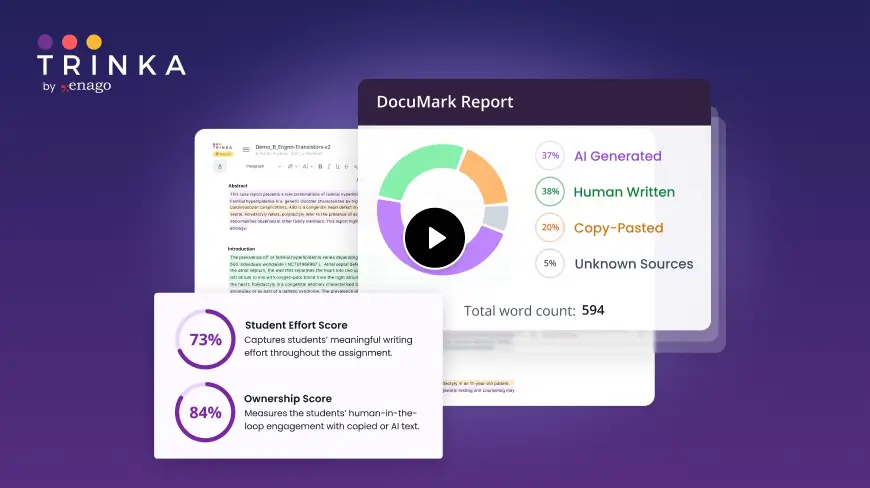
DocuMark: Responsible AI Use for Academic Integrity
Knowing your institution's AI policy is step one. DocuMark helps enforce it fairly by empowering universities to manage AI-generated content, prevent cheating, and support student writing through responsible AI use.
Common Questions About University of Stuttgart's AI Policies
University of Stuttgart has defined AI policies in 9 of 12 categories, with an overall coverage score of 75%.
Students are required to document AI use transparently in consultation with the examiner. For graded work and examinations, disclosure and labeling requirements are set by lecturers or examiners, who must communicate them clearly; examiner guidance also emphasizes that transparency and clear rules on labeling are essential.
The university guidance states that students can face sanctions for improper AI use or for failing to label adopted content, but it also notes that AI use is difficult to prove. The guidance therefore stresses fairness and the need for clear prior communication of permitted and prohibited uses, rather than presenting a reliable AI-detection regime.
The university sets explicit data-protection and approved-tool rules for AI use. Students and lecturers may not enter personal, confidential, internal, or copyrighted material into unsuitable AI systems, and employees must follow confidentiality classifications and the whitelist of approved AI system types; use permissions depend on the classification level of the information. The whitelist distinguishes university-owned systems, university interfaces to scientific-partner models, university-operated interfaces to commercial models, contracted external services, and non-audited public AI systems, with stricter limits on higher-classified data and public tools.