Teaching & Learning
- UT San Antonio leaves student AI use in coursework to faculty control at the course level
- Faculty are expected to state in the syllabus and course site whether AI use is encouraged, limited to certain assignments or activities, or not allowed at all
Faculty are responsible for their syllabus and courses. Because faculty may choose different approaches for generative AI, clearly state in the syllabus and the course homepage whether and how you are allowing the use of AI.
You always have control over your course, and you may choose to not use generative AI for your course. Examples of these statements include: a) Use of generative AI is encouraged to complete assignments; b) Use of generative AI is authorized only as a virtual learning assistant; c) Use of generative AI is not authorized.
Faculty should incorporate a statement in their syllabi that reflects how they expect students to use AI in their course. Faculty can:
• Encourage all students to fully embrace the use of generative AI to help with assignments in the course.
• Allow the use of generative AI only in certain circumstances, activities or assignments in the course as set out in the syllabus and assignment instructions.
• Not allow students to use generative AI in any form in the course.
- UT San Antonio states in the student conduct rules that using unauthorized AI during an examination, quiz, or other academic work is prohibited
- The faculty guidance also says instructors should clearly communicate when AI is not the right choice for certain assessments or is not allowed
giving aid to or seeking aid from another person where doing so is prohibited by the instructor, or using unauthorized assistance, material, or study aids during an examination, quiz, or other academic work;
failing to make any effort to prevent another from using unauthorized assistance, artificial intelligence, material, or study aids during an examination, quiz, or other academic work;
Additionally, faculty members should provide clear expectations and rationale for when AI might not be the optimal choice for certain assessments or is not allowed.
Provide clear expectations and rationale for when AI might not be the optimal choice for certain assessments or is not allowed.
- UT San Antonio encourages instructional uses of AI as a support tool for learning rather than a substitute for learning
- Faculty guidance includes allowing AI as a virtual learning assistant and teaching students to use generative AI for deeper learning, while emphasizing that it should complement development of core skills
AI is a tool to enhance, not replace, the educator's role in facilitating meaningful learning experiences. Use AI to complement teaching methods, emphasizing the development of creative, analytical, and problem-solving skills.
Examples of these statements include: a) Use of generative AI is encouraged to complete assignments; b) Use of generative AI is authorized only as a virtual learning assistant; c) Use of generative AI is not authorized.
▪ Teaching students to use generative AI as a tool for deeper learning.
This broader strategy ensures that AI serves as a valuable tool for learning, complementing students' efforts without overshadowing the critical thinking, writing, and analytical skills essential for lifelong success.
Research
- UT San Antonio allows limited AI assistance in research writing but requires transparency and human verification
- Authors must disclose use of generative AI to journals and co-authors, remain responsible for checking and editing outputs, and verify whether journals or grant applications prohibit AI use
Developing manuscripts and grant applications using AI:
▪ Authors must be transparent to the journal and the paper's co-authors in disclosing the use of generative AI tools for creating any portion of the work.
▪ Authors are responsible for checking the accuracy of the AI-generated outputs and should carefully edit any incorrect, incomplete, or biased content.
▪ Generative AI can help create outlines or summaries within the limitations described in the two above points.
▪ The use of generative AI tools for writing manuscripts or grant proposals may be prohibited in many cases. Check the specific journal or grant application requirements before using any AI tool.
- The research guidance specifically references AI being used to analyze and create peer reviews as prohibited by the sponsoring agency example it cites
- UT San Antonio does not provide a general research data-analysis rule, but it does prohibit uploading novel grant content into AI tools and warns about confidentiality risks in research review contexts
▪ Never upload your grant application (novel idea) into any AI tool as then it will be in the public domain and accessible by others.
For example, the National Institutes of Health (NIH) has prohibited scientific peer reviewers from employing natural language processors, large language models, or other generative Artificial Intelligence (AI) technologies to analyze and create peer reviews for grant applications and R&D contract proposals.
This limitation is in place due to concerns about maintaining confidentiality, as these AI tools lack guarantees regarding the handling, storage, access, and future use of data.
- It also states that researchers should check sponsoring-agency policies for peer review work and notes confidentiality-based prohibitions in that context
- UT San Antonio requires research transparency and accuracy review when AI is used in manuscripts or grant applications, and it warns that sponsor rules may prohibit such use
▪ Authors must be transparent to the journal and the paper's co-authors in disclosing the use of generative AI tools for creating any portion of the work.
▪ Authors are responsible for checking the accuracy of the AI-generated outputs and should carefully edit any incorrect, incomplete, or biased content.
▪ The use of generative AI tools for writing manuscripts or grant proposals may be prohibited in many cases. Check the specific journal or grant application requirements before using any AI tool.
Researchers should always check with the sponsoring agency regarding their policies and normal expectations for preparing reviews.
Using AI tools for composing critiques or improving grammar and syntax is also regarded as a breach of confidentiality.
Academic Integrity
- UT San Antonio recommends transparency and citation for AI use rather than imposing a single university-wide student disclosure rule
- Faculty are told to disclose their own AI approach to students, instructors may ask students to document how they used AI, and students are recommended or required in some contexts to attribute, properly cite, and provide secondary citations to verify AI-produced content
your students, always disclose your approach to AI integration, the factors considered when evaluating AI-generated content, and your rationale for adopting it.
To educate students to develop critical information literacy, they must provide a secondary citation to verify their AI response's content and correctly attribute it.
We recommend that students attribute and properly cite generative AI when it is used for text or images. Refer to the APA guidelines for proper citation and attribution:
• Assignments can encourage transparency by asking students to document how they used AI tools, what specific prompts or inputs they provided, and how the outputs were refined or integrated into their work.
- UT San Antonio says AI detection tools should not be relied on by themselves because they can be inaccurate
- Enforcement should follow the university code of conduct with evidence-based evaluation and communication with students, and unauthorized AI use in academic work is addressed under student conduct rules
AI detection tools, designed to identify the use of artificial intelligence in student work, operate using algorithms that analyze patterns and language structures. However, as AI-generated content continues to evolve, these tools are inherently imperfect and prone to false positives and false negatives.
Relying solely on detection tools can lead to inaccuracies and potential misunderstandings.
To uphold academic integrity, we emphasize following the established processes and guidelines outlined in the university's code of conduct. This ensures a fair and consistent approach to addressing concerns, relying on evidence-based evaluations and open communication with students rather than depending solely on AI detection results.
Turnitin is a powerful web-based tool designed to support academic integrity for both faculty and students. It helps identify unoriginal content in student submissions by comparing them against a vast database of web pages, academic works, and previously submitted papers.
giving aid to or seeking aid from another person where doing so is prohibited by the instructor, or using unauthorized assistance, material, or study aids during an examination, quiz, or other academic work;
failing to make any effort to prevent another from using unauthorized assistance, artificial intelligence, material, or study aids during an examination, quiz, or other academic work;
Institutional & Administrative
- UT San Antonio permits faculty and staff use of AI for teaching and work support, while requiring human oversight and clear communication
- Faculty guidance includes using AI for course design tasks and formative feedback, and staff guidance allows help with emails or presentations but says outputs must be reviewed, fact-checked, and edited
Generative AI can help create content and optimize time and engagement in your courses through capabilities such as:
▪ Create rubrics, assessment questions, and learning objectives.
▪ Provide students with constructive, formative feedback on their work.
Clarify the expectations for TAs and Graders regarding the use of AI, emphasizing the importance of academic integrity and the ramifications of improper AI use.
Generative AI is a fairly new tool and can enable us to work more efficiently and effectively. So, the next time you are struggling to craft an email or need help creating a presentation, you can use these tips to help you utilize AI.
Never use AI generated content without taking time to review, fact-check, and edit the result.
- UT San Antonio identifies Microsoft Copilot as the only UTSA-approved AI tool and the only safe way to use GPT-4 with UTSA data
- The university also instructs users not to enter confidential information into generative AI services, and faculty guidance stresses reviewing platform sign-on and data-privacy policies and teaching students about risks of sharing personal or sensitive data
Faculty, staff and students can use the Microsoft CoPilot license to get started with generative AI. This is the only
Microsoft Copilot is the only UTSA-approved AI tool because it offers the power of GPT-4 (a powerful AI large language model) with Microsoft’s stringent commercial data protection—meaning UTSA information is not being saved or used to teach the AI. This is the only safe way to use GPT-4 with UTSA data.
Microsoft Copilot (formerly Bing Chat Enterprise) is UTSA’s approved and protected AI-driven chat solution.
Please verify that you are signed in and see the Green "Protected" shield symbol. This is the only way to safely use Copilot.
Do not enter confidential information into any generative AI service.
Most AI tools retain any entered information for future use, which is a security risk.
It is critical to educate your students about data privacy and the potential risks associated with sharing personal information or sensitive data.
▪ Review the sign-on and data privacy policies for the various AI platforms available and read the privacy agreements and guidelines carefully.
- The initiative is charged with making recommendations on policy, processes, ethics, tools, and future planning for faculty, staff, and students
- UT San Antonio has an institution-level AI initiative led through a provost task force focused on responsible, strategic integration of AI across teaching, research, and operations
Artificial intelligence is rapidly transforming higher education, creating new opportunities to enhance teaching, research and administrative efficiency. Through the provost’s Artificial Intelligence Initiative, UT San Antonio is taking a proactive approach to integrate AI responsibly and strategically across the academic enterprise.
The task force will identify ways of empowering faculty, staff and students to use AI with confidence, competence, and integrity. Examining factors such as opportunities for skill development, policy and process improvements, ethical considerations, and potential pathways to collaborate with the College of AI, Cyber and Computing, the task force will make recommendations to the provost on integrating AI strategically and responsibly to support excellence in teaching, research and operations.
The task force commenced in October 2023 and will present its recommendations to the provost in March 2024.
DocuMark: Responsible AI Use for Academic Integrity
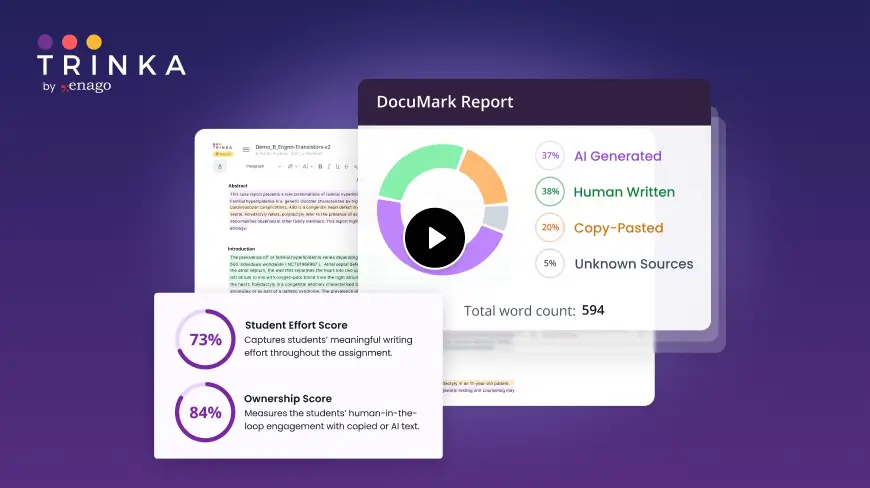
Knowing your institution's AI policy is step one. DocuMark helps enforce it fairly by empowering universities to manage AI-generated content, prevent cheating, and support student writing through responsible AI use.
Common Questions About University of Texas at San Antonio's AI Policies
University of Texas at San Antonio has defined AI policies in 11 of 12 categories, with an overall coverage score of 92%.
UT San Antonio recommends transparency and citation for AI use rather than imposing a single university-wide student disclosure rule. Faculty are told to disclose their own AI approach to students, instructors may ask students to document how they used AI, and students are recommended or required in some contexts to attribute, properly cite, and provide secondary citations to verify AI-produced content.
UT San Antonio says AI detection tools should not be relied on by themselves because they can be inaccurate. Enforcement should follow the university code of conduct with evidence-based evaluation and communication with students, and unauthorized AI use in academic work is addressed under student conduct rules.
UT San Antonio identifies Microsoft Copilot as the only UTSA-approved AI tool and the only safe way to use GPT-4 with UTSA data. The university also instructs users not to enter confidential information into generative AI services, and faculty guidance stresses reviewing platform sign-on and data-privacy policies and teaching students about risks of sharing personal or sensitive data.