Teaching & Learning
- AI policy for coursework is otherwise largely set at the course level by instructors, who are guided to state permitted and prohibited uses in the syllabus
- Students are broadly prohibited from using AI to create content or to complete or assist with assignments without authorization and proper citation under the university student conduct rules
- Program handbooks add stricter examples, including that AI may support learning but not complete assignments unless authorized, that students may not use AI as the primary source or writer of an assignment, and that unauthorized AI-generated content for academic work is treated as an academic integrity violation
Using artificial intelligence such as ChatGPT, DALL-E, or a similar service to create content and pass on that content as if it was one’s own without authorization and proper citation;
Using artificial intelligence such as ChatGPT, DALL-E, or a similar service to complete or assist in the completion of an assignment or test without authorization;
Clearly outline expectations regarding AI use in your syllabus. Start by determining which assessments, if any, will allow the use of Generative AI tools. If AI use is prohibited entirely, state that explicitly. If you permit AI for specific assessments, list those assessments and define what is allowed and what is restricted.
AI may be used to support learning—such as brainstorming, research guidance, or practice—but not to complete assignments, tests, assessments, case notes, client interventions, or biopsychosocial assessments unless authorized.
Students may not use AI as the primary source or writer of any assignment.
Unless explicitly permitted by the instructor, any use of AI to generate content for assignments, examinations, or other academic work is considered unauthorized assistance and a violation of academic integrity.
- The MSW handbook also states AI may not be used to complete tests or assessments unless authorized
- University-wide student conduct rules prohibit using AI to complete or assist with tests without authorization
- Faculty guidance says whether AI is allowed on particular assessments is determined at the course level and should be made explicit in the syllabus
Using artificial intelligence such as ChatGPT, DALL-E, or a similar service to complete or assist in the completion of an assignment or test without authorization;
Clearly outline expectations regarding AI use in your syllabus. Start by determining which assessments, if any, will allow the use of Generative AI tools. If AI use is prohibited entirely, state that explicitly. If you permit AI for specific assessments, list those assessments and define what is allowed and what is restricted.
Whether AI use is permitted or restricted for each assessment.
AI may be used to support learning—such as brainstorming, research guidance, or practice—but not to complete assignments, tests, assessments, case notes, client interventions, or biopsychosocial assessments unless authorized.
- UTRGV materials permit AI to be used for learning support when used responsibly
- Faculty-facing pages also encourage instructors to discuss AI's capabilities, limitations, and ethical use and to help students verify AI-generated information critically
- Program-level guidance in MSW explicitly allows AI to support learning for brainstorming, research guidance, or practice, but not to complete graded work unless authorized
AI may be used to support learning—such as brainstorming, research guidance, or practice—but not to complete assignments, tests, assessments, case notes, client interventions, or biopsychosocial assessments unless authorized.
As important as setting expectations is taking time to communicate them clearly to your students. In these conversations, address the capabilities, limitations, and ethical use of AI technologies, such as Microsoft Copilot, and explain how these relate to your course objectives.
Students should understand that information provided by AI should never be accepted at face value. Encourage them to analyze, question, and verify AI-generated content critically.
- As written, use of AI to obtain or use a computer program without permission or to submit computer code attributable to another source without indication of the source is prohibited; otherwise, AI use depends on authorization
- University-wide academic misconduct rules include AI-generated content and specifically list computer programs within cheating and plagiarism provisions, but they do not set a separate standalone rule for code-generation tools
Using, obtaining, or attempting to obtain by any meansthe whole or any part of a non-administered test, test key, homework solution, or computer program, or using a test that has been administered in prior classes or semesters, but which will be used again either in whole or in part, without permission of the instructor; or accessing a test bank without instructor permission;
Using artificial intelligence such as ChatGPT, DALL-E, or a similar service to complete or assist in the completion of an assignment or test without authorization;
Plagiarism is the appropriation of material that is attributable in whole or in part to another source, or the use of one’s own previous work in another context (self‐plagiarism) without any indication of the original source, including words, ideas, illustrations, structure, computer code, and other expression or media, and presenting that material as one’s own academic work being offered for credit or in conjunction with a program course or degree requirements.
Research
- The same document requires that AI use not compromise UTRGV information resources and that informed consent be obtained when collecting and using human data
- UTRGV's information security agreement permits AI for approved academic and research activities and specifically lists analyzing large datasets to extract insights as a permissible use, provided data privacy, security, and compliance are maintained
The appropriate use of AI involves utilizing AI technologies to enhance productivity, improve decision-making, and support the University’s goals while ensuring data privacy, security, and compliance with relevant regulations. Users must ensure that AI applications do not compromise the confidentiality, integrity, or availability of UTRGV Information Resources.
Permissible uses of AI include:
b. Analyzing large datasets to extract valuable insights.
f. Approved activities supporting the academic, research, and medical missions of UTRGV.
• Informed Consent: When collecting and using data from humans, clear and understandable informed consent must be obtained from the data subject and adherence to all applicable legal and ethical standards must be maintained.
- Those requirements include transparency and accountability, bias mitigation, respect for human rights, and informed consent when collecting and using human data
- UTRGV does not provide an AI-specific research misconduct policy in the provided research misconduct document, but its information security agreement sets ethical requirements for AI use that apply to approved research activities
f. Approved activities supporting the academic, research, and medical missions of UTRGV.
It is important to use AI responsibly and ethically, ensuring that AI applications are transparent, fair, and do not discriminate against any individuals or groups. Users must also be aware of the potential risks associated with AI and take appropriate measures to mitigate them.
• Transparency and Accountability: Transparency in the development, use, or application of AI or AI enabled systems, platforms, or services, including disclosure of data sources, algorithms, and decision-making processes must be respected. Individuals must also be accountable for the outcomes and consequences related to the development or use of AI systems.
• Bias Mitigation: Where appropriate, users must actively work to identify, report, and mitigate biases in AI algorithms and data, and strive to create or utilize AI systems that are fair and objective.
• Informed Consent: When collecting and using data from humans, clear and understandable informed consent must be obtained from the data subject and adherence to all applicable legal and ethical standards must be maintained.
Academic Integrity
- UTRGV has multiple layers of disclosure requirements
- The Student Code of Conduct requires proper citation for any authorized use of AI
- Faculty guidance also instructs instructors to specify citation or acknowledgment requirements in their syllabi
Using artificial intelligence such as ChatGPT, DALL-E, or a similar service to create content and pass on that content as if it was one’s own without authorization and proper citation;
If AI is used, students must provide proper citation and acknowledge the use of the AI tool in their work, following guidelines provided by the instructor or the appropriate academic style guide.
Requirements for citation or acknowledgment of AI assistance.
All uses of AI must be transparent, fair, ethical, and honest.
• Transparency and Accountability: Transparency in the development, use, or application of AI or AI enabled systems, platforms, or services, including disclosure of data sources, algorithms, and decision-making processes must be respected.
- UTRGV's materials focus on consequences and reporting rather than AI-detection tools
- Undisclosed or unauthorized AI use may be treated as academic misconduct or academic dishonesty, with discipline, disciplinary action, reporting through Vaqueros Report IT in MSW, grade reduction for unfact-checked AI content in MSW, and faculty discretion to readjust grades in nursing when a student cannot explain AI-assisted written work
Academic Misconduct is prohibited and subject to discipline.
Students who do not fact check their assignments may be subject to a reduction of points in the assignment. Misinformation, disinformation, or incorrect facts given to the student using AI or other technology will not be an allowable excuse for restoration of points.
Misuse of AI during practicum may also be considered academic dishonesty and be reported to Vaqueros Report IT.
Misuse of AI will be considered academic dishonesty and may result in disciplinary action.
"In any written paper with AI, the student must be able to explain if requested to summarize or apply his/her understanding of the concepts of the course. If unable to do so, the grade may be readjusted at the discretion of the faculty.
Institutional & Administrative
- UTRGV provides faculty-facing guidance encouraging instructors to explore approved AI tools, set course AI policies in the syllabus, and decide which assessments permit AI use
- Institutionally, users are told that AI should be used in ways consistent with university policy, ethics, law, privacy, and security, but the provided sources do not set detailed AI rules specifically for grading, recommendation letters, or administrative writing
A critical first step is to become familiar with Generative AI tools—their capabilities and limitations. Start by exploring Microsoft Copilot, an approved application for UTRGV that you can access through the My.UTRGV portal by selecting M365 under applications.
Clearly outline expectations regarding AI use in your syllabus. Start by determining which assessments, if any, will allow the use of Generative AI tools.
Please modify as you see fit and align to your teaching values, beliefs, and course learning objectives. These potential approaches are only an example and optional in case you would like to include in your syllabus.
Artificial Intelligence (AI) should be used in a manner that aligns with the University’s policies, ethical guidelines, and legal requirements.
- UTRGV requires AI use to protect confidentiality, integrity, and availability of university information resources and to comply with privacy, security, and legal requirements
- Users may not disclose confidential data except as legally permitted in official duties, and confidential data on personal devices must be encrypted; the university also identifies Microsoft Copilot as an approved application and requires technology assessment and approval before purchase or installation of tools for processing, storing, or transmitting data
Users must ensure that AI applications do not compromise the confidentiality, integrity, or availability of UTRGV Information Resources.
Users shall not disclose Confidential Data except as permitted or required by law and only as part of their official UTRGV duties.
Any personally owned computing devices on which Confidential UTRGV Data is stored or created must be encrypted and follow all prescribed UTRGV and UT-System policies, procedures, and standards.
Start by exploring Microsoft Copilot, an approved application for UTRGV that you can access through the My.UTRGV portal by selecting M365 under applications.
All technology, including software, hardware, appliances, cloud and local services, and any tools for processing, storing, or transmitting data must be assessed and approved by the appropriate offices before purchase or installation on UTRGV Information Resources.
- The provided sources do not identify a central AI committee or a formal university-wide strategic roadmap by name
- The same document points users to additional university AI policy and divisional guidance, and faculty resources present optional syllabus approaches for integrating or restricting AI in teaching
- UTRGV has institution-level AI governance language in its information security agreement that frames AI use around policy alignment, ethics, legal compliance, transparency, accountability, bias mitigation, and informed consent
Artificial Intelligence (AI) should be used in a manner that aligns with the University’s policies, ethical guidelines, and legal requirements.
At a minimum the ethical use of AI must provide for:
• Respect for Human Rights: AI technologies should be used in ways that respect and protect human rights, including privacy, dignity, and equality. Illegal or unethical use of AI technologies may result in disciplinary actions.
• Transparency and Accountability: Transparency in the development, use, or application of AI or AI enabled systems, platforms, or services, including disclosure of data sources, algorithms, and decision-making processes must be respected. Individuals must also be accountable for the outcomes and consequences related to the development or use of AI systems.
• Bias Mitigation: Where appropriate, users must actively work to identify, report, and mitigate biases in AI algorithms and data, and strive to create or utilize AI systems that are fair and objective.
• Informed Consent: When collecting and using data from humans, clear and understandable informed consent must be obtained from the data subject and adherence to all applicable legal and ethical standards must be maintained.
Further guidance on the use of AI can be found in the university’s AI Policy and in additional Information Security Office requirements and in divisional specific guidelines.
These potential approaches are only an example and optional in case you would like to include in your syllabus.
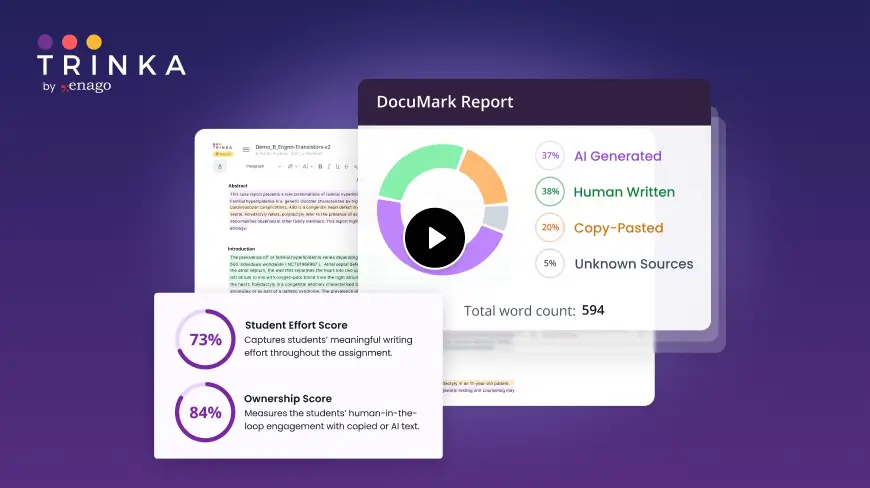
DocuMark: Responsible AI Use for Academic Integrity
Knowing your institution's AI policy is step one. DocuMark helps enforce it fairly by empowering universities to manage AI-generated content, prevent cheating, and support student writing through responsible AI use.
Common Questions About University of Texas Rio Grande Valley's AI Policies
University of Texas Rio Grande Valley has defined AI policies in 11 of 12 categories, with an overall coverage score of 92%.
UTRGV has multiple layers of disclosure requirements. The Student Code of Conduct requires proper citation for any authorized use of AI. The School of Podiatric Medicine handbook explicitly requires students to provide proper citation and acknowledge the use of the AI tool. Faculty guidance also instructs instructors to specify citation or acknowledgment requirements in their syllabi. At an institutional level, the information security agreement requires transparency in AI systems, including disclosure of data sources and algorithms, and the nursing handbook requires AI use to be transparent, fair, ethical, and honest.
UTRGV's materials focus on consequences and reporting rather than AI-detection tools. Undisclosed or unauthorized AI use may be treated as academic misconduct or academic dishonesty, with discipline, disciplinary action, reporting through Vaqueros Report IT in MSW, grade reduction for unfact-checked AI content in MSW, and faculty discretion to readjust grades in nursing when a student cannot explain AI-assisted written work.
UTRGV requires AI use to protect confidentiality, integrity, and availability of university information resources and to comply with privacy, security, and legal requirements. Users may not disclose confidential data except as legally permitted in official duties, and confidential data on personal devices must be encrypted; the university also identifies Microsoft Copilot as an approved application and requires technology assessment and approval before purchase or installation of tools for processing, storing, or transmitting data.