Teaching & Learning
- Use of AI in coursework is only permitted when it has been specifically allowed for that assessment item
- If AI-generated material is submitted without that specific permission, the university treats it as academic misconduct
- The university also says students must be given clear guidance for each assessment item about what AI use is appropriate
• Submission of material generated by artificial intelligence where such material has not been specifically deemed appropriate for that assessment item;
At UWS a commitment to Academic Integrity and the Principles for the use of Generative Artificial Intelligence (see Appendix 4) informs assessment practice. This is reflected in Chapter 5 Code of Discipline for Students (Regulatory Framework) which includes as academic misconduct the ‘submission of material generated by artificial intelligence where such material has not been specifically deemed appropriate for that assessment item’. This necessitates that clear guidance should be provided to students on what is deemed appropriate use of Generative AI for each assessment item.
- In examinations, accessing unauthorised material before or during the exam is treated as cheating
- The same academic integrity rules apply across assessments, and the university expects item-level guidance on permitted AI use
- For formal assessments, AI-generated material is prohibited unless it has been specifically deemed appropriate for that assessment item
• Submission of material generated by artificial intelligence where such material has not been specifically deemed appropriate for that assessment item;
• Cheating in an examination by accessing unauthorised material before or during an examination;
• Submission of unauthorised material in an assessment, such as material generated by artificial intelligence where such material has been specifically deemed unauthorised for that assessment item
- However, it does not set a specific operational rule here for personal, non-graded study assistance
- It also states that teaching, learning and assessment should incorporate ethical use of generative AI
- The university states an institutional aim to support students and staff in becoming generative AI literate and to help students use generative AI effectively and appropriately in their learning
In March 2024, the Learning and Teaching Committee approved five institutional principles for Generative Artificial Intelligence use, underpinning a range of institutional practice at UWS:
1. We ensure academic integrity and rigour is upheld.
2. We support students and staff to become generative AI literate.
3. We equip staff to support students to use generative AI tools effectively and appropriately in their learning experience.
4. We design learning, teaching and assessment to incorporate the ethical use of generative AI and support equal access.
- For programming-related academic work, the same assessment rule applies: AI-generated output is only allowed where it has been specifically deemed appropriate for that assessment item
- The university's data protection guidance also recognizes that generative AI tools can be used to produce code, but that statement is about data-protection controls for university business rather than permission for student coding assignments
• Submission of material generated by artificial intelligence where such material has not been specifically deemed appropriate for that assessment item;
Generative AI is a broad term used to describe any type of artificial intelligence (AI) that can be used to create new text, images, video, audio, or code.
The tools can be used to summarise articles/reports, or to generate answers to a question, or to produce code.
Research
- It also requires researchers to acknowledge all sources used in their research
- The university does not set a general rule on using AI to draft or edit research manuscripts
- It does, however, state that generative AI cannot be listed as a co-author, because authors must take public responsibility for the work and identify their contribution
anyone listed as an author of any work should be prepared to take public responsibility for that work and ensure its accuracy and be able to identify their contribution to it. For this reason, the use of generative AI as co-author is unacceptable.
3.14.7 Researchers must clearly acknowledge all sources used in their research and seek permission from any individuals if a significant amount of their work has been used in the publication.
- The university does not provide a general research policy on using AI for data analysis or synthetic data generation in the cited materials
- It does explicitly prohibit sharing material under peer review with generative AI tools, including research designs, data, or findings from a grant application, manuscript, or other material under review, unless the author(s) have given express permission
Researchers must maintain strict confidentiality and not retain or copy any material under review without the express written permission of the organisation which requested the review. Maintaining confidentiality includes not sharing any material with generative AI tools. They must not make use of research designs, data, or research findings from a grant application, manuscript, or other material under review without the express permission of the author(s) and must not allow others to do so.
- Researchers acting as peer reviewers must not share material under review with generative AI tools, and the use of generative AI as a co-author is unacceptable
- Separately, failure to obtain appropriate ethical approval for research or data collection activities is treated as academic misconduct in student conduct rules
- The university's research integrity materials do not set a broad AI framework for grant proposals or ethics applications, but they do impose specific integrity restrictions
Researchers must maintain strict confidentiality and not retain or copy any material under review without the express written permission of the organisation which requested the review. Maintaining confidentiality includes not sharing any material with generative AI tools. They must not make use of research designs, data, or research findings from a grant application, manuscript, or other material under review without the express permission of the author(s) and must not allow others to do so.
anyone listed as an author of any work should be prepared to take public responsibility for that work and ensure its accuracy and be able to identify their contribution to it. For this reason, the use of generative AI as co-author is unacceptable.
• Failure to obtain appropriate ethical approval for research or data collection activities; and
Academic Integrity
- For research publications, researchers must clearly acknowledge all sources used, and AI cannot be named as a co-author
- For student assessment, the university requires clear assessment-level guidance about what AI use is appropriate, but the provided sources do not set a university-wide rule requiring students to disclose or cite AI use in submitted work
This necessitates that clear guidance should be provided to students on what is deemed appropriate use of Generative AI for each assessment item.
3.14.7 Researchers must clearly acknowledge all sources used in their research and seek permission from any individuals if a significant amount of their work has been used in the publication.
anyone listed as an author of any work should be prepared to take public responsibility for that work and ensure its accuracy and be able to identify their contribution to it. For this reason, the use of generative AI as co-author is unacceptable.
- Attempts to circumvent similarity software are themselves misconduct
- The university uses plagiarism detection software together with other detection methods rather than relying on software alone
- Where unauthorised AI use or other non-original work is suspected, staff may request plans and drafts or interview students to judge whether they produced the work themselves, and the Academic Integrity Panel may question students as part of its investigation
• Subversion of, or attempts to circumvent, similarity software and other anti-cheating protocols;
• The University’s plagiarism detection software is used in conjunction with other means of detection to analyse assessment submissions in all modes where text-based plagiarism may be an issue;
• Where it is suspected that students submit work that is not their own, e.g., contract cheating, use of material generated by artificial intelligence where such material has not been deemed appropriate that assessment item, the module co-ordinator/PGR supervisor (or nominee) may take approaches to verify students’ work such as requesting plans and draft work, or interviewing students to form a judgement on whether or not students produced the work themselves.
The Student Academic Integrity Panel has the authority to ask students questions to investigate any alleged improper conduct or reports of academic misconduct.
Institutional & Administrative
- For staff, contractors and students using AI for university business, use is permitted subject to data protection restrictions
- The university states that staff should be equipped to support students in using generative AI effectively and appropriately in their learning experience
- The cited sources do not provide a specific rule on staff use of AI for grading, feedback, recommendation letters, or administrative communications beyond these general principles and data-protection controls
3. We equip staff to support students to use generative AI tools effectively and appropriately in their learning experience.
These guidelines set out how University staff, contractors and students are permitted to use generative AI tools when carrying out University business to ensure that we meet our obligations under data protection law.
- The university permits staff, contractors and students to use generative AI tools for university business only within data-protection rules
- Restricted or confidential information must not be entered into generative AI tools, including personal data, commercially sensitive information, passwords, university intellectual property, and some third-party non-personal data
- New AI tools involving restricted data must go through IT approval, the university maintains a register of approved tools, Copilot is the currently supported university AI tool under a UWS Microsoft licence, and other tools are approved only in exceptional circumstances with a business case
These guidelines set out how University staff, contractors and students are permitted to use generative AI tools when carrying out University business to ensure that we meet our obligations under data protection law.
1. Any information classified as Restricted or Confidential must not be submitted to generative AI tools (such as ChatGPT). Detail on what Information falls into these classifications can be found within our Data Handling Classification Protocol.
This includes the personal data of our staff, students, visitors, research participants and others and also sensitive non personal information that is commercially sensitive data.
2. Information that, if compromised or lost, could have damaging consequences for other individuals, groups of individuals, or the University more generally (including reputational damage) should not be submitted into generative AI tools, for example copyright protected materials, where the volume of material exceeds the provisions for fair dealing, available to educational institutions and students.
3. University passwords and usernames should never be inputted into AI tool.
4. Any data related to University Intellectual Property.
5. Any non-personal data from third parties where the individual has not explicitly consented for their data to be used with AI, with the exception of data that is clearly already in the public domain.
The use of any new AI tools involving the categories of restricted data set out above must be requested via logging a change request with the IT service desk (helpdesk@uws.ac.uk). IT will maintain a register of University approved Generative AI tools, outlining what levels of data and information can safely be used within those applications, and for what purposes.
Co-pilot is the currently supported University AI tool and is available with a UWS Microsoft licence.
Requests for use of other tools will only be approved in exceptional circumstances where a suitable business case is shown.
- The cited sources do not identify a university-wide AI task force or broader standalone AI strategy document beyond these principles and governance controls
- The university has an institution-level AI position through five institutional principles for generative AI approved by the Learning and Teaching Committee in March 2024
- These principles focus on academic integrity, AI literacy for students and staff, staff support for student use, ethical integration of AI into learning, teaching and assessment, equal access, and collaborative sharing of practice
In March 2024, the Learning and Teaching Committee approved five institutional principles for Generative Artificial Intelligence use, underpinning a range of institutional practice at UWS:
1. We ensure academic integrity and rigour is upheld.
2. We support students and staff to become generative AI literate.
3. We equip staff to support students to use generative AI tools effectively and appropriately in their learning experience.
4. We design learning, teaching and assessment to incorporate the ethical use of generative AI and support equal access.
5. We work collaboratively to share best practice as the technology and its application in the education process.
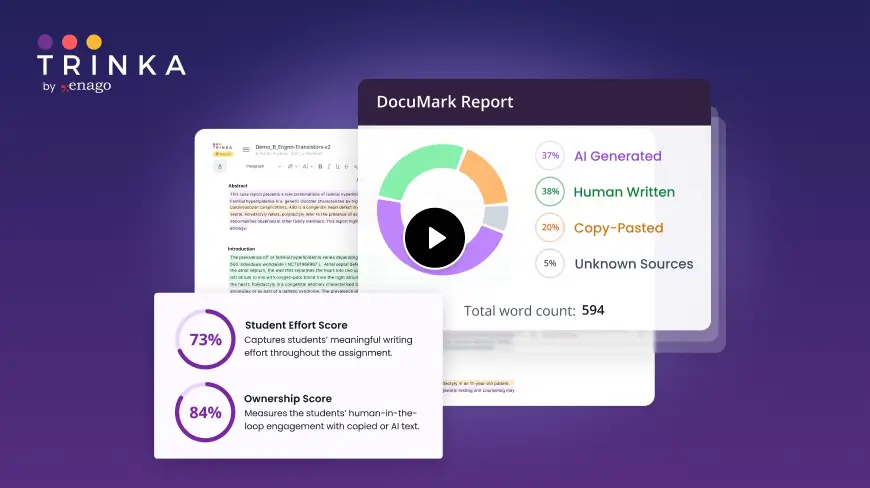
DocuMark: Responsible AI Use for Academic Integrity
Knowing your institution's AI policy is step one. DocuMark helps enforce it fairly by empowering universities to manage AI-generated content, prevent cheating, and support student writing through responsible AI use.
Common Questions About University of the West of Scotland's AI Policies
University of the West of Scotland has defined AI policies in 12 of 12 categories, with an overall coverage score of 100%.
For student assessment, the university requires clear assessment-level guidance about what AI use is appropriate, but the provided sources do not set a university-wide rule requiring students to disclose or cite AI use in submitted work. For research publications, researchers must clearly acknowledge all sources used, and AI cannot be named as a co-author.
The university uses plagiarism detection software together with other detection methods rather than relying on software alone. Where unauthorised AI use or other non-original work is suspected, staff may request plans and drafts or interview students to judge whether they produced the work themselves, and the Academic Integrity Panel may question students as part of its investigation. Attempts to circumvent similarity software are themselves misconduct.
The university permits staff, contractors and students to use generative AI tools for university business only within data-protection rules. Restricted or confidential information must not be entered into generative AI tools, including personal data, commercially sensitive information, passwords, university intellectual property, and some third-party non-personal data. New AI tools involving restricted data must go through IT approval, the university maintains a register of approved tools, Copilot is the currently supported university AI tool under a UWS Microsoft licence, and other tools are approved only in exceptional circumstances with a business case.