Teaching & Learning
- Use of GenAI in coursework is permitted only within module-specific rules and must follow assignment-level authorization
- The university uses a sliding scale: low-risk uses are permitted with disclosure, some moderate-risk uses may be allowed if explicitly set out by the module leader, and producing entire assignments with AI is treated as unacceptable academic misconduct
Understand and adhere to GenAI rules within each module.
Disclose/cite any GenAI use that influenced submitted work using guidance provided by staff, the Library, the module handbook and the assessment brief
Use of GenAI in the context of coursework can be viewed through the lens of a sliding scale from fully acceptable to unacceptable.
GenAI is used sparingly for basic tasks:
* Writing assistance (e.g. grammar checks, paraphrasing suggestions, streamlining word counts)
* Study support (e.g. summarising notes, generating practice questions)
* Brainstorming ideas or outlining structure
Permitted with disclosure.
This kind of approach needs to be made explicit by the module leader in the module handbook and student facing assessment briefs supported by opportunities to explain and discuss.
Detailed disclosure in coursework submissions is required.
GenAI is used to:
* Produce entire assignments, essays, or code with no meaningful student input
* Generate fake data, citations, or reflection
Circumvent exam or controlled conditions
- Using AI beyond permitted assessment instructions, including during controlled conditions, is treated as academic misconduct
- AI use in assessment is not uniformly allowed across the university; students must check whether it is authorized for the specific assignment, module, or course
AI can be a useful teaching and learning tool. The use of AI in assessment does not automatically breach standards of academic integrity but before beginning any piece of assessed work, students must check with their course team that the use of AI tools is authorised, as this practice may differ across assignments, modules and courses of study.
Where AI has been used by a student as part of an assessment, it must be acknowledged appropriately and in line with University guidance to ensure that any output is not misconstrued as the student’s own work.
Inappropriate use of Generative Artificial Intelligence (AI) tools
Generative AI tools deployed for assessment purposes without authorisation or beyond that permitted in the assessment instructions.
GenAI is used to:
* Produce entire assignments, essays, or code with no meaningful student input
* Generate fake data, citations, or reflection
Circumvent exam or controlled conditions
- The guidance emphasizes that AI can support learning but does not replace student understanding, critical thinking, or judgment
- The university permits students to use GenAI for personal learning support, such as study support and practice activities, provided it is used ethically and with academic honesty
Use GenAI tools to help learning ethically and with academic honesty
GenAI is used sparingly for basic tasks:
* Writing assistance (e.g. grammar checks, paraphrasing suggestions, streamlining word counts)
* Study support (e.g. summarising notes, generating practice questions)
* Brainstorming ideas or outlining structure
Permitted with disclosure.
Generative AI tools can produce new content, (such as text, images, audio, video, or computer code), in response to prompts you provide. Many of these tools are now built into familiar software, such as web browsers or document editors.
These tools can support learning, but they do not replace your understanding, critical thinking, or academic judgement. You are always responsible for the work you submit.
- AI-assisted coding is addressed in both taught and doctoral guidance
- Generating code skeletons may be acceptable with detailed disclosure when module documentation allows it
- AI may also be used to support processes like testing and debugging code, provided this is properly acknowledged, but producing entire assignments or code with no meaningful student input is unacceptable
GenAI is used to:
* Assist with structuring content, generating code skeletons, or visual assets
This kind of approach needs to be made explicit by the module leader in the module handbook and student facing assessment briefs supported by opportunities to explain and discuss.
Detailed disclosure in coursework submissions is required.
GenAI is used to:
* Produce entire assignments, essays, or code with no meaningful student input
* to support a particular process such as testing and debugging code or translating
Research
- Generating new text/content and substantive rewriting are identified as unacceptable uses that may lead to misconduct, and any use in a thesis must be acknowledged and referenced
- For doctoral research, the university allows limited AI assistance such as proofreading, but requires the researcher to critically review outputs and preserve authorship integrity
The overriding principle in avoiding abuses and malpractice of GenAI tools is to ensure that research is conducted with integrity. Again, while not exhaustive, unacceptable use of GenAI which may lead to misconduct would include:
* proofreading (proofread your own work first, use the tool as an assistant, and critically review its suggestions to ensure accuracy and alignment with your intended meaning and style)
* generating new text/content
* Using GenAI to re-write text that you have written yourself (while acceptable use may include refining text and sentence restructure, it would be unacceptable to use tools for substantive changes to your original text, such as condensing or re-writing any of your sentences or sections of work).
A key part of maintaining the integrity of your research and thesis is to appropriately acknowledge the use of GenAI, in the same way that you would acknowledge and reference sources used. As the content created in GenAI tools cannot be replicated by another person and cannot be linked to, you must reference the outputs in the same way that you would a personal communication or correspondence.
- For doctoral research, the university treats AI use for data analysis, pattern recognition, and generating insights as a high-risk area that may lead to misconduct unless tightly limited
- The guidance requires caution on privacy, copyright, and integrity grounds, limits use to trustworthy tools that do not train on uploaded data, and prohibits entering personal or sensitive information into generative AI tools
* for data analysis, pattern recognition, or generating insights (caution is needed with data analysis in terms of privacy, copyright and integrity as it requires input of research data and therefore it should be limited to trustworthy software or tools that do not use uploaded data for training purposes or automate critical analysis or deduction)
Do not enter any personal or sensitive information about yourself or others into a Generative AI tool. Doing so risks the data being shared online or being used to train the AI and would be a breach of GDPR to share someone else’s information.
data that cannot be anonymised must be held securely and in confidence, with coded access as appropriate, for a pre-set period of time which is subject to the consent of the individual concerned and the needs of the study or potential future requirements
anonymous, raw data should be transcribed or transferred for analysis as quickly as possible after collection;
once transcribed or transferred, the data should be stored securely in condensed form;
- Research misconduct procedures also apply to failures involving data handling, falsification, fabrication, plagiarism, and compliance with procedures or legislation
- The university requires GenAI use in research applications and research outputs to be clearly acknowledged and aligned with ethics review and sponsor requirements where relevant
AI tools can however be used in ethical and appropriate ways, during the application process, to generate ideas and inspiration or to help with the development of a research proposal or personal statement. The use of any GenAI tools should be clearly acknowledged. Research applicants should be advised to read Ulster’s position in the use of AI tools before applying, particularly the Governance and Ethics section of the website.
6. I have checked that sharing of content with GenAI tools is consistent with guidelines for the handling of material in any contractual agreements with individual sponsors (if relevant) and accrediting bodies.
7. I have considered whether my use of GenAI tools conforms to Ulster University’s ethics review regulations, including where necessary by engaging with the ethics review processes and I have received a positive response to my ethical review application.
8. I have checked that sharing of content with GenAI tools is consistent with my ethics review approval (if relevant).
Appendix I Definition of Research Misconduct
The following are intended as examples of research misconduct.
Fabrication
Falsification
Misrepresentation of data and/or interests or involvement
Plagiarism
Failure to follow procedures, regulations or legislation in relation to:
risk or harm to human subjects (including their data or tissues), animals or the environment
the proper handling and storage of personal information obtained from research subjects
Academic Integrity
- Disclosure of AI use is required whenever AI influenced submitted coursework or authorized academic work
- For theses, the university requires a declaration including the tool name and version, source, how it was used, date of output generation, and confirmation that use was discussed with the supervisory team
All use of GenAI should be acknowledged in coursework whatever form it takes, and this is highlighted in the student declaration that accompanies all submitted work.
Disclose/cite any GenAI use that influenced submitted work using guidance provided by staff, the Library, the module handbook and the assessment brief
If you are permitted to use Generative AI for academic purposes, you must acknowledge it clearly.
A key part of maintaining the integrity of your research and thesis is to appropriately acknowledge the use of GenAI, in the same way that you would acknowledge and reference sources used. As the content created in GenAI tools cannot be replicated by another person and cannot be linked to, you must reference the outputs in the same way that you would a personal communication or correspondence.
As a minimum, you should include the following detail as part of your declaration of use of GenAI:
* Name and version of the GenAI tool used, e.g. ChatGPT-3.5
* URL or source of the GenAI tool
* A brief description of how the tool was used
* Date the content/output was generated
* Confirmation that use has been discussed with the supervisory team
- Undisclosed or unauthorized AI use in assessment is enforceable under the student academic misconduct procedure
- The university explicitly states that failing to acknowledge AI may be treated as misconduct, and it has disabled Turnitin’s AI detection service because of ethical, accuracy, and privacy concerns
If Generative AI is used without being acknowledged, this may be treated as academic misconduct. Before starting assessed work, always be clear whether GenAI use is allowed, restricted, or not appropriate for that assessment.
Acknowledging use does not automatically lead to penalty. Failing to acknowledge use is the real risk
Inappropriate use of Artificial Intelligence (AI) tools – AI tools deployed for assessment purposes without authorisation or beyond that permitted in the assessment instructions. This includes submitting AI-generated content without acknowledgement, or presenting AI-generated work as original, even if acknowledged.
Turnitin do provide an AI detection service writing which can be integrated within normal grading workflows. Instructors are presented with a prediction of the likelihood of a piece of work being generated by AI tools, such as ChatGPT, when they are grading a paper. However, The AI working group, at Ulster, had many concerns from an ethical, accuracy and privacy perspective and made the decision to disable this tool.
Institutional & Administrative
- Staff are expected to support student disclosure practices, design module-level rules, and engage with responsible, ethical, and effective uses of GenAI
- The university provides staff-facing guidance focused on responsible use of GenAI in learning, teaching, and assessment design rather than a detailed operational policy for grading or administration
Guidance on using AI at course level for staff
The AiCoP supports staff to explore responsible, ethical and effective uses of GenAI in learning, teaching and assessment.
This kind of approach needs to be made explicit by the module leader in the module handbook and student facing assessment briefs supported by opportunities to explain and discuss.
Disclose/cite any GenAI use that influenced submitted work using guidance provided by staff, the Library, the module handbook and the assessment brief
- It also warns students not to upload work to unapproved plagiarism detectors or answer-sharing platforms and states that only university-approved platforms should be used
- The university prohibits sharing personal or sensitive data with generative AI tools and emphasizes use of trustworthy tools that do not train on uploaded data for research contexts
Before experimenting with any generative AI tool, you should give some consideration to privacy. We do not know what data is being collected, by whom, and how it is applied in AI when we use these tools. For this reason, you should not share personal or sensitive data - for instance it would not be appropriate to ask an AI tool to perform some analysis on a dataset containing student data.
Do not enter any personal or sensitive information about yourself or others into a Generative AI tool. Doing so risks the data being shared online or being used to train the AI and would be a breach of GDPR to share someone else’s information.
* for data analysis, pattern recognition, or generating insights (caution is needed with data analysis in terms of privacy, copyright and integrity as it requires input of research data and therefore it should be limited to trustworthy software or tools that do not use uploaded data for training purposes or automate critical analysis or deduction)
I understand that I must not upload my work before, during or after submission to any unapproved plagiarism detectors or answer sharing platforms, or equivalent, and that only University-approved platforms should be used.”
- The university also references an AI working group and an AI Community of Practice as governance and implementation structures supporting responsible adoption
- Ulster frames GenAI through a values-led institutional strategy tied to People, Place and Partnership, the Principles and Qualities of Learning, Teaching and the Student Experience, and Graduate Attributes
At Ulster University, our approach to Generative Artificial Intelligence (GenAI) in learning and teaching practice is guided by our institutional strategy, People, Place and Partnership: Delivering Sustainable Futures for All, our Principles and Qualities of Learning, Teaching and the Student Experience, and the Graduate Attributes .
When designing learning, teaching or assessment considering GenAI, ask yourself:
Does this enhance active student engagement?
Does it promote inclusion and equity?
Does it preserve authentic disciplinary judgement?
Does it strengthen relationships and partnership?
Does it develop our graduate attributes?
If so, it aligns with our principles and with People, Place and Partnership — ensuring the student experience remains protected, enhanced and future-facing.
GenAi is not an external disruption to be managed in isolation. It is one of many technological developments that must be integrated through principled, research-informed and values-led practice.
The AiCoP supports staff to explore responsible, ethical and effective uses of GenAI in learning, teaching and assessment.
However, The AI working group, at Ulster, had many concerns from an ethical, accuracy and privacy perspective and made the decision to disable this tool.
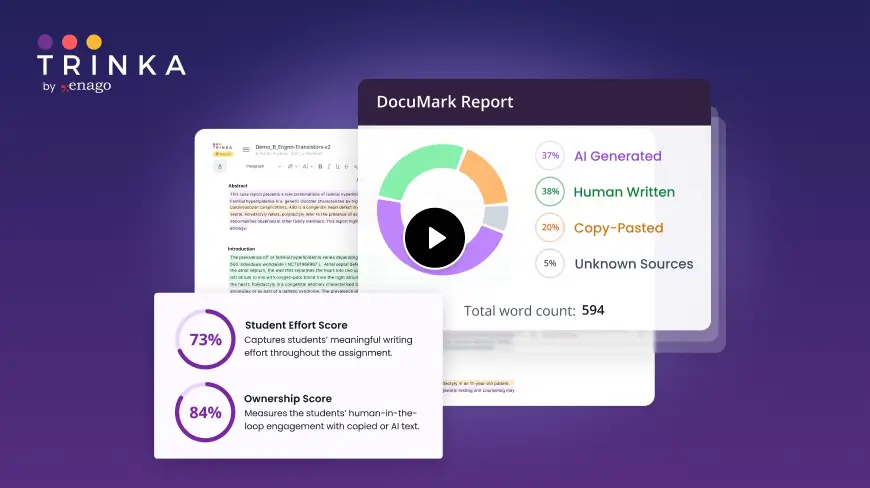
DocuMark: Responsible AI Use for Academic Integrity
Knowing your institution's AI policy is step one. DocuMark helps enforce it fairly by empowering universities to manage AI-generated content, prevent cheating, and support student writing through responsible AI use.
Common Questions About University of Ulster's AI Policies
University of Ulster has defined AI policies in 12 of 12 categories, with an overall coverage score of 100%.
Disclosure of AI use is required whenever AI influenced submitted coursework or authorized academic work. For theses, the university requires a declaration including the tool name and version, source, how it was used, date of output generation, and confirmation that use was discussed with the supervisory team.
Undisclosed or unauthorized AI use in assessment is enforceable under the student academic misconduct procedure. The university explicitly states that failing to acknowledge AI may be treated as misconduct, and it has disabled Turnitin’s AI detection service because of ethical, accuracy, and privacy concerns.
The university prohibits sharing personal or sensitive data with generative AI tools and emphasizes use of trustworthy tools that do not train on uploaded data for research contexts. It also warns students not to upload work to unapproved plagiarism detectors or answer-sharing platforms and states that only university-approved platforms should be used.