Teaching & Learning
Research
- This guidance is framed for staff and does not set a specific university-wide rule for research manuscripts alone
- The university's copyright guidance permits staff to use generative AI to support writing tasks such as generating ideas, suggesting text, improving style, and translation, but it warns that users remain responsible for checking outputs and for copyright risks
Using AI software to create written material in a workplace setting is likely to be useful and is unlikely to infringe copyright. Such uses might include:
• Suggesting ideas based on prompts
• Creating or suggesting text based on prompts
• Improving style / editing and proofreading
• Summarising longer text
• Translation.
You should still be aware that AI software can produce factually inaccurate, biased or otherwise distorted information, so should not rely on this without checking it carefully.
The user of AI software remains potentially responsible if AI-generated outputs are used to infringe copyright.
- The university's research ethics materials require researchers to address the use of AI in ethics applications
- Applicants must state whether AI will be used in the project and explain the associated ethical issues and how they will be handled
Will Artificial Intelligence (AI) be used in your research? Y/N
If yes please explain what ethical issues this raises and how these will be addressed.
Academic Integrity
Institutional & Administrative
- Staff are told not to rely on outputs without careful checking, and responsibility remains with the user if AI output infringes copyright
- The university provides staff-facing guidance that generative AI may be used in workplace writing tasks, including idea generation, drafting, editing, summarising, and translation
Using AI software to create written material in a workplace setting is likely to be useful and is unlikely to infringe copyright. Such uses might include:
• Suggesting ideas based on prompts
• Creating or suggesting text based on prompts
• Improving style / editing and proofreading
• Summarising longer text
• Translation.
You should still be aware that AI software can produce factually inaccurate, biased or otherwise distorted information, so should not rely on this without checking it carefully.
The user of AI software remains potentially responsible if AI-generated outputs are used to infringe copyright.
- It also warns that AI-generated outputs may still create copyright liability for the user
- The staff copyright guidance warns users not to upload material they do not have permission to use into public AI systems, because prompts and uploads may be stored and reused to train models
As a rule, users should avoid entering content into publicly available AI software unless they have permission or a legal right to do so. As with all software, users should familiarise themselves with the software licence terms and privacy notices before uploading or entering content. AI software may store your prompts and uploads and make use of those to train the AI model.
It should be noted that if software is used to generate a substantial amount of output that is copied from the works of a copyright owner, that might amount to copyright infringement.
The user of AI software remains potentially responsible if AI-generated outputs are used to infringe copyright.
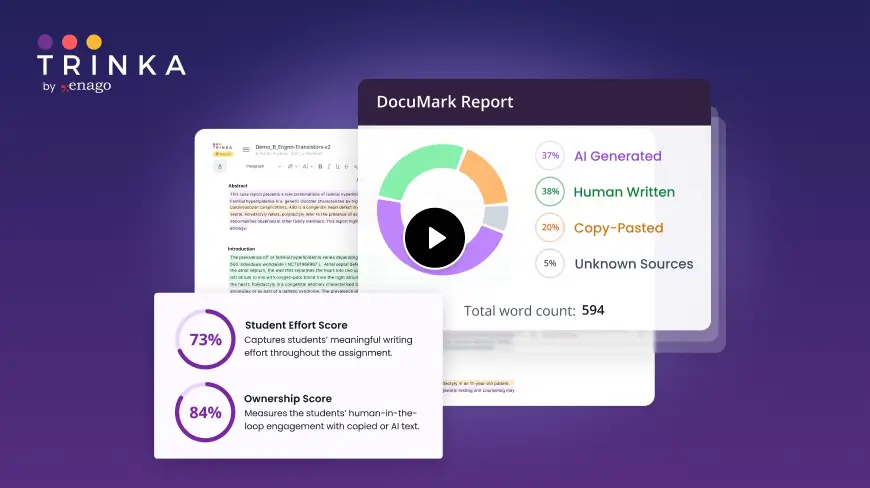
DocuMark: Responsible AI Use for Academic Integrity
Knowing your institution's AI policy is step one. DocuMark helps enforce it fairly by empowering universities to manage AI-generated content, prevent cheating, and support student writing through responsible AI use.
Common Questions About University of Wales Lampeter's AI Policies
University of Wales Lampeter has defined AI policies in 4 of 12 categories, with an overall coverage score of 33%.
No explicit disclosure requirement is currently defined in the available policy sources.
No explicit detection or enforcement process is currently defined in the available policy sources.
The staff copyright guidance warns users not to upload material they do not have permission to use into public AI systems, because prompts and uploads may be stored and reused to train models. It also warns that AI-generated outputs may still create copyright liability for the user.