Teaching & Learning
- Warwick Law provides a faculty-specific example allowing AI only when permitted by the module convenor and requiring acknowledgement
- For student coursework, use of AI is only permitted where it is expressly allowed by the relevant department, module, or assessment guidance
- University-level guidance says students must follow specific local rules, and undisclosed or unauthorized use can be treated as academic misconduct
If your course or module allows the use of AI then your lecturer will explain your assignment's requirements and will outline acceptable usage.
If your course or module does not allow the use of AI, then using AI to generate any materials that are then represented as your own work is not permitted and you could be at risk of being accused of academic misconduct.
There are many legitimate uses of AI in the context of academic work, for example helping to explain key concepts. As above, your department will tell you what is and is not appropriate and in what circumstances and there may be different approaches to AI use in different departments or even in different modules within the same department.
Any use of AI in assessed work or exams should be acknowledged and clearly explained.
The default position is that the use of AI is prohibited in all assessed work, unless your module convener has expressly stated otherwise in a module handbook or other module-specific guidance. In all cases, use of AI must be acknowledged explicitly and appropriately by the student.
- Warwick Law states a stricter faculty-level default for assessed work: AI is prohibited unless expressly allowed by the module convener
- The university states that AI use in assessed work and exams must be acknowledged and explained, but whether AI is allowed depends on department, module, or assessment-specific instructions
Your department will tell you what is and isn't acceptable AI usage in your course, module or assessment.
Any use of AI in assessed work or exams should be acknowledged and clearly explained.
The default position is that the use of AI is prohibited in all assessed work, unless your module convener has expressly stated otherwise in a module handbook or other module-specific guidance. In all cases, use of AI must be acknowledged explicitly and appropriately by the student.
- Warwick explicitly recognizes AI as having legitimate study-support uses, such as explaining concepts, brainstorming, and generating practice questions
- The student guidance frames these uses as acceptable learning support, while warning that students remain responsible for checking outputs and ensuring their submitted work complies with course rules
There are many legitimate uses of AI in the context of academic work, for example helping to explain key concepts.
The use of AI in learning can be beneficial for helping students to understand topics and concepts, to aid with revision and can provide a new way of approaching study tasks. AI tools can also be useful for helping students to improve their understanding and practice some of the skills and tasks that may be required during their academic work, such as helping to refine arguments or generate ideas.
Students can use AI tools for:
• brainstorming or refining ideas, such as creating essay plans or other structures;
• generating practice tests, case studies, questions or examples to support their learning;
• support understanding by explaining difficult concepts and theories or to provide examples
Research
- Warwick allows AI tools to support research writing only in limited ways and does not permit listing AI as an author
- Researchers must remain accountable for the accuracy, integrity, and originality of their work, and any AI-assisted drafting or editing must be disclosed where required by publishers, funders, or local guidance
Researchers should not list AI tools as authors of research outputs.
Researchers remain responsible and accountable for all content in outputs where AI tools have been used.
Researchers should be transparent about where and how AI tools have been used in the preparation of research outputs, in line with publisher, funder and disciplinary requirements.
Use of AI tools for drafting, editing or improving text should be approached with caution, and researchers should carefully review outputs for accuracy, bias, plagiarism, and confidentiality risks.
- Warwick permits use of AI in research data and analysis only with careful human oversight and subject to legal, ethical, and data-protection constraints
- Researchers are responsible for validating outputs and must consider confidentiality, bias, consent, intellectual property, and whether the tool is appropriate for the data and method used
Researchers considering the use of AI tools in data collection, analysis, interpretation or visualisation should ensure that such use is appropriate for the research design and complies with disciplinary, legal and ethical standards.
Researchers must carefully assess the risks of uploading research data into AI systems, particularly where data are confidential, personal, commercially sensitive, or subject to contractual restrictions.
Researchers remain responsible for verifying the accuracy and validity of AI-generated analyses or interpretations.
The use of AI tools in research involving human participants may require consideration in ethics applications, particularly where AI is used to collect, analyse or generate data.
- Warwick has explicit research-integrity expectations for AI use
- Researchers must follow research integrity, ethics, legal, and funder requirements; consider AI use in ethics applications where relevant; and remain accountable for all outputs and declarations associated with their research
The use of AI in research must comply with the principles of research integrity, including honesty, rigour, transparency, open communication, care and respect, and accountability.
Researchers should ensure that any use of AI tools is consistent with the University's Research Integrity Policy and relevant ethical approval processes.
The use of AI tools in research involving human participants may require consideration in ethics applications, particularly where AI is used to collect, analyse or generate data.
Researchers should be transparent about where and how AI tools have been used in the preparation of research outputs, in line with publisher, funder and disciplinary requirements.
Academic Integrity
- Warwick requires disclosure when AI is used in assessed work or exams, and students must clearly explain that use
- Faculty-specific guidance from Warwick Law adds that students must acknowledge AI explicitly and appropriately whenever it is used in assessed work where permitted
Any use of AI in assessed work or exams should be acknowledged and clearly explained.
In all cases, use of AI must be acknowledged explicitly and appropriately by the student.
- Warwick treats unauthorized AI-generated material submitted as a student's own work as potential academic misconduct
- The policy materials provided describe misconduct risk and the academic integrity regulatory framework, but they do not set out a specific institutional stance on AI detection tools in the cited text
If your course or module does not allow the use of AI, then using AI to generate any materials that are then represented as your own work is not permitted and you could be at risk of being accused of academic misconduct.
Academic misconduct is any action or attempted action that may result in creating an unfair academic advantage for yourself or an unfair academic advantage or disadvantage for any other member or members of the academic community.
These regulations are designed to ensure a fair and consistent approach in the treatment of alleged academic misconduct by students of the University, and to ensure that all allegations are investigated thoroughly and fixed penalties or sanctions are imposed where academic misconduct is admitted or found proven.
Institutional & Administrative
- Warwick provides staff guidance encouraging responsible use of AI in teaching and related work, while stressing human oversight, transparency, and compliance with university rules
- The materials support staff use for teaching preparation and educational activities, but do not establish a single mandatory rule for grading, recommendation letters, or all administrative uses in the cited text
This site provides guidance for Warwick staff on the use of generative artificial intelligence (GenAI) tools in teaching, learning and assessment.
When using GenAI, staff should consider how they can use these tools responsibly and ethically, and with awareness of the limitations and risks of these tools.
The output of GenAI tools should always be reviewed by a human. Users remain responsible for the content they produce with the support of GenAI.
You should be transparent about your use of GenAI where appropriate.
- Warwick restricts what data may be entered into public or external AI tools and requires compliance with information governance rules
- University guidance says confidential, personal, commercially sensitive, and other restricted data should not be uploaded unless approved safeguards are in place, and users must follow information classification and protection requirements
Do not input confidential, personal, sensitive or commercially valuable information into publicly available GenAI tools unless you are certain that appropriate contractual, technical and organisational safeguards are in place.
Researchers must carefully assess the risks of uploading research data into AI systems, particularly where data are confidential, personal, commercially sensitive, or subject to contractual restrictions.
Information must be protected in line with its classification and handled according to the University's Information Classification Standard.
Personal data must be processed in accordance with data protection legislation and University policies.
- Warwick has institution-level AI governance and principles through university guidance on responsible use and explanatory policy materials
- The cited materials emphasize responsible, ethical, transparent, and human-reviewed AI use across education and research, but they do not set out a single detailed university-wide AI strategy roadmap in the provided text
When using GenAI, staff should consider how they can use these tools responsibly and ethically, and with awareness of the limitations and risks of these tools.
The output of GenAI tools should always be reviewed by a human. Users remain responsible for the content they produce with the support of GenAI.
The use of AI in research must comply with the principles of research integrity, including honesty, rigour, transparency, open communication, care and respect, and accountability.
This page explains Warwick's institutional approach to AI policy in education.
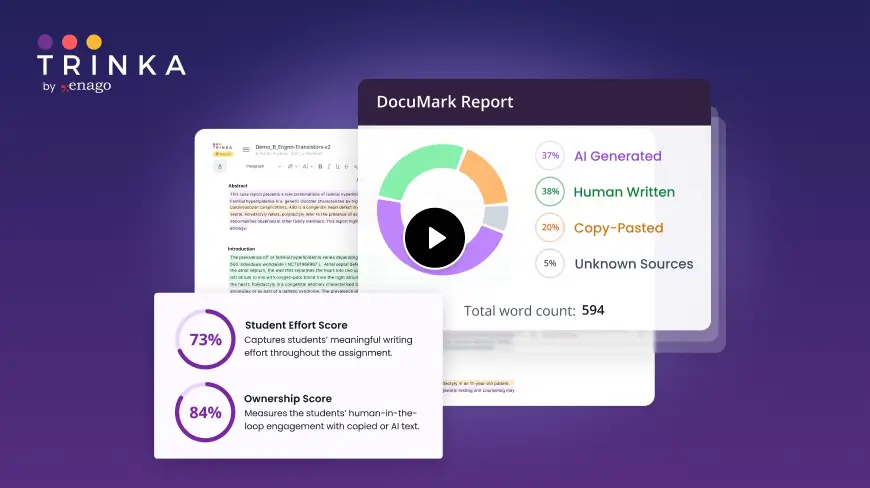
DocuMark: Responsible AI Use for Academic Integrity
Knowing your institution's AI policy is step one. DocuMark helps enforce it fairly by empowering universities to manage AI-generated content, prevent cheating, and support student writing through responsible AI use.
Common Questions About University of Warwick's AI Policies
University of Warwick has defined AI policies in 11 of 12 categories, with an overall coverage score of 92%.
Warwick requires disclosure when AI is used in assessed work or exams, and students must clearly explain that use. Faculty-specific guidance from Warwick Law adds that students must acknowledge AI explicitly and appropriately whenever it is used in assessed work where permitted.
Warwick treats unauthorized AI-generated material submitted as a student's own work as potential academic misconduct. The policy materials provided describe misconduct risk and the academic integrity regulatory framework, but they do not set out a specific institutional stance on AI detection tools in the cited text.
Warwick restricts what data may be entered into public or external AI tools and requires compliance with information governance rules. University guidance says confidential, personal, commercially sensitive, and other restricted data should not be uploaded unless approved safeguards are in place, and users must follow information classification and protection requirements.