Teaching & Learning
- Use of generative AI for course assignments is generally prohibited unless the instructor explicitly allows it
- The task force recommendations and advising guidance both place assignment-level AI use at instructor discretion, and the academic conduct code prohibits using materials or information not expressly permitted by the faculty member
In accordance with UWF’s Academic Misconduct Policies, generative AI tools should not be used in the completion of course assignments unless an instructor for a given course explicitly allows their use. For some purposes, instructors may allow the use of generative AI tools for the completion of assignments. However, these tools should be used only in an approved manner with specific and clear permission from the instructor.
AI tools of any type are not allowed to be used to complete assignments in this course. If you have questions about this policy, contact me for further discussion and guidance.
AI tools are allowed to be used to complete assignments in this course in these specific cases: [Instructor Will Define]. If you have questions about this policy, contact me for further discussion and guidance.
IMPORTANT: In some courses, any use of AI is prohibited. Students must adhere to the course instructor’s policy. If you have any questions about their policy, contact the instructor for clarification.
A. Cheating -- Using or attempting to use material or information where such use is not expressly permitted by the Faculty Member on exams, quizzes, homework, essays, discussion board posts, and lab activities or reports, or other assignments.
- AI use during exams and other assessments is controlled by the faculty member
- The university materials direct instructors to set course policies and state that using material or information not expressly permitted by the instructor on exams or quizzes is cheating
Engage students in discussions about AI ethics and the appropriate use of AI in graded assignments and examinations, focusing on the course policies.
IMPORTANT: In some courses, any use of AI is prohibited. Students must adhere to the course instructor’s policy. If you have any questions about their policy, contact the instructor for clarification.
A. Cheating -- Using or attempting to use material or information where such use is not expressly permitted by the Faculty Member on exams, quizzes, homework, essays, discussion board posts, and lab activities or reports, or other assignments.
- These uses are presented as helpful educational practices, but students are still told to follow course-specific instructor policies and avoid replacing their own thinking
- The university recommends responsible AI use for learning support such as concept explanation, study planning, productivity, and tutoring, while emphasizing verification, critical thinking, and human support
Develop AI-powered tutoring and support services for students, such as AI chatbots and AI tutoring.
Time management is a great tool to help you manage your time, create schedules/task lists, prioritize, create study plans, and give tips to help you increase your productivity.
Is there a concept or an assignment that you are not understanding? AI can break it down for you and make it easier to understand or often alternative explanations.
Never treat an AI's output as an objective truth; always verify its claims with a reliable source.
Supplement AI with human advice—Meet with real career coaches to get personalized perspectives. AI should complement human guidance, not replace it.
- The university does not set a separate institution-wide rule for AI code generation in coursework
- Programming-related AI use falls under the broader assignment policy of instructor permission, and the conduct code defines plagiarism to include misrepresenting computer programming or output as one’s own
Plagiarism -- Misrepresenting words, data, works, ideas, computer programming or output, or any other material as one’s own when the material was not self-generated.
In accordance with UWF’s Academic Misconduct Policies, generative AI tools should not be used in the completion of course assignments unless an instructor for a given course explicitly allows their use. For some purposes, instructors may allow the use of generative AI tools for the completion of assignments. However, these tools should be used only in an approved manner with specific and clear permission from the instructor.
Research
- For research publications, direct AI generation of written content is generally not acceptable; if used, it must be fully disclosed
- For grants, researchers are told to investigate funder rules first and use AI mainly for language improvement while taking full responsibility for the final content
- Faculty may use AI to improve readability and language, but not to generate core content or scientific insights, and human authors must review journal rules, take responsibility for accuracy, and rigorously review any AI-assisted text
Due to authorship, copyright, and plagiarism concerns, the direct generation of AI written content for research publications is generally not acceptable, and if used, must be fully disclosed. It should be noted that many major journals have explicit guidelines on what is acceptable, and human authors should review those guidelines carefully prior to submission. Most make an exception for the use of AI to edit and improve the grammar and readability of author written work.
• Disclose any use of AI tools in the writing process.
• Use AI only to improve readability, language, and to polish your text not to generate core content or scientific insights.
• Take full responsibility for the accuracy of all content, including AI-assisted portions.
• Rigorously review and edit any AI-generated content for accuracy.
While grants do not carry identical concerns with regard to copyright and plagiarism issues that journal publications do, there are still critical factors to consider in using AI assistance with writing grants. Funding agency guidelines have not developed the same level of guidelines for AI use that publishers have, but researchers should investigate prior to using AI-generated content.
• Take full responsibility for the final content as the human author.
• Carefully verify and validate any AI-generated content for accuracy.
• Use AI primarily for language improvement and readability enhancement.
- The task force recommendations prohibit faculty from using AI to generate core research data or modify existing data
- They also warn researchers not to rely on AI to judge research quality and require human verification and responsibility for accuracy
• Do not use AI to generate core research data or modify existing data.
• Understand that AI cannot evaluate the quality of research publications
• Carefully verify and validate any AI-generated content for accuracy.
• Avoid relying on AI to discern between high- and low-quality research.
- Researchers are also told not to share sensitive, proprietary, or unpublished information with AI platforms because confidentiality and integrity may be compromised
- The university provides research-integrity guidance for publications and grants: AI use must follow journal or funder rules, disclosure may be required, AI cannot be listed as an author, and AI must not be used for peer review or grant review
It should be noted that many major journals have explicit guidelines on what is acceptable, and human authors should review those guidelines carefully prior to submission.
• Do not use AI tools for peer review or to generate review reports.
• Do not use AI-generated text or images without full disclosure.
• Do not list AI tools as authors or co-authors. [11]
Funding agency guidelines have not developed the same level of guidelines for AI use that publishers have, but researchers should investigate prior to using AI-generated content. It is important to note that some granting agencies prohibit the use of AI in the grant review process.
• Do not use AI in the grant review process, as it may compromise confidentiality and integrity.
• Refrain from sharing sensitive and proprietary information or unpublished findings with AI platforms.
Academic Integrity
- Disclosure and citation of AI use are required or strongly directed in multiple contexts
- The task force recommends requiring students to cite AI use in coursework, faculty research writing guidance requires disclosure of AI use in the writing process and full disclosure for AI-generated text or images, and student-facing advising states that citing AI use is critical but does not by itself make AI use permitted
Require students to cite AI use in their work after instructing them on the proper citation styles, e.g., APA, MLA.
• Disclose any use of AI tools in the writing process.
• Do not use AI-generated text or images without full disclosure.
If you use AI, citing the use of AI is critical to not claiming others' ideas as your own. However, please be aware: Citing an AI tool does not automatically make its use 'legal' for every assignment. In some courses, any use of AI is prohibited.
If you use AI, be sure to cite it - check out this resource from the Purdue OWL for directions
This document incorporates insights and ideas generated with assistance from OpenAI’s ChatGPT, Google’s Gemini, Anthropic’s Claude, Perplexity AI, and Microsoft’s CoPilot. These AI tools were used to support ideation and content development, but all final decisions and content were reviewed and approved by the members of the Group.
- The university treats unauthorized AI use under existing academic misconduct processes, with cheating defined by whether the faculty member permitted the material or information
- The task force recommends exploring AI detection tools beyond Turnitin, while advising guidance warns that detectors can produce false positives and recommends students keep drafts and version history to defend original work
A. Cheating -- Using or attempting to use material or information where such use is not expressly permitted by the Faculty Member on exams, quizzes, homework, essays, discussion board posts, and lab activities or reports, or other assignments.
1. Explore different AI detection tools in addition to Turnitin to address academic integrity issues and concerns.
In addition to violating academic integrity values, it is likely that AI detectors will catch it.
It is also important to know that these detectors are not perfect and can sometimes produce 'false positives,' flagging original student work as AI-generated. To protect yourself, we strongly recommend keeping your early drafts, outlines, and browser history (like Google Doc version history) to prove that the work is yours if it is ever questioned.
Institutional & Administrative
- The university recommends faculty use AI with human oversight in teaching, research, and administrative writing
- For staff, the recommendations require caution with private or protected information, human-in-the-loop supervision, and avoiding unsupervised organizational decisions
- Faculty may use AI for tasks such as readability improvement, brainstorming, translations, and drafting letters of support, but not as a replacement for expertise; they must review outputs for accuracy, protect confidentiality, and avoid high-stakes unsupervised uses
Provide faculty training on integrating AI into their teaching practices and stay updated on the latest AI advancements and educational technologies.
• Use AI only to improve readability, language, and to polish your text not to generate core content or scientific insights.
Generative AI can be a helpful tool in drafting and refining letters of support, but its use requires careful consideration and oversight.
• Use AI as a starting point or editing tool, not as a replacement for your expertise.
• Thoroughly review and personalize any AI-generated content.
• Avoid using AI to generate high-stakes recommendations. [11]
C. Guidelines for staff based on the Potential Losses above:
• Ensure you’re exercising caution when using ‘free’ AI tools by keeping any private or protected information off these platforms. If using paid AI tools, ensure that the contract stipulates how the information is protected, retained and retrieved in case of a records request or legal discovery. This means any paid AI tool should go through the KREQ process so risk management can be exercised.
• Be careful in the areas which the technology is used by being specifically aware of potential bias the tool may have. It’s important that the tools are used with adequate human supervision (human in the loop) and that they are not used to make unsupervised organizational decisions.
• Consider getting advice from several colleagues, and leadership before employing any AI tool as a primary contact in a customer support role.
- The career toolkit also states that UWF does not endorse any specific AI platforms
- For staff procurement and use of paid tools, the recommendations require contract review and the KREQ process for risk management
- UWF guidance emphasizes not entering private, protected, sensitive, proprietary, or confidential information into AI tools unless protections are assured, and it instructs users to treat information given to AI as public
• Treat information given to AI tools as public.
• Refrain from sharing sensitive and proprietary information or unpublished findings with AI platforms.
Sensitive Information: Avoid using AI translation tools for highly sensitive or confidential information (e.g., legal, medical, personal data) unless the tool explicitly ensures end-to-end encryption and data protection.
Terms of Service and Privacy Policies: Thoroughly review the tool’s privacy policy to understand how data is collected, stored, and shared. Opt for tools that comply with relevant privacy regulations (e.g., GDPR).
Compliance with regulations like GDPR, FERPA, and HIPAA ensures that AI tools respect privacy and handle sensitive data ethically. [15]
• Ensure you’re exercising caution when using ‘free’ AI tools by keeping any private or protected information off these platforms. If using paid AI tools, ensure that the contract stipulates how the information is protected, retained and retrieved in case of a records request or legal discovery. This means any paid AI tool should go through the KREQ process so risk management can be exercised.
Personally identifiable information such as names, addresses or company names should NEVER be included in an AI search.
Please note: UWF does not endorse or recommend any specific AI platforms.
- UWF has an AI Task Force that was created by the provost in 2024 to guide Academic Affairs on AI approaches and guidelines for faculty, staff, and students
- The recommendations describe an institutional governance effort that includes developing a new UWF AI policy, revising the Student Code of Academic Conduct, and updating recommendations as technology and circumstances change
The AI Task Force was created by Provost Jaromy Kuhl in April, 2024, to help guide the Division of Academic Affairs in developing an approach to and guidelines for the use of artificial intelligence tools. The group was tasked with developing guidelines for faculty with agreed upon language for class policies and recommendations. They were also asked to develop guidelines for faculty, staff, and students on when to use and when not to use AI tools.
Creating a new UWF Policy on Artificial Intelligence has commenced. The policy is being modeled after Florida Atlantic University’s policy that went into effect in September 2024 [1].
Adding the redlined language below regarding AI to Section IV.C (Plagiarism) of the current UWF/REG 3.030 Student Code of Academic Conduct effective June 2024.
The information presented in this document addresses those questions and provides recommendations, some of which are already being acted on. These recommendations will be updated as technology and circumstances change over time.
In April, the AI Task Force was created to help guide the Division of Academic Affairs in developing an approach to and guidelines for the use of artificial intelligence tools.
Some of the recommendations put forth are already being implemented, such as creating a new UWF Policy on Artificial Intelligence, modeled after Florida Atlantic University's new policy.
DocuMark: Responsible AI Use for Academic Integrity
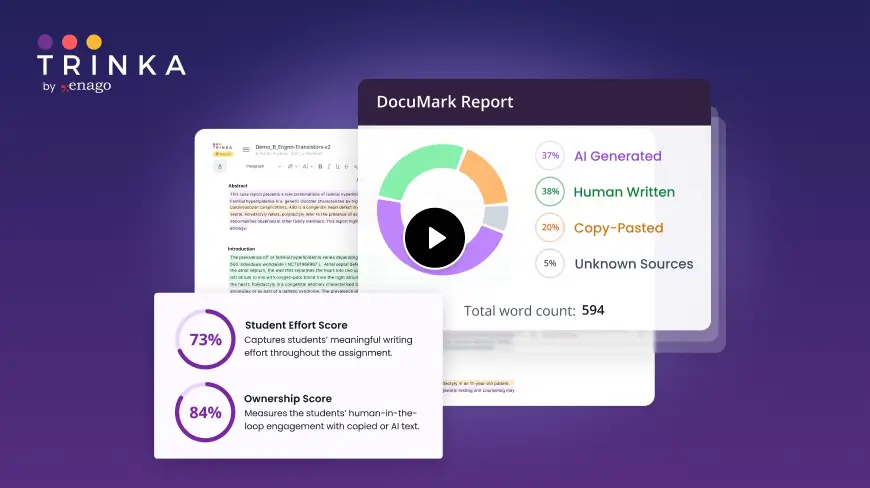
Knowing your institution's AI policy is step one. DocuMark helps enforce it fairly by empowering universities to manage AI-generated content, prevent cheating, and support student writing through responsible AI use.
Common Questions About University of West Florida's AI Policies
University of West Florida has defined AI policies in 12 of 12 categories, with an overall coverage score of 100%.
Disclosure and citation of AI use are required or strongly directed in multiple contexts. The task force recommends requiring students to cite AI use in coursework, faculty research writing guidance requires disclosure of AI use in the writing process and full disclosure for AI-generated text or images, and student-facing advising states that citing AI use is critical but does not by itself make AI use permitted.
The university treats unauthorized AI use under existing academic misconduct processes, with cheating defined by whether the faculty member permitted the material or information. The task force recommends exploring AI detection tools beyond Turnitin, while advising guidance warns that detectors can produce false positives and recommends students keep drafts and version history to defend original work.
UWF guidance emphasizes not entering private, protected, sensitive, proprietary, or confidential information into AI tools unless protections are assured, and it instructs users to treat information given to AI as public. For staff procurement and use of paid tools, the recommendations require contract review and the KREQ process for risk management. The career toolkit also states that UWF does not endorse any specific AI platforms.