Teaching & Learning
- Undisclosed or unauthorized AI use in assessments is treated as academic misconduct
- For assessed coursework, generative AI may be used only when the assessment brief or module leader explicitly permits it
- Students remain responsible for the accuracy of submitted work, must verify AI outputs, and must not present AI-generated material as their own
If your coursework / assessment brief does not mention the use of GenAI, and you are in any doubt then ask your module leader for clarification. AI generated content should never be presented as your own work.
There is no one-size-fits-all answer to whether AI can be used for assessments and coursework. It depends on the rules for the individual course and assessment and the context in which AI is used.
Students can use generative AI only if their module leader/tutor allows it or if their assessment brief says they can.
You are responsible for checking the accuracy of what generative AI tools produce.
Presenting AI-generated work as if it were your own is a form of plagiarism and therefore academic misconduct.
The unacknowledged use of artificial intelligence (AI) tools in the development and/or production of the submitted assessment and/or where there is evidence that a student has submitted work generated by artificial intelligence (AI) tools as if it was their own work.
- Use of generative AI in formal assessments is controlled at the assessment level
- Unauthorized or unacknowledged AI use in submitted assessments is classified as academic misconduct
- Students may use it only where the module leader or assessment brief explicitly allows it; otherwise they must seek clarification
There is no one-size-fits-all answer to whether AI can be used for assessments and coursework. It depends on the rules for the individual course and assessment and the context in which AI is used.
Students can use generative AI only if their module leader/tutor allows it or if their assessment brief says they can.
If your coursework / assessment brief does not mention the use of GenAI, and you are in any doubt then ask your module leader for clarification.
The unacknowledged use of artificial intelligence (AI) tools in the development and/or production of the submitted assessment and/or where there is evidence that a student has submitted work generated by artificial intelligence (AI) tools as if it was their own work.
- This use is framed as support for learning rather than a replacement for students' own thinking, and students are told to critically evaluate outputs and avoid relying on AI-generated references
- The university permits students to use generative AI as a study aid for independent learning tasks such as summarising material, explaining concepts, making flashcards, generating quiz questions, and practising languages
You can use GenAI tools to support your independent learning e.g.:
• summarise difficult concepts or articles
• explain a theory in simple terms
• generate study flashcards or quiz questions
• practise language learning or revision planning.
Don't let GenAI do all the work. It can be useful for support, but overusing it may stop you from developing your own critical thinking and creativity.
Generative AI can be useful for independent study, but there are some key considerations. For example, you should avoid relying on AI-generated references without verifying them, and critically evaluate the outputs you get.
- The university does not set a separate university-wide rule for AI code generation
- Programming-related AI use falls under the general rule for coursework and assessments: it is only allowed when the module leader or assessment brief permits it, and students remain responsible for what they submit
There is no one-size-fits-all answer to whether AI can be used for assessments and coursework. It depends on the rules for the individual course and assessment and the context in which AI is used.
Students can use generative AI only if their module leader/tutor allows it or if their assessment brief says they can.
You are responsible for checking the accuracy of what generative AI tools produce.
Research
- AI must not be credited as an author, confidential or unpublished material should not be uploaded without approval, and any use must follow university guidance and supervisory expectations
- Doctoral researchers may use generative AI in limited ways to support research writing, such as language refinement, but they remain fully responsible for the originality, accuracy, and integrity of the work
Generative AI may be used to support aspects of the research process, such as idea generation, language refinement, coding assistance, or literature searching, provided its use is transparent, critically evaluated, and does not compromise the originality or integrity of the work.
Doctoral researchers remain fully responsible for the content of any submitted work, including ensuring the accuracy of factual claims, the validity of interpretations, the originality of analysis, and compliance with ethical and disciplinary standards.
Generative AI tools must not be listed as authors on publications or theses.
Doctoral researchers should not upload unpublished research data, participant data, or confidential documents into public GenAI platforms unless explicitly authorised and compliant with University data governance policies.
- Public AI systems must not be used to upload unpublished research data, participant data, or confidential documents unless explicitly authorised and compliant with university data governance policies
- Doctoral researchers may use generative AI for some research-support tasks, including coding assistance, but its use must be transparent, critically evaluated, and consistent with research integrity requirements
Generative AI may be used to support aspects of the research process, such as idea generation, language refinement, coding assistance, or literature searching, provided its use is transparent, critically evaluated, and does not compromise the originality or integrity of the work.
Doctoral researchers should not upload unpublished research data, participant data, or confidential documents into public GenAI platforms unless explicitly authorised and compliant with University data governance policies.
Doctoral researchers remain fully responsible for the content of any submitted work, including ensuring the accuracy of factual claims, the validity of interpretations, the originality of analysis, and compliance with ethical and disciplinary standards.
- The university ties AI use in research to research integrity and ethics obligations
- More broadly, the university's research integrity framework requires honesty, rigour, transparency, and accountability in research conduct
- Doctoral researchers must use AI transparently, critically evaluate outputs, protect confidential and participant data, and ensure AI use does not undermine originality or ethical compliance
Generative AI may be used to support aspects of the research process, such as idea generation, language refinement, coding assistance, or literature searching, provided its use is transparent, critically evaluated, and does not compromise the originality or integrity of the work.
Doctoral researchers should not upload unpublished research data, participant data, or confidential documents into public GenAI platforms unless explicitly authorised and compliant with University data governance policies.
Doctoral researchers remain fully responsible for the content of any submitted work, including ensuring the accuracy of factual claims, the validity of interpretations, the originality of analysis, and compliance with ethical and disciplinary standards.
The University is committed to promoting and upholding the highest standards of integrity in all aspects of research.
The University expects all staff and students engaged in research to maintain the principles of honesty, rigour, transparency and open communication, care and respect, and accountability in conducting research.
Academic Integrity
- For research students, AI use must be transparent
- Students are required to acknowledge AI use in assessed work whenever they use it
- The university provides a standard acknowledgement statement and indicates that students should also provide references or screenshots where requested by the tutor or assessment brief
If you use GenAI in your work, you must acknowledge it.
You may need to include:
• a statement explaining how the AI tool was used.
• references or screenshots of prompts/output, if requested by your tutor or assessment brief.
Example acknowledgement statement:
I used [Tool Name] to [explain what you used it for, e.g. brainstorm ideas, improve sentence clarity, summarise an article]. I reviewed and edited the output to ensure it reflected my own understanding and met the academic requirements of the task.
Generative AI may be used to support aspects of the research process, such as idea generation, language refinement, coding assistance, or literature searching, provided its use is transparent, critically evaluated, and does not compromise the originality or integrity of the work.
- The university treats undisclosed AI use and submission of AI-generated work as academic misconduct, specifically as plagiarism
- The materials provided do not set out a specific university position on AI-detection software reliability or mandatory detector use
- Enforcement proceeds through academic misconduct processes, and students may face penalties where there is evidence of AI-generated work being submitted as their own
Presenting AI-generated work as if it were your own is a form of plagiarism and therefore academic misconduct.
The unacknowledged use of artificial intelligence (AI) tools in the development and/or production of the submitted assessment and/or where there is evidence that a student has submitted work generated by artificial intelligence (AI) tools as if it was their own work.
Plagiarism is where a student incorporates another person's work, including words, images, ideas, opinions, discoveries and inventions into their own work and presents it as their own, whether intentionally or not.
Penalties may be imposed where a student is found guilty of academic misconduct.
Institutional & Administrative
- The university provides a dedicated 'AI Code of Practice for Colleagues' that establishes guidelines for faculty and staff regarding the use of generative AI in professional practice, teaching, assessment design, and administrative duties
[From the University's internal guidance hub]: The 'AI Code of Practice for Colleagues' outlines approved practices, responsibilities, and operational guidelines for staff utilizing artificial intelligence in university systems and educational workflows.
- Additionally, the university maintains specific guidance resources for analyzing the risk of generative AI applications and for corporate tools that make use of generative AI
- The university strictly prohibits uploading unpublished research or sensitive participant data into public generative AI platforms unless explicitly authorised and compliant with university data governance policies
Doctoral researchers should not upload unpublished research data, participant data, or confidential documents into public GenAI platforms unless explicitly authorised and compliant with University data governance policies.
[Additional guidance provides frameworks for 'Analysing the risk of a Generative AI application or system' and outlines expectations for 'Corporate tools making use of generative AI'].
- However, the provided source text does not specify a detailed future AI adoption roadmap in the extracted material
- The university has an overarching AI policy and related guidance resources, indicating institution-level governance of AI use
- Its research integrity framework also establishes institution-wide principles of honesty, rigour, transparency, care, and accountability that apply to research-related AI use
The University is committed to promoting and upholding the highest standards of integrity in all aspects of research.
The University expects all staff and students engaged in research to maintain the principles of honesty, rigour, transparency and open communication, care and respect, and accountability in conducting research.
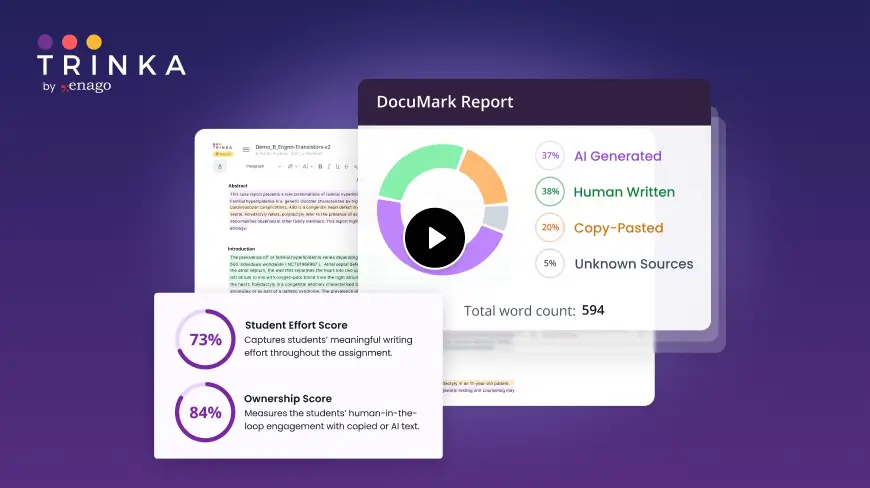
DocuMark: Responsible AI Use for Academic Integrity
Knowing your institution's AI policy is step one. DocuMark helps enforce it fairly by empowering universities to manage AI-generated content, prevent cheating, and support student writing through responsible AI use.
Common Questions About University of Westminster's AI Policies
University of Westminster has defined AI policies in 12 of 12 categories, with an overall coverage score of 100%.
Students are required to acknowledge AI use in assessed work whenever they use it. The university provides a standard acknowledgement statement and indicates that students should also provide references or screenshots where requested by the tutor or assessment brief. For research students, AI use must be transparent.
The university treats undisclosed AI use and submission of AI-generated work as academic misconduct, specifically as plagiarism. Enforcement proceeds through academic misconduct processes, and students may face penalties where there is evidence of AI-generated work being submitted as their own. The materials provided do not set out a specific university position on AI-detection software reliability or mandatory detector use.
The university strictly prohibits uploading unpublished research or sensitive participant data into public generative AI platforms unless explicitly authorised and compliant with university data governance policies. Additionally, the university maintains specific guidance resources for analyzing the risk of generative AI applications and for corporate tools that make use of generative AI.