Teaching & Learning
- The university also states that the submitted work must be the student's own and that students should ask their tutor or course leader if they are unsure
- For assessed coursework, students are generally not permitted to use AI tools to create assignment content unless the module tutor has said in advance that AI use is permitted or required for that assessment
It is vital that the work you submit for your assessments is your own work. It is important to be transparent about the tools you use and the sources you are reading and citing. If you are unsure whether use of AI is appropriate, please speak to your module tutor or course leader.
There may be some assessments where the use of AI tools is permitted or required. Your module tutor will communicate this to you in advance. Unless this is the case you should assume that the use of any AI tools for creating the content of an assessment is not permitted.
No, the use of third parties, including generative artificial intelligence sites to write assignments is not permitted and may lead to an academic misconduct investigation.
- The university states that use of GenAI in assessments is acceptable provided it is used responsibly and academic integrity is maintained
- Acceptable use may vary by module or assessment context, and module tutors should clearly state when GenAI use is acceptable and when it is not appropriate
This Policy is based on the position that the use of GenAI tools for assessments is acceptable provided such tools are used responsibly, and academic integrity is maintained.
Within all modules, academic staff should clearly articulate the acceptable use of GenAI tools by students (or where in a specific context such use may not be appropriate), based on this Policy and associated guidance.
There may be assessment contexts where the use of GenAI tools is not appropriate, and module tutors should make this clear in assignment briefs.
- The university supports students using GenAI for learning and study support when the use is appropriate, responsible, critical, and ethical
- Students should be helped to develop AI literacy, and staff may encourage AI use for class preparation and assessment preparation, while the university recommends Microsoft Co-pilot for academic work
Students will be supported to develop GenAI literacy/capital so that they are able to use GenAI critically, responsibly, and ethically.
All students should have opportunities to develop GenAI literacy with respect to:
• Understanding the significance of GenAI for their studies and future careers.
• Recognising appropriate and inappropriate uses of GenAI in supporting learning and assessment.
• Appreciating the strengths and limitations of GenAI when used as part of the learning experience.
• Developing the skills to utilise GenAI tools critically and ethically to support learning and to avoid compromising academic integrity in assessments, including referencing the use of GenAI.
GenAI tools have significant potential to support and enhance the student learning experience, and staff should support and encourage appropriate and responsible use. For example, students might be encouraged to use GenAI tools to prepare for classes and seminars or workshops, and also in relation to aspects of assessment preparation.
We are aware of the challenges for students in relation to the digital divide and therefore recommend the use of Microsoft Co-pilot in relation to academic work.
Research
Academic Integrity
- The university requires transparency and acknowledgement when AI is used in assessed work
- For staff-created teaching materials, AI use should also be clearly stated and referenced
- Students must understand how to acknowledge and reference GenAI use, and the university says students should keep a record of how they planned and constructed assignments, including AI use where appropriate
Key to the responsible use of GenAI tools is intellectual ownership of academic work and the proper acknowledgement of the role played by GenAI tool in developing the work.
• Developing the skills to utilise GenAI tools critically and ethically to support learning and to avoid compromising academic integrity in assessments, including referencing the use of GenAI.
There should be a consistent approach across modules within a course wherever possible, and there should be clarity for students on how they should acknowledge and reference the use of GenAI (see Cite them right guidance here).
The importance of students maintaining a record of how they planned and constructed their assignment, detailing the use of GenAI where appropriate, should be embedded as part of good academic practice.
If you use AI tools as part of the process of creating an assessment, it is important that you acknowledge their use.
Where GenAI tools are used by academic staff to create course materials, this should be clearly articulated and referenced within the learning materials or assessments.
- The university does not currently permit the use of AI detection tools because it states that such tools are problematic
- Undisclosed or prohibited AI use can lead to academic misconduct investigation, and the university states that its academic misconduct procedures have been updated to incorporate reference to GenAI use
Staff should note that tools designed to detect the use of GenAI are known to be problematic and therefore their use is not currently permitted by the University.
The University has reviewed its academic misconduct procedures, and reference to use of GenAI tools is incorporated.
No, the use of third parties, including generative artificial intelligence sites to write assignments is not permitted and may lead to an academic misconduct investigation.
Institutional & Administrative
- Staff must also review assessments to mitigate inappropriate student use of GenAI, and AI use in course materials should be clearly articulated and referenced
- The university permits and supports academic staff using GenAI in teaching, lesson planning, course content, assessment design, problem solving, and data analysis, but expects ethical use and staff responsibility
- Staff must be familiar with opportunities, limitations, privacy policies, and ethical issues, must alert students to relevant privacy policies when GenAI is used, and remain individually responsible for the factual accuracy and quality of AI-generated teaching materials
Academic staff can use GenAI to assist lesson planning, generate new content and otherwise support innovative teaching.
Staff will be supported to develop capabilities in the appropriate and ethical use of GenAI to support student learning.
Academic staff incorporating GenAI tools within their teaching or assessments should ensure:
• familiarity with the opportunities, limitations and ethical issues of GenAI tools, which should be discussed with students. Examples include privacy and data considerations; potential for bias; inaccuracy and misrepresentation of information; ethics codes; plagiarism; sustainability and exploitation.
• familiarity with the specific privacy policies or user agreements relating to their use. Students should be explicitly alerted to these policies whenever GenAI is to be used.
GenAI offers the potential for academic staff to enhance their learning and teaching materials and assessments, for example through content generation (e.g. case studies, simulations), problem solving and data analysis.
Where GenAI tools are used by academic staff to create course materials, this should be clearly articulated and referenced within the learning materials or assessments. Academic staff are individually responsible for ensuring the factual accuracy and quality of any materials created using generative GenAI tools.
All academic staff have an individual responsibility to review their assessments to mitigate the effects of the inappropriate use of GenAI tools.
- The university recommends Microsoft Co-pilot for academic work and requires attention to privacy policies and data considerations when GenAI is used
- The information handling policy permits University-approved OneDrive for Business across data classes, while non-University cloud storage is not permitted for highly sensitive or personal/confidential data
- More generally, users must comply with data protection obligations, use university-approved systems such as OneDrive or SharePoint for work and data, and must not store confidential or sensitive data on portable drives, personal online storage, local computer drives, or personal computers
We are aware of the challenges for students in relation to the digital divide and therefore recommend the use of Microsoft Co-pilot in relation to academic work.
• familiarity with the opportunities, limitations and ethical issues of GenAI tools, which should be discussed with students. Examples include privacy and data considerations; potential for bias; inaccuracy and misrepresentation of information; ethics codes; plagiarism; sustainability and exploitation.
• familiarity with the specific privacy policies or user agreements relating to their use. Students should be explicitly alerted to these policies whenever GenAI is to be used.
d) When processing personal data ensure full compliance with all obligations under Data Protection Legislation. The University maintains information under the current legislation that should cover most data used for administrative purposes, but users are responsible for ensuring that any particular use of personal data complies with the University's Data Protection Policy and the data protection legislation. In cases of doubt, advice should be sought from the University’s Data Protection Officer.
e) Use University approved systems, such as OneDrive or SharePoint to store work and data. Under no circumstances should confidential or sensitive data be stored on portable drives or personal online storage areas. For further guidance refer to the Information Classification and Handling policy.
Personal (home) computers
X Not permitted X Not permitted X Not permitted
The University approved cloud storage is OneDrive for Business, part of the Microsoft Office 365 account package, which is accessed with your University staff login.
Permitted Permitted Permitted
Non-University Cloud Storage such as iCloud, Google Drive, Dropbox, Personal OneDrive and all similar cloud storage solutions.
X Not permitted X Not permitted Permitted
Storage of University data to local computer drives is not permitted as this is not an approved backup solution.
- The university also says course and module handbooks should be updated to reflect the GenAI policy and its implementation within schools
- The university has an institution-level position not to prohibit GenAI, but to support responsible and ethical use through guidance, literacy development, and adaptation of teaching, learning, and assessment strategies
- Its approach is guided by a formal set of principles, builds on the Russell Group's common principles, and assigns course teams responsibility for incorporating GenAI into programme design and reviewing practice through course approval
Along with other Universities, our position is not to prohibit the use of GenAI tools, but rather to provide all members of the academic community with support and guidance on how GenAI can be used responsibly and ethically; this is what is sometimes referred to as GenAI literacy or GenAI capital.
The following principles adapted from the Russell Group’s work, will guide our approach to the use of GenAI:
• Staff will be supported to develop capabilities in the appropriate and ethical use of GenAI to support student learning.
• Students will be supported to develop GenAI literacy/capital so that they are able to use GenAI critically, responsibly, and ethically.
• Teaching, learning and assessment strategies will be adapted to incorporate ethical use of GenAI tools.
• Academic integrity and rigour in assessment will be upheld.
• A culture of innovation, collaboration, and sharing of best practice in the application of evolving GenAI tools will be fostered.
Course teams working with Learning and Teaching Directors and Co-ordinators should determine how GenAI can be incorporated into programme design and learning and teaching activity.
How course teams are developing students’ GenAI literacy will be considered through course approval and will be regularly reviewed to foster consistency of approach and to promote innovative and best practice responses.
Course and module handbooks should be updated to include details of the University’s policy regarding the use of GenAI tools by students and its implementation within the School.
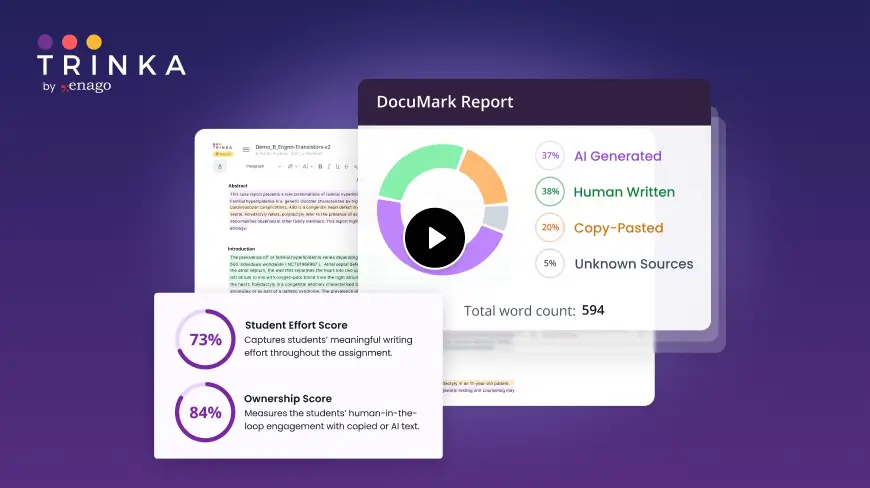
DocuMark: Responsible AI Use for Academic Integrity
Knowing your institution's AI policy is step one. DocuMark helps enforce it fairly by empowering universities to manage AI-generated content, prevent cheating, and support student writing through responsible AI use.
Common Questions About University of Worcester's AI Policies
University of Worcester has defined AI policies in 8 of 12 categories, with an overall coverage score of 67%.
The university requires transparency and acknowledgement when AI is used in assessed work. Students must understand how to acknowledge and reference GenAI use, and the university says students should keep a record of how they planned and constructed assignments, including AI use where appropriate. For staff-created teaching materials, AI use should also be clearly stated and referenced.
The university does not currently permit the use of AI detection tools because it states that such tools are problematic. Undisclosed or prohibited AI use can lead to academic misconduct investigation, and the university states that its academic misconduct procedures have been updated to incorporate reference to GenAI use.
The university recommends Microsoft Co-pilot for academic work and requires attention to privacy policies and data considerations when GenAI is used. More generally, users must comply with data protection obligations, use university-approved systems such as OneDrive or SharePoint for work and data, and must not store confidential or sensitive data on portable drives, personal online storage, local computer drives, or personal computers. The information handling policy permits University-approved OneDrive for Business across data classes, while non-University cloud storage is not permitted for highly sensitive or personal/confidential data.