Teaching & Learning
- Use of AI in graded coursework is at instructor discretion
- Students may not submit work produced by AI or another source as their own when a faculty member has not permitted that use, and unauthorized use can be treated as a violation of academic integrity
Unauthorized use of another person’s work or an artificial intelligence to complete academic work and submit it as one’s own constitutes lying and cheating.
Lying and cheating include, but are not limited to, the following forms: … submitting, whether in whole or in part, another person’s work or artificial intelligence output without acknowledgment; … unauthorized use of devices or resources, such as calculators and translation software
- The policy does not create an AI-specific exam rule beyond treating unauthorized tool use as cheating
- For exams and other assessments, AI use is not uniformly allowed; unauthorized use of devices or resources is prohibited under academic responsibility rules
Unauthorized use of another person’s work or an artificial intelligence to complete academic work and submit it as one’s own constitutes lying and cheating.
Lying and cheating include, but are not limited to, the following forms: … unauthorized use of devices or resources, such as calculators and translation software
Research
- The college allows approved AI features in institutional platforms for work tasks, but institutional data rules limit what may be entered into AI systems
- Public AI tools may only receive data classified as Public, while Internal Use, Protected, and Restricted data require an approved enterprise solution or are barred from external generative AI systems
As you know, Vassar is enabling new M365 Copilot features to support our employees in various tasks. Microsoft has guaranteed Vassar’s data and prompts remain secure and inaccessible to unauthorized parties, unlike public AI applications such as free ChatGPT.
In order to access these Copilot features, users need to have read and agreed to the official college policy on AI, as detailed here: https://go.vassar.edu/policy/artificalintelligence. This is not optional and must be completed before access is granted.
Artificial Intelligence (AI) services may only be used with data classified as Public. College community members shall not submit or disclose Internal Use, Protected, or Restricted information to public or unauthorized AI services under any circumstances.
Internal Use data may be used with approved enterprise AI solutions that ensure appropriate security and privacy protections.
Protected and Restricted data may only be used with approved enterprise AI solutions if expressly permitted by the Vassar CIO or ISO based on documented safeguards and a completed privacy and security review.
- Vassar’s research integrity policy does not set AI-specific rules for grant proposals, IRB materials, or ethics declarations in the provided text
- However, if AI use in research involves falsification, fabrication, or misappropriation, it would fall under existing research misconduct standards
Research Misconduct means fabrication, falsification, plagiarism, or misappropriation in proposing, performing, or reviewing research, or in reporting research results.
Falsification means manipulating research materials, equipment, or processes, or changing or omitting data or results, such that the research is not accurately represented in the research record.
Plagiarism means the appropriation of another person's ideas, processes, results, or words without giving appropriate credit.
Misappropriation means the unauthorized use of confidential information, including private ideas, processes, results or words, or any actions to use or publish any of these. Such actions can include a breach of confidentiality or the abuse of material or financial resources.
Academic Integrity
- When AI-generated material is used in academic work, acknowledgment is required
- Submitting AI output without acknowledgment is treated as a form of lying and cheating under the academic responsibility policy
Lying and cheating include, but are not limited to, the following forms: … submitting, whether in whole or in part, another person’s work or artificial intelligence output without acknowledgment
- The university does not define AI detection tools in the provided sources
- Enforcement is through existing academic integrity processes: unauthorized AI use in academic work is categorized as lying and cheating, which places it within the college's academic misconduct framework
Unauthorized use of another person’s work or an artificial intelligence to complete academic work and submit it as one’s own constitutes lying and cheating.
If there is evidence that a student’s work may have involved lying and cheating, a faculty member should consult with the dean of studies office before speaking to the student directly.
Any member of the faculty who has reason to think that a student may have engaged in lying and cheating should notify the dean of studies office and furnish the evidence. The faculty member and student then meet with the dean of studies or their designee to discuss the issue and determine whether a hearing by the Academic Panel may be warranted.
Institutional & Administrative
- Faculty and staff may use institutional AI tools, but only after reading and agreeing to the college AI policy
- Staff communications describe Microsoft 365 Copilot as enabled for employee tasks, and remind employees that use requires prior policy acknowledgment and compliance with data protection rules
As you know, Vassar is enabling new M365 Copilot features to support our employees in various tasks. Microsoft has guaranteed Vassar’s data and prompts remain secure and inaccessible to unauthorized parties, unlike public AI applications such as free ChatGPT.
In order to access these Copilot features, users need to have read and agreed to the official college policy on AI, as detailed here: https://go.vassar.edu/policy/artificalintelligence. This is not optional and must be completed before access is granted.
Vassar is offering a free linked-in learning course called, “Copilot for all”, to support your understanding and use of this AI technology.
- Vassar has an explicit data-governance rule for AI
- Only Public data may be used with public or unauthorized AI services; Internal Use data may be used only with approved enterprise AI solutions; Protected and Restricted data require approved enterprise AI solutions plus express permission from the CIO or ISO based on safeguards and review
Artificial Intelligence (AI) services may only be used with data classified as Public. College community members shall not submit or disclose Internal Use, Protected, or Restricted information to public or unauthorized AI services under any circumstances.
Internal Use data may be used with approved enterprise AI solutions that ensure appropriate security and privacy protections.
Protected and Restricted data may only be used with approved enterprise AI solutions if expressly permitted by the Vassar CIO or ISO based on documented safeguards and a completed privacy and security review.
Data Classification Policy
The College categorizes institutional data as Public, Internal Use, Protected, or Restricted according to its sensitivity and potential impact if improperly accessed, disclosed, altered, or destroyed.
- The provided sources do not identify a separate AI committee or a broader public strategy roadmap beyond these governance and operational requirements
- Vassar has a formal institutional AI policy that establishes data-use rules and conditions for approved AI use, and staff communications show implementation through Microsoft 365 Copilot access controls and training
Artificial Intelligence (AI) services may only be used with data classified as Public. College community members shall not submit or disclose Internal Use, Protected, or Restricted information to public or unauthorized AI services under any circumstances.
Internal Use data may be used with approved enterprise AI solutions that ensure appropriate security and privacy protections.
Protected and Restricted data may only be used with approved enterprise AI solutions if expressly permitted by the Vassar CIO or ISO based on documented safeguards and a completed privacy and security review.
In order to access these Copilot features, users need to have read and agreed to the official college policy on AI, as detailed here: https://go.vassar.edu/policy/artificalintelligence. This is not optional and must be completed before access is granted.
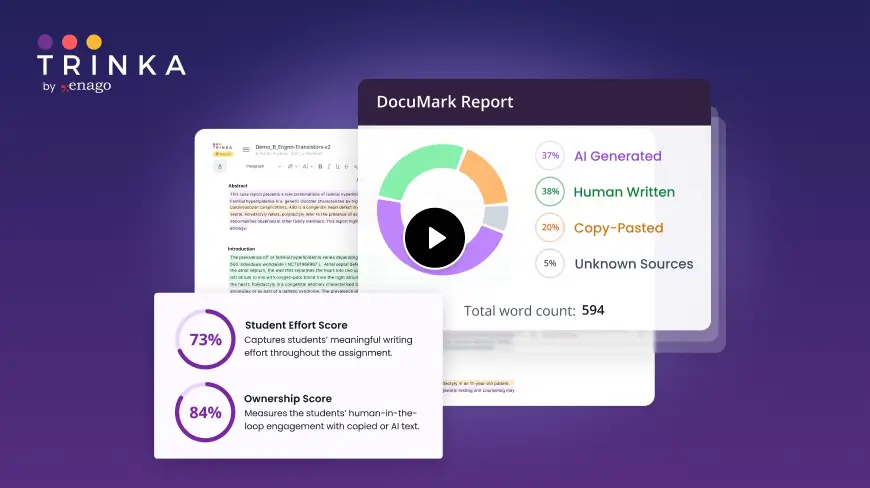
DocuMark: Responsible AI Use for Academic Integrity
Knowing your institution's AI policy is step one. DocuMark helps enforce it fairly by empowering universities to manage AI-generated content, prevent cheating, and support student writing through responsible AI use.
Common Questions About Vassar College's AI Policies
Vassar College has defined AI policies in 9 of 12 categories, with an overall coverage score of 75%.
When AI-generated material is used in academic work, acknowledgment is required. Submitting AI output without acknowledgment is treated as a form of lying and cheating under the academic responsibility policy.
The university does not define AI detection tools in the provided sources. Enforcement is through existing academic integrity processes: unauthorized AI use in academic work is categorized as lying and cheating, which places it within the college's academic misconduct framework.
Vassar has an explicit data-governance rule for AI. Only Public data may be used with public or unauthorized AI services; Internal Use data may be used only with approved enterprise AI solutions; Protected and Restricted data require approved enterprise AI solutions plus express permission from the CIO or ISO based on safeguards and review.