Teaching & Learning
- Unauthorized AI use can be treated as academic misconduct
- Use of generative AI in coursework is at instructor discretion
- Faculty are told to set course-specific expectations ranging from no AI use to unrestricted use, and students are directed to follow each instructor’s stated requirements
If your assignment is representative of your effort and learning, and your instructor permits the use of GenAI, then use of these technologies would not fall into the category of academic dishonesty.
The amount and type of acceptable use should be clearly outlined by the instructor and students should observe these expectations.
Before using GenAI to complete an assignment, first review your syllabus and assignment prompt to determine whether your instructor has any expectations of or restrictions against its use.
Need to know
An instructor or program may choose to
• Prohibit any use of generative AI for a class/assignment.
• Permit the use of generative AI in specific ways for a class/assignment with proper documentation/citation.
• Permit the use of generative AI for broad use in a class/assignment.
No use – this statement indicates that no AI tools are to be used in the completion of this assignment and that all work should be solely your own.
Generative AI can be used to aid your completion of this assignment, but only in the ways approved in this syllabus/assignment. Any use outside of this permission should be discussed with and approved by the instructor before use. If this policy is not followed, unauthorized use of generative AI can result in academic dishonesty allegations under VCU policy.
This class may use Generative AI to support your learning and create things, and some assignments and activities may permit use of these tools. You are responsible for ensuring that your use of Generative AI follows assignment and course expectations and can explain why and how your use of these tools supports your learning. Please note that using Generative AI in unauthorized ways can violate VCU policy around academic dishonesty.
- Students must follow syllabus and assignment expectations, so AI use on exams or quizzes depends on instructor or program rules
- The university materials do not set a single institution-wide exam rule, but they allow instructors to prohibit AI entirely for particular assessments
Before using GenAI to complete an assignment, first review your syllabus and assignment prompt to determine whether your instructor has any expectations of or restrictions against its use.
Need to know
An instructor or program may choose to
• Prohibit any use of generative AI for a class/assignment.
• Permit the use of generative AI in specific ways for a class/assignment with proper documentation/citation.
• Permit the use of generative AI for broad use in a class/assignment.
No use – this statement indicates that no AI tools are to be used in the completion of this assignment and that all work should be solely your own.
- The guidance frames these uses as acceptable when they support learning rather than replace it
- Students are encouraged to use generative AI for personal learning support such as explanation, brainstorming, feedback, and study help, so long as they do not use it in ways barred by their instructor
As with all technologies, there are appropriate and inappropriate uses of GenAI. These technologies can be good resources to support your learning and provide help in understanding concepts, answering questions, brainstorming and organizing your thoughts, and creating a personalized tutor/coach to support your studies.
Productive uses of GenAI technologies can include:
• explaining difficult concepts in another way,
• creating multiple choice questions for self-assessing your understanding,
• brainstorming essay topics and ideas,
• summarizing your writing and checking if your argument is clear,
• asking for your writing to be reviewed and feedback provided for improvement,
• generating examples to study from.
- Unauthorized use outside those permissions may be treated as academic dishonesty
- Course-level permission for AI coding tools is reflected in VCU’s sample syllabus statements
- Instructors may prohibit AI entirely, limit it to approved forms, or allow it more broadly, and one sample statement specifically permits generative AI to support programming tasks such as planning, generating, and debugging code
Need to know
An instructor or program may choose to
• Prohibit any use of generative AI for a class/assignment.
• Permit the use of generative AI in specific ways for a class/assignment with proper documentation/citation.
• Permit the use of generative AI for broad use in a class/assignment.
You can use Generative AI tools to support your work in this assignment, including to (1) support your thinking process, such as by brainstorming topics, gathering information, or creating drafts of code and text, (2) generate products that can be used in assignment completion, such as creating images or generating code, and/or (3) support your review process, such as providing feedback or identifying errors in coding or writing.
Generative AI can be used to aid your completion of this assignment, but only in the ways approved in this syllabus/assignment. Any use outside of this permission should be discussed with and approved by the instructor before use. If this policy is not followed, unauthorized use of generative AI can result in academic dishonesty allegations under VCU policy.
Research
- The university also states that AI tools cannot be listed as authors
- Graduate students may use AI technologies for editing and similar support only with faculty approval, and they must document that use in the manuscript
- VCU does not provide a general university-wide rule for all research manuscripts, but it does set specific disclosure rules for theses and dissertations
Use of AI technologies (e.g., for editing services such as Grammarly, image generation, ChatGPT, etc.) is permitted only if allowed by the faculty advisor and committee chair.
Use of such technologies must be properly documented in the ETD, preferably in the methods section but if not there, then in a designated acknowledgement section.
AI tools may not be listed as co-authors.
As for any approved use of AI tools, documentation and acknowledgment are expected.
- No broader standalone rule on AI-based analysis methods was identified beyond these conditions
- Separately, institutional AI guidance restricts what university data may be entered into AI tools, which limits research uses involving sensitive data
- For theses and dissertations, AI use in research-related work is permitted only with advisor and committee chair approval and must be documented in the manuscript
Use of AI technologies (e.g., for editing services such as Grammarly, image generation, ChatGPT, etc.) is permitted only if allowed by the faculty advisor and committee chair.
Use of such technologies must be properly documented in the ETD, preferably in the methods section but if not there, then in a designated acknowledgement section.
Approved data:
Publicly available information and low-risk data can be used in many AI tools.
No high-risk data:
Never enter Confidential or Highly Confidential university data, including FERPA-protected student information, HIPAA-regulated health information, employee records or other protected information, into AI systems unless a Data Processing Agreement and security review explicitly authorize it.
- The university’s explicit research-integrity guidance in the provided sources is limited
- No specific rules were found in the provided sources for grant proposals, IRB applications, or ethics declarations
- For graduate theses and dissertations, AI use requires faculty advisor and committee chair approval, must be documented, and AI tools may not be credited as co-authors
Use of AI technologies (e.g., for editing services such as Grammarly, image generation, ChatGPT, etc.) is permitted only if allowed by the faculty advisor and committee chair.
Use of such technologies must be properly documented in the ETD, preferably in the methods section but if not there, then in a designated acknowledgement section.
AI tools may not be listed as co-authors.
Academic Integrity
- Disclosure requirements depend on context
- For theses and dissertations, approved AI use must be documented in the methods or acknowledgements, and AI tools may not be named as co-authors
- When instructors permit AI in coursework, they may require proper documentation or citation, and students are expected to be transparent about their use
Need to know
An instructor or program may choose to
• Prohibit any use of generative AI for a class/assignment.
• Permit the use of generative AI in specific ways for a class/assignment with proper documentation/citation.
• Permit the use of generative AI for broad use in a class/assignment.
One thing that all instructors and students should keep in mind is transparency with regards to the use of generative AI. As this technology evolves and use patterns emerge, being transparent with regards to use can help others support and improve your learning or facilitate more appropriate use of AI in your course context.
Use of such technologies must be properly documented in the ETD, preferably in the methods section but if not there, then in a designated acknowledgement section.
AI tools may not be listed as co-authors.
As for any approved use of AI tools, documentation and acknowledgment are expected.
- Undisclosed or unauthorized AI use can be pursued under VCU’s academic misconduct process
- The provided sources did not identify a university policy endorsing specific AI detection tools
- The guidance warns that misuse may result in academic dishonesty allegations, and the Honor System defines academic misconduct to include unauthorized aid and receiving unpermitted assistance
If this policy is not followed, unauthorized use of generative AI can result in academic dishonesty allegations under VCU policy.
Please note that using Generative AI in unauthorized ways can violate VCU policy around academic dishonesty.
Academic misconduct includes, but is not limited to, cheating, plagiarism, collusion, submission of work commissioned from another person or source, unauthorized use of artificial intelligence technology, lying and stealing.
cheating: Intentionally or knowingly using or attempting to use unauthorized materials, information or study aids in any academic exercise; intentionally or knowingly receiving or giving unpermitted assistance in any academic work or assignment, including the use of unauthorized sources, collaboration or artificial intelligence technology
Institutional & Administrative
- In recommendation-letter contexts, the School of Medicine requires disclosure if AI tools were used
- Faculty may use generative AI to support teaching and course development, but they are advised to verify outputs, protect sensitive data, and be transparent with students
- VCU cautions against entering student work or personally identifiable information into public AI systems and advises against relying on AI as the sole basis for grading or high-stakes decisions
Faculty may decide to use GenAI technologies to support student learning and course planning.
Human oversight is essential to verify information and to ensure use is compatible with the goals and values of the university and your class.
Refrain from uploading student work into publicly available GenAI technologies and be aware of student concerns around data privacy and sensitive topics.
It is not recommended to input personally identifiable, protected, confidential, or sensitive information into publicly available GenAI technologies.
Use caution when using AI-generated content in any formal school communication. Do not rely on AI-generated content as the sole basis for critical or high-stakes decisions such as grading, academic advisement, admissions, hiring, promotions or disciplinary actions. Human review and accountability remain essential.
The writer should disclose whether AI tools were used in generating the final recommendation letter.
- VCU allows AI use only within its data-governance rules
- The university also identifies approved enterprise tools and services, including VCU-supported Microsoft Copilot Chat with commercial data protection and a review process for new AI tools
- Public and low-risk information may be used in many AI tools, but confidential or highly confidential university data must not be entered unless a Data Processing Agreement and security review specifically authorize it
Approved data:
Publicly available information and low-risk data can be used in many AI tools.
No high-risk data:
Never enter Confidential or Highly Confidential university data, including FERPA-protected student information, HIPAA-regulated health information, employee records or other protected information, into AI systems unless a Data Processing Agreement and security review explicitly authorize it.
Choose approved tools:
Whenever possible, use VCU-supported or vendor-contracted AI services reviewed for security and privacy.
VCU-supported AI tools
Microsoft Copilot Chat with commercial data protection is available to current faculty, staff and students signed in with a VCU account.
Request a review before purchasing or connecting a new AI tool to university systems or data.
- VCU has a formal AI governance structure and institution-level guidance for responsible, ethical, and safe use
- The CIO guidance also frames university AI use around governance, human accountability, risk management, privacy, and review of new tools
- The GenAI Committee is charged with monitoring developments, identifying opportunities and challenges, coordinating institutional responses, and advising on policy and practice
VCU's Generative Artificial Intelligence Committee was created in 2023 to consider and make recommendations about the opportunities and challenges of GenAI for the university and to support a university-wide approach for the use and response to this technology.
The committee's charge is to gather information and perspectives related to GenAI, identify and elevate considerations and implications of GenAI technologies in relation to the academic and operational areas of the university, and develop recommendations regarding use and response.
VCU’s approach to generative AI emphasizes responsible, ethical and safe use while protecting university data and supporting teaching, learning, research, health care and operations.
Governance, not avoidance:
VCU supports experimentation and innovation when it occurs within existing laws, policies and data protection requirements.
Human accountability:
Individuals remain responsible for decisions made with the assistance of AI. Human review is required for high-impact uses.
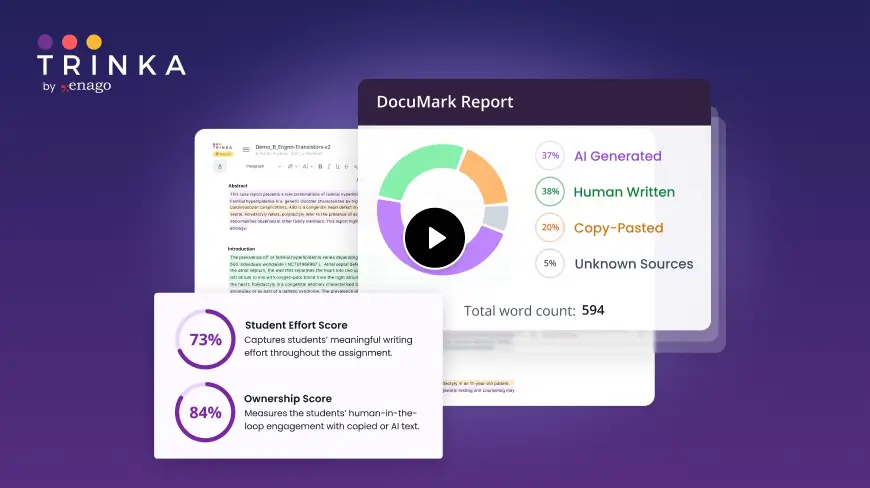
DocuMark: Responsible AI Use for Academic Integrity
Knowing your institution's AI policy is step one. DocuMark helps enforce it fairly by empowering universities to manage AI-generated content, prevent cheating, and support student writing through responsible AI use.
Common Questions About Virginia Commonwealth University's AI Policies
Virginia Commonwealth University has defined AI policies in 12 of 12 categories, with an overall coverage score of 100%.
Disclosure requirements depend on context. When instructors permit AI in coursework, they may require proper documentation or citation, and students are expected to be transparent about their use. For theses and dissertations, approved AI use must be documented in the methods or acknowledgements, and AI tools may not be named as co-authors.
Undisclosed or unauthorized AI use can be pursued under VCU’s academic misconduct process. The guidance warns that misuse may result in academic dishonesty allegations, and the Honor System defines academic misconduct to include unauthorized aid and receiving unpermitted assistance. The provided sources did not identify a university policy endorsing specific AI detection tools.
VCU allows AI use only within its data-governance rules. Public and low-risk information may be used in many AI tools, but confidential or highly confidential university data must not be entered unless a Data Processing Agreement and security review specifically authorize it. The university also identifies approved enterprise tools and services, including VCU-supported Microsoft Copilot Chat with commercial data protection and a review process for new AI tools.