Teaching & Learning
- When permitted, students must disclose how AI was used through appropriate citations
- Coursework AI rules are presented as instructor-defined via syllabus/course assignment instructions
- A syllabus template from the Office of Undergraduate Academic Integrity states that generative AI tools may only be used for assignments specifically designated by the instructor, and that AI use is otherwise prohibited as unauthorized assistance under the Honor Code
In this course, generative AI tools may only be used for specific assignments that are designated by the instructor. Any assignment requiring use of AI will be clearly outlined in the assignment instructions and may include tasks such as brainstorming, analyzing information or editing. For all other assignments, the use of AI tools is prohibited and constitutes unauthorized assistance under the Honor Code. When AI use is permitted, students must disclose how AI was used through appropriate citations.
Students enrolled in this course are responsible for abiding by the undergraduate Honor Code on each assignment and/or exam. A student who has doubts about how the Honor Code applies to any assignment is responsible for obtaining specific guidance from the course instructor before submitting the assignment for evaluation. Students are strongly discouraged from misusing unauthorized online sources including generative artificial intelligence outlets.
- Virginia Tech’s undergraduate academic integrity syllabus guidance includes exams within the Honor Code scope and places responsibility on students to get instructor guidance when in doubt
- The same syllabus template language treats AI use as only permitted when designated by the instructor for specific assignments; otherwise, AI use is prohibited as unauthorized assistance under the Honor Code
Students enrolled in this course are responsible for abiding by the undergraduate Honor Code on each assignment and/or exam. A student who has doubts about how the Honor Code applies to any assignment is responsible for obtaining specific guidance from the course instructor before submitting the assignment for evaluation.
In this course, generative AI tools may only be used for specific assignments that are designated by the instructor. Any assignment requiring use of AI will be clearly outlined in the assignment instructions and may include tasks such as brainstorming, analyzing information or editing. For all other assignments, the use of AI tools is prohibited and constitutes unauthorized assistance under the Honor Code.
- The undergraduate academic integrity syllabus guidance discourages misuse of “unauthorized online sources including generative artificial intelligence outlets” and directs students to consult instructors when uncertain how the Honor Code applies
- The university’s teaching/learning guidance discusses setting course-specific expectations for generative AI and encourages instructors to communicate guidelines early and update syllabi, indicating that appropriate uses vary by course and assignment
Appropriate and inappropriate uses of generative AI vary from course to course (and may even vary among assignments and activities within a single course), so students need clear, context-specific guidance they can confidently apply in each setting.
Students enrolled in this course are responsible for abiding by the undergraduate Honor Code on each assignment and/or exam. A student who has doubts about how the Honor Code applies to any assignment is responsible for obtaining specific guidance from the course instructor before submitting the assignment for evaluation. Students are strongly discouraged from misusing unauthorized online sources including generative artificial intelligence outlets.
- Not defined
not defined
Research
- that involved AI assistance”)
- The same guidance also includes manuscript submission context (“Before submitting a manuscript..
- Virginia Tech research guidance states that AI use in writing/editing must comply with academic integrity, sponsor requirements, and data security policies
Responsible and Ethical Use Ensure AI use in writing and editing complies with academic integrity, sponsor requirements, and data security policies.
Data Security and Privacy Protect reference lists, annotations, and draft materials in accordance with university security standards.
Use only Virginia Tech–approved AI systems for managing literature and notes.
Avoid using personal or public accounts for collaborative writing or AI-assisted editing.
Before submitting a manuscript, outreach piece, or translation that involved AI assistance:
- It also instructs researchers to test AI- or machine learning-generated code and models in a controlled environment before deployment and to document human verification steps and approvals
- Virginia Tech research guidance requires researchers to consider data security and tool approvals and to ensure platforms and data storage align with project risk levels and have been approved by the university
Confirm that the platform and data storage align with the risk level of your project and have been approved by Virginia Tech.
Test AI- or machine learning-generated code and models in a controlled environment before deployment.
Document human verification steps and approvals in your version control or lab notebook.
Am I complying with the Virginia Tech’s Risk Classification Standard, disciplinary standards, and research sponsor and other contractual data security requirements?
- It also states that AI cannot determine whether a study requires IRB/IACUC/IBC review or approval and requires researchers to consult the appropriate compliance office
- The guidance also requires using only Virginia Tech-approved AI tools and prohibits entering confidential or proprietary information into tools that are not Virginia Tech-approved
- Virginia Tech research guidance emphasizes transparency and ethical caution in research use of AI, including acknowledging AI’s role and disclosing AI assistance in certain research processes
Fairness and Transparency Acknowledge AI’s role in idea creation to promote integrity and reproducibility.
Fairness and Transparency Maintain transparency in code authorship, model development, and disclose AI assistance in automation or algorithm design.
AI cannot decide whether a study requires review or approval by the IRB, IACUC, or IBC. Researchers must consult the appropriate compliance office.
Use only Virginia Tech-approved AI tools.
Do not enter confidential or proprietary information (including grant concepts, unpublished data, inventions, or other information that cannot be shared publicly) into tools that are not Virginia Tech-approved.
Academic Integrity
- In undergraduate course contexts, the academic integrity syllabus guidance provides that when AI use is permitted, students must disclose how AI was used through appropriate citations
- The same syllabus guidance suggests instructors require transparency and specify what AI citations should look like, including whether prompts/output should be provided or whether naming the tool is sufficient
When AI use is permitted, students must disclose how AI was used through appropriate citations.
Explain the importance of transparency in using AI tools, and what citations should look like.
Do you expect all prompts and output to be provided, or just that students include the name of the AI tool used? Refer to the appropriate citation style guide.
- Virginia Tech teaching/learning guidance states that the university has not licensed or endorsed any specific AI detection platforms and recommends caution
- It further advises faculty to refrain from using AI detection software to check students’ assignments/exams and states that the Office for Undergraduate Academic Integrity does not accept AI detection reports as evidence for Honor Code cases
Due to these concerns, Virginia Tech has not licensed or endorsed any specific platforms for detecting generative AI, and TLOS recommends caution when using these tools.
Please also refrain from using AI detection software to check students’ assignments/exams, as the Office for Undergraduate Academic Integrity does not accept AI detection reports as a form of evidence for Honor Code cases.
Institutional & Administrative
- Virginia Tech’s AI principles state that humans remain accountable for decisions influenced by AI and that a human should always be in the loop for important decisions
- Faculty-focused teaching guidance also instructs that Virginia Tech affiliates should use approved tools and provides that Microsoft Copilot is the only generative AI tool currently licensed and approved for use by all faculty, staff, and students
People remain accountable for decisions influenced by AI. A human should always be in the loop for important decisions.
At Virginia Tech, the only generative AI tool currently licensed and approved for use by all faculty, staff, and students is Microsoft Copilot, which is powered by OpenAI’s large language models.
- Research guidance requires use of only Virginia Tech-approved AI tools and prohibits entering confidential/proprietary information into non-approved tools
- Virginia Tech also prohibits access to DeepSeek on state-owned or managed resources (including university-owned devices and networks), effective immediately Feb
- Virginia Tech provides an “AI Tools & Access” page describing approved AI platforms and services for university use, and teaching guidance states Microsoft Copilot is the only generative AI tool currently licensed and approved for use by all faculty, staff, and students
Approved artificial intelligence platforms and services for university use, with guidance on access and appropriate usage.
At Virginia Tech, the only generative AI tool currently licensed and approved for use by all faculty, staff, and students is Microsoft Copilot, which is powered by OpenAI’s large language models.
Use only Virginia Tech-approved AI tools.
Do not enter confidential or proprietary information (including grant concepts, unpublished data, inventions, or other information that cannot be shared publicly) into tools that are not Virginia Tech-approved.
Access to DeepSeek on state-owned or managed resources is prohibited.
A new state executive order prohibits the use of DeepSeek’s artificial intelligence large language model via the website (deepseek.com) or app on university-owned devices and networks, and requires that these applications be deleted from university-owned devices. Effective immediately (Feb. 12, 2025), access to these apps and websites will be restricted on all Virginia Tech and state-managed networks, including eduroam, VT Open WiFi, wired, and VPN (virtual private network) at Virginia Tech.
- Virginia Tech states it is establishing comprehensive AI governance for responsible AI adoption across all university functions
- The governance model includes an AI Working Committee as a formal standing working committee within Virginia Tech’s IT governance framework with delegated responsibility for AI-related issues across the university
- Virginia Tech’s AI Working Group published a Responsible and Ethical AI Framework report (Fall 2025 / September 2025) that establishes governance structures, ethical principles, and implementation guidance, and recommends establishing a permanent AI Working Committee as part of IT governance
Virginia Tech is establishing comprehensive AI governance to guide responsible artificial intelligence adoption across all university functions. Our governance approach ensures specialized AI expertise while integrating with university-wide technology governance, providing clear accountability and decision-making structures.
The AI Working Committee will serve as a formal standing working committee within Virginia Tech’s IT governance framework, reporting to the IT Governance Advisory Committee with delegated responsibility for AI-related issues across the university.
In Fall of 2025, the AI Working Group published the Responsible and Ethical AI Framework for Virginia Tech, establishing governance structures, ethical principles, and implementation guidance for responsible AI adoption across all university functions.
Note: Throughout this document, the working group that authored this report will be referred to as the current AI Working Group. This group recommends establishing a permanent AI Working Committee as part of IT governance.
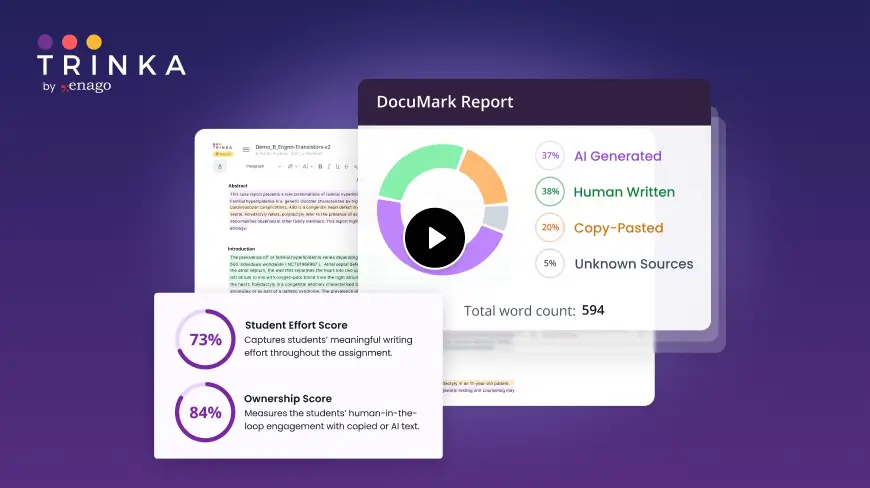
DocuMark: Responsible AI Use for Academic Integrity
Knowing your institution's AI policy is step one. DocuMark helps enforce it fairly by empowering universities to manage AI-generated content, prevent cheating, and support student writing through responsible AI use.
Common Questions About Virginia Polytechnic Institute and State University's AI Policies
Virginia Polytechnic Institute and State University has defined AI policies in 12 of 12 categories, with an overall coverage score of 100%.
In undergraduate course contexts, the academic integrity syllabus guidance provides that when AI use is permitted, students must disclose how AI was used through appropriate citations. The same syllabus guidance suggests instructors require transparency and specify what AI citations should look like, including whether prompts/output should be provided or whether naming the tool is sufficient.
Virginia Tech teaching/learning guidance states that the university has not licensed or endorsed any specific AI detection platforms and recommends caution. It further advises faculty to refrain from using AI detection software to check students’ assignments/exams and states that the Office for Undergraduate Academic Integrity does not accept AI detection reports as evidence for Honor Code cases.
Virginia Tech provides an “AI Tools & Access” page describing approved AI platforms and services for university use, and teaching guidance states Microsoft Copilot is the only generative AI tool currently licensed and approved for use by all faculty, staff, and students. Research guidance requires use of only Virginia Tech-approved AI tools and prohibits entering confidential/proprietary information into non-approved tools. Virginia Tech also prohibits access to DeepSeek on state-owned or managed resources (including university-owned devices and networks), effective immediately Feb. 12, 2025.