Teaching & Learning
- For academic coursework and assignments, Wake Forest’s academic guidelines emphasize that permitted uses of generative AI are set by instructors and may differ by course and assignment
- The guidelines also indicate that unauthorized student use of generative AI can be defined as academic misconduct, and the Graduate School provides syllabus policy language that can prohibit AI use or allow it only under specified conditions (e.g., prior permission or documented/cited use)
* As courses fulfill various roles in our curricula, the permitted uses of GAI may not be the same in every course or on every assignment in a course, and permitted uses of GAI may change over time.
* Within the overlapping frameworks of academic freedom, course coordination, and department/unit curriculum and policies, instructors set expectations for their classes, and these expectations can differ.
* For example: “The unauthorized use of generative AI platforms by a student, whether in the classroom, laboratory, studio, intern- and externships, independent research settings, or other spaces identified as serving educational goals.”
* Students are not allowed to use AI or machine learning tools (such as, but not limited to, Bard, Claude, Gemini, CoPilot, ChatGPT, Dall-E 2, etc.) on assignments in this course. Any such use will be considered misconduct and may result in a referral to the Honor Council.
* Students may use the AI or machine learning tools listed on this syllabus on assignments if that use is properly documented and credited.
- Wake Forest’s academic-use guidelines state that unauthorized student use of generative AI in educational contexts (including classroom and laboratory settings) can be treated as academic misconduct, but they do not provide exam-specific rules
- The Graduate School syllabus guidance directs faculty to define course-specific policies and consequences for AI misuse, which could include exam and assessment settings, but the default is course/instructor-specific rather than a single uniform exam rule
* For example: “The unauthorized use of generative AI platforms by a student, whether in the classroom, laboratory, studio, intern- and externships, independent research settings, or other spaces identified as serving educational goals.”
* All faculty members should include a statement explaining their specific policies and expectations regarding the use of generative AI on each course syllabus and the explicit consequences of misuse of generative AI on each course syllabus.
- Wake Forest notes that generative AI can be used as a learning tool and recommends that departments include instruction on AI use and best practices somewhere in the curriculum
- At the same time, Wake Forest information systems guidance cautions users to avoid sharing personal or confidential information with any AI tool, and help documentation encourages users to check expectations with instructors or supervisors for academic or business work
* Using GAI as a learning tool and an appropriate professional skill: GAI may not be an appropriate learning or skills development tool in all courses, but program instructors should be aware of GAI use across their shared curricula.
* As students are already using GAI across all disciplines, the AIWG strongly recommends departments include instruction in GAI use and best practices somewhere in their curriculum.
* As with all new and emerging technologies, we encourage you to work with your instructors or supervisors to understand expectations for leveraging these or other AI tools in any academic or business work. Use caution when providing any data, and do not share personal or sensitive information in queries.
* Never share personal or confidential information with any AI tool.
- For academic coursework (including programming assignments), Wake Forest’s academic guidelines emphasize that instructors set expectations and that permitted uses may vary by course and assignment
- Wake Forest’s administrative-use guidelines acknowledge that some AI tools have benefits for coding and programming projects, and direct users to use AI outputs ethically and in accordance with Wake Forest policies
* Some AI tools have keen abilities or benefits in coding and programming projects. Use AI outputs ethically and in accordance with all Wake Forest policies, including the Information Security, Responsible and Ethical Use of Computing Resources, Copyright, etc.
* As courses fulfill various roles in our curricula, the permitted uses of GAI may not be the same in every course or on every assignment in a course, and permitted uses of GAI may change over time.
* Within the overlapping frameworks of academic freedom, course coordination, and department/unit curriculum and policies, instructors set expectations for their classes, and these expectations can differ.
Research
- Wake Forest’s academic guidelines indicate that generative AI is changing faculty work relative to research and scholarship, but do not define specific rules for using AI in research writing or manuscript preparation
* Advance understanding of how GAI 1) is taught and experienced by students across courses in academic programs and 2) is changing faculty work relative to teaching, research, scholarship, creative activities, and administrative tasks through ongoing conversations among program faculty.
- Wake Forest does state that AI tools should be used with caution regarding privacy and reliability, and that personal or confidential information should never be shared with any AI tool
- Wake Forest’s materials describe AI tools that can support data analysis (e.g., in Excel) and list AI tools as useful for analysis and research, but they do not define a specific research-policy position on using AI for research data collection, analysis, or synthetic data
* Data Analysis: Assists with data interpretation and visualization in Excel, including generating charts and identifying trends.
* Great for: Analysis, Answering Questions, Research, Text-Based Content, Productivity
* These tools should be regarded with caution, however, as they typically store queries to train their models and may pose certain privacy and other risks, and the outputs may not be reliable.
* Never share personal or confidential information with any AI tool.
- Wake Forest’s academic-use guidelines recommend that schools ensure their existing academic misconduct and judicial frameworks are adequate to address misconduct involving generative AI, and provide an example definition framing unauthorized AI use as misconduct
- Wake Forest also maintains separate research misconduct and research security policies describing processes and a framework for research integrity and risk mitigation, but the provided source text does not explicitly define AI-specific requirements for grant proposals, IRB applications, or research ethics declarations
* While each school maintains its own system, evidentiary standards, and procedures for identifying and adjudicating cases of academic misconduct, the College and each school should ensure that existing processes and criteria in judicial frameworks and academic honor codes are adequate to address academic misconduct with GAI.
* For example: “The unauthorized use of generative AI platforms by a student, whether in the classroom, laboratory, studio, intern- and externships, independent research settings, or other spaces identified as serving educational goals.”
* Wake Forest University is committed to upholding research information integrity, safeguarding intellectual property, and ensuring compliance with federal, state, and institutional research security requirements.
* The following policy describes the process by which possible misconduct by faculty and others conducting research will be investigated and resolved.
Academic Integrity
- Wake Forest’s academic-use guidelines caution against relying on AI detectors due to false positives and privacy/intellectual property concerns, and state that detector results should not be sufficient proof on their own in academic misconduct cases
* Insufficiency of GAI Detectors: AI detectors are principally problematic for the high numbers of false positives they currently return.
* Evidentiary standards for academic misconduct should not allow for AI detectors alone to constitute a sufficient standard of proof. GAI detector results may be included as evidence but are insufficient on their own.
Institutional & Administrative
- Wake Forest also provides administrative-use guidelines for using generative AI tools in administrative operations, stating that they can be beneficial but should be regarded with caution and do not supersede other university policies
- Wake Forest’s academic-use guidelines indicate that faculty discussions should address how faculty might use generative AI for teaching support work such as preparing syllabi, designing assignments, grading, and writing letters of recommendation, emphasizing best practices, risks, data security, and privacy
* Identify and discuss the ways faculty might use GAI in teaching support work (outside the classroom, such as preparing syllabi, designing assignments, grading, writing letters of recommendation, etc.) and administrative tasks.
* Understanding that GAI is useful in many areas and that the tools are embedded in our day-to-day software (Google suite, Canvas, etc.), conversations focused on best practices and risks, data security, and privacy will help faculty make informed choices.
* Enterprise-licensed Generative AI tools can be beneficial in your operations and administrative work at Wake Forest.
* These tools should be regarded with caution, however, as they typically store queries to train their models and may pose certain privacy and other risks, and the outputs may not be reliable.
* These guidelines do not supplant other University policies that may apply to your work or use of University resources or data.
- Wake Forest promotes using campus-licensed/enterprise tools and signing in with WFU accounts to ensure enhanced data protections, and indicates that using existing enterprise tools provides confidence that tools have been evaluated for compliance with security, accessibility, data privacy, and/or compatibility standards
- Wake Forest advises that consumer/personal-use AI tools should be used with caution and explicitly instructs users never to share personal or confidential information with any AI tool; it also states (in an internal communication) that it lacks legal agreements with AI developers to share protected data, warning that entering data into ChatGPT-like services may disclose confidential data
* Never share personal or confidential information with any AI tool.
* Wake Forest University does not have any legal agreements with any AI developer that permit WF to share protected data with such developers or that provide any assurance of data confidentiality. This means that putting data into ChatGPT or similar services may disclose confidential data to the public.
* Sign in with your WFU account to ensure enhanced data protections are in place for all queries.
* Using existing Wake Forest enterprise tools ensures confidence that the tools have been evaluated for compliance with Wake Forest’s security, accessibility, data privacy, and/or compatibility standards.
- The GAI Discussion Framework is described as recommended (not required) and intended to align with guiding principles and address program-level opportunity and concern for instructors
- Wake Forest indicates that its AI efforts are guided by institutional vision principles and that academic and administrative AI working groups have developed guidelines and discussion frameworks to support ongoing conversations and policy development
* The guiding principles in our vision – honoring human dignity and wellbeing, embracing transformative learning and meaningful work, and advancing the ethical pursuit of knowledge – ground our uses of GAI such that we realize its revolutionary potential for good without losing sight of our human and educational purpose.
* This document was developed by the Wake Forest University Administrative AI Working Group and informed through multiple other advisory and partner conversations.
* Discussion Framework: Recommended GAI Issues for Ongoing Faculty Conversations
* The topics are neither required nor exhaustive and are intended to support productive conversations among colleagues.
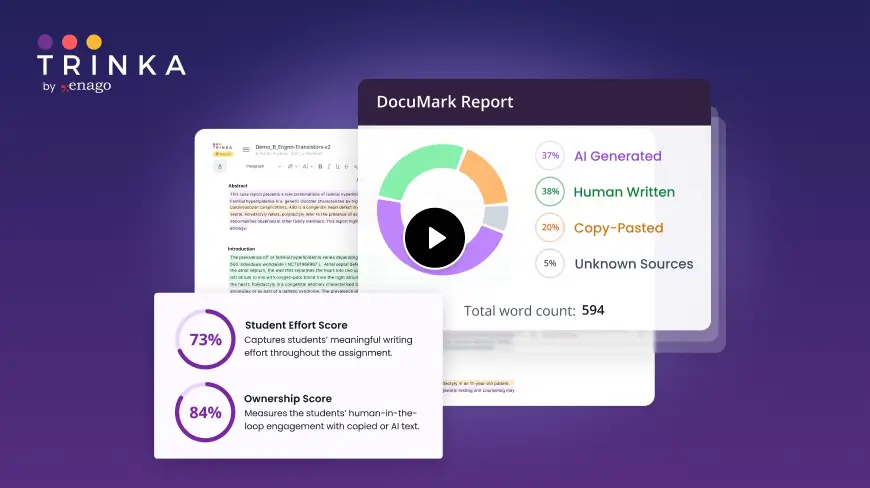
DocuMark: Responsible AI Use for Academic Integrity
Knowing your institution's AI policy is step one. DocuMark helps enforce it fairly by empowering universities to manage AI-generated content, prevent cheating, and support student writing through responsible AI use.
Common Questions About Wake Forest University's AI Policies
Wake Forest University has defined AI policies in 11 of 12 categories, with an overall coverage score of 92%.
No explicit disclosure requirement is currently defined in the available policy sources.
Wake Forest’s academic-use guidelines caution against relying on AI detectors due to false positives and privacy/intellectual property concerns, and state that detector results should not be sufficient proof on their own in academic misconduct cases.
Wake Forest advises that consumer/personal-use AI tools should be used with caution and explicitly instructs users never to share personal or confidential information with any AI tool; it also states (in an internal communication) that it lacks legal agreements with AI developers to share protected data, warning that entering data into ChatGPT-like services may disclose confidential data. Wake Forest promotes using campus-licensed/enterprise tools and signing in with WFU accounts to ensure enhanced data protections, and indicates that using existing enterprise tools provides confidence that tools have been evaluated for compliance with security, accessibility, data privacy, and/or compatibility standards.