Teaching & Learning
- Wellesley does not state a uniform college-wide AI rule for coursework in the provided sources
- However, the CS 111 course has a course-specific rule that prohibits any use of AI-powered tools for learning and completing assignments, and treats intentional violations as Honor Code violations
Intentionally breaking this policy is considered a violation of Wellesley’s Honor Code.
You are expected to turn in code that you have authored in this class. Submitting code created by or with the help of AI-powered tools (see below what is included under such tools) is considered equivalent to consulting a student who took CS 111 in prior semesters or any other CS knowledgeable person. Given that such consultations are prohibited, the use of AI-powered tools for learning and completing any type of assignments is also prohibited. Read below our longer rationale for this decision.
To be super clear, any AI use is explicitly disallowed in CS111.
- In CS 111, quizzes and exams prohibit consulting anything other than hardcopy notes, and the separate CS 111 AI tools policy states that any AI use is explicitly disallowed in the course
- The provided university-wide Honor Code materials discuss non-proctored take-home exams and self-scheduled finals as privileges of the Honor Code, but they do not define an AI-specific exam rule
The assumption that Wellesley College students are trustworthy confers a number of privileges, the most readily discernible of which are non-proctored take-home exams and self-scheduled final exams.
When working on quizzes or exams, you must not communicate with anyone else in any way and must not consult anything other than hardcopy notes.
To be super clear, any AI use is explicitly disallowed in CS111.
- But CS 111 separately prohibits AI-powered tools even for learning, so permitted use varies by course rather than following a single university-wide student rule
- Wellesley’s broader academic AI page includes an example course where students use generative AI as a tutor to help explain complicated neuroscience techniques and explore questions
In NEUR 301, students write an NIH-style grant proposal on a neuroscience topic of their choice. Students use generative AI as a tutor to help explain complicated neuroscience techniques they encounter in their literature searches. In addition, students are encouraged to use GenAI to help explore the critical questions in their topic (for example, mechanisms of cell death in Alzheimer’s disease) and help determine the advantages and limitations of the experimental approaches in their proposals.
Given that such consultations are prohibited, the use of AI-powered tools for learning and completing any type of assignments is also prohibited.
- For CS 111, Wellesley explicitly prohibits AI use for code generation or assistance
- Students are expected to submit code they authored themselves, AI-generated or AI-assisted code is treated like prohibited outside consultation, and the course uses automated analysis of submissions with possible Honor Code charges
You are expected to turn in code that you have authored in this class. Submitting code created by or with the help of AI-powered tools (see below what is included under such tools) is considered equivalent to consulting a student who took CS 111 in prior semesters or any other CS knowledgeable person. Given that such consultations are prohibited, the use of AI-powered tools for learning and completing any type of assignments is also prohibited. Read below our longer rationale for this decision.
To be super clear, any AI use is explicitly disallowed in CS111. Accordingly, throughout the semester, we will use our own tools that automatically analyze your submitted code to check for signs of AI-generated code.
If we detect what we think is AI-generated code in one of your submissions, we may, at any point in the semester, have a conversation with you about your code, and/or file an Honor Code charge against you.
Research
- The materials are descriptive rather than regulatory
- The provided sources describe research and internship examples involving AI, but they do not set a policy governing the use of AI for research data collection, analysis, or interpretation
In summer 2024, Vicky Lee ’25 bridged technology and policy through two experiences: researching the reliability of large language model (LLM)-generated relevance judgments at the National Institute of Standards and Technology, and exploring national security theory within the context of U.S.-China relations with the Hertog Foundation.
Using AI models for drug development has become a promising strategy in cancer research, as it reduces the time and cost to find possible starter molecules. During summer 2024, Lucia Urreta ’26 worked as an intern with Dr. Al-Lazikani at the MD Anderson Cancer Center, developing code to evaluate 3D molecular generative models using several metrics and analyzing intermolecular interactions between the generated molecules and their protein pockets.
Academic Integrity
- The provided sources do not define a university-wide AI disclosure or citation rule
- CS 111 does require students to disclose human collaborators in a "Consulted:" row, but its AI policy prohibits AI use altogether rather than prescribing attribution for allowed AI use
Each student will create solution files for a task. You should write the names of everyone you collaborated with in the "Consulted:" row of your top-of-file information, including other classmates, tutors, and instructors.
To be super clear, any AI use is explicitly disallowed in CS111.
- Wellesley’s Honor Code procedures provide a general mechanism for investigating and adjudicating academic violations
- In CS 111, the course explicitly states that intentional AI-policy violations are Honor Code violations, that instructors will use automated tools to analyze submitted code for signs of AI generation, and that suspected cases may lead to conversations with the student or an Honor Code charge
The Honor Code Council, a student-staff-faculty committee, is responsible for policies and procedures pertaining to the Honor Code.
The following procedures are used to investigate and adjudicate alleged violations of the Code of Student Conduct as applied to academic and conduct related matters
Any member of the College community may file Charges against a student for violations of the Code of Student Conduct and thus the Honor Code. A Charge shall be prepared in writing and submitted to the Case Coordinating Team through a secure on-line form. A Charge should be submitted as soon as possible after the alleged violation takes place.
Intentionally breaking this policy is considered a violation of Wellesley’s Honor Code.
To be super clear, any AI use is explicitly disallowed in CS111. Accordingly, throughout the semester, we will use our own tools that automatically analyze your submitted code to check for signs of AI-generated code.
If we detect what we think is AI-generated code in one of your submissions, we may, at any point in the semester, have a conversation with you about your code, and/or file an Honor Code charge against you.
Institutional & Administrative
- The provided sources do not set AI-specific rules for grading, feedback, lesson planning, or administrative communications
- Wellesley’s academic approach encourages individual faculty to critically and creatively develop curricula in a world of AI, indicating faculty discretion in classroom use
Our academic approach encourages individual faculty to think critically and explore creatively as they iterate and develop curricula in a world of AI.
- Wellesley articulates an institutional AI strategy centered on preparing ethical leaders with interdisciplinary AI understanding and on engaging AI as a campus imperative
- It also states that the academic approach encourages faculty experimentation and that experiential learning contributes to the evolution of the campus approach to AI, but the provided sources do not identify a dedicated AI committee or formal governance body
Preparing ethical leaders with an interdisciplinary understanding of AI and the confidence and agency to transform our digital future
Thus, a commitment to engaging with AI is not only in our interest; it is our imperative.
As a community, we call upon students who will become future leaders to investigate bias, grapple with philosophical and technical challenges, preserve humanistic values, and innovate in ways that prioritize positive societal impact.
Through a multifaceted and insightful liberal arts education, Wellesley students will lead as wise stewards, mitigating harm to leverage positive advancements for human flourishing.
Our academic approach encourages individual faculty to think critically and explore creatively as they iterate and develop curricula in a world of AI.
Experiential learning provides opportunities for undergraduates to apply their liberal arts skills and knowledge in the world and facilitates the ongoing iterative evolution of our campus approach to AI as they bring new perspectives, ideas, and innovations back to the classroom and community.
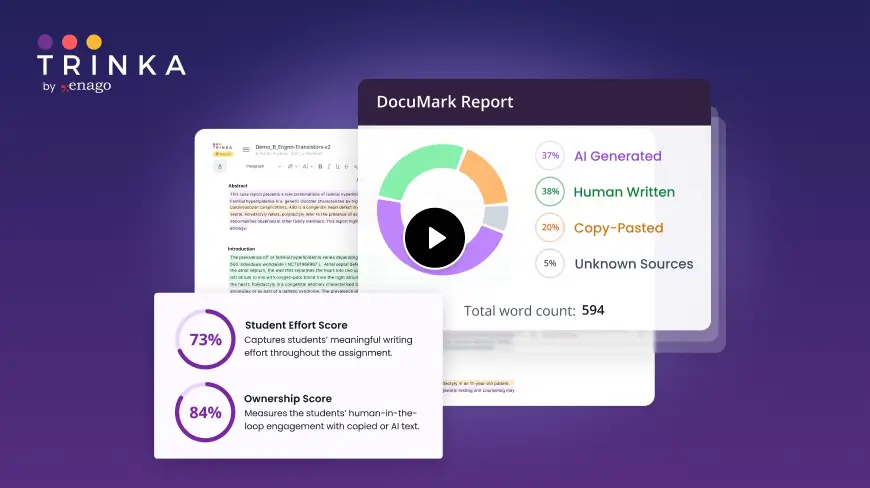
DocuMark: Responsible AI Use for Academic Integrity
Knowing your institution's AI policy is step one. DocuMark helps enforce it fairly by empowering universities to manage AI-generated content, prevent cheating, and support student writing through responsible AI use.
Common Questions About Wellesley College's AI Policies
Wellesley College has defined AI policies in 9 of 12 categories, with an overall coverage score of 75%.
The provided sources do not define a university-wide AI disclosure or citation rule. CS 111 does require students to disclose human collaborators in a "Consulted:" row, but its AI policy prohibits AI use altogether rather than prescribing attribution for allowed AI use.
Wellesley’s Honor Code procedures provide a general mechanism for investigating and adjudicating academic violations. In CS 111, the course explicitly states that intentional AI-policy violations are Honor Code violations, that instructors will use automated tools to analyze submitted code for signs of AI generation, and that suspected cases may lead to conversations with the student or an Honor Code charge.
No explicit data protection or approved AI platform policy is currently defined in the available policy sources.