Teaching & Learning
- Students may use AI for coursework and assignments only if their instructor allows it
- The university states that permission can vary by program, course, and assignment, and unauthorized use may lead to academic dishonesty charges
Students can only use artificial intelligence tools when allowed by instructors. Permission to use these tools can vary from program to program, course to course, and assignment to assignment. If you are unsure whether you can use an AI tool on an assignment, you should ask your instructor before using the tool.
Artificial intelligence (AI) tools that can create and develop academic content are not allowed unless permission is given by an instructor. Students must receive instructor permission prior to utilizing AI tools. Unauthorized use of AI tools may result in academic dishonesty charges.
- WVU does not provide a separate university-wide AI rule specifically for exams or quizzes in the provided sources
- The available guidance addresses assignments and academic content generally, with use left to instructor permission rather than a distinct examinations policy
not defined
- The university does not define a standalone policy for students using AI as ungraded study support or tutoring in the provided sources
- The student guidance instead says students should consult instructors when a tool replaces or substantially enhances their knowledge or ability
It is important that your work honestly reflect your knowledge of a subject and ability to communicate your understanding. If you use a tool that replaces or substantially enhances your knowledge or ability, you should discuss its use with your instructor before submitting work created using the tool.
- WVU does not set a single university-wide rule for AI coding help across all courses
- The Faculty Senate materials provide sample syllabus language showing that coding or problem-solving assistance may be permitted in a course if documented, clearly cited, discussed with the instructor, and the student can explain the submitted work
Forms of coding and/or problem-solving assistance that use generative artificial intelligence (AI) to enhance or refine a student’s own work are permitted in this course. However, the use of such tools must be documented and clearly cited in all submitted work. Students must talk with their instructor prior to using such tools and be prepared to explain/answer any questions about the work submitted.
Research
- Use with such data is only permissible if explicitly approved through the IT Purchase Request process to ensure security and privacy compliance
- WVU prohibits the use of generative AI tools with personally identifiable information (PII), confidential, or other sensitive data, which would include many forms of research data
Never put personally identifiable information (PII), confidential, or other sensitive data into a generative AI tool unless you have been explicitly approved to do so through the IT Purchase Request process. ... The WVU Information Privacy Policy identifies that WVU will never distribute or share PII it has collected unless it has a contractual agreement that the data will be secured and destroyed when no longer required. Again, generative AI tools cannot guarantee these security requirements.
- The provided sources do not set AI-specific research ethics rules for grant proposals, IRB applications, or research declarations
- They do state that research misconduct matters are handled through a separate research integrity process covering plagiarism, falsification, and fabrication for faculty, staff, and students engaged in research
Violations of research integrity (e.g., allegations of research misconduct, including plagiarism and falsification/fabrication of research material) are handled through a separate office and process.
The Research Integrity Officer deals with allegations of plagiarism, falsification, and fabrication of research materials for all WVU faculty, staff, and students engaged in research.
Academic Integrity
- When AI use is allowed, disclosure and citation may be required
- WVU's student FAQ says students may have to cite tools and explain their use, and Faculty Senate syllabus materials include sample language requiring students to document, clearly cite, and identify AI-generated writing, text, or media
When students are allowed to use generative AI tools, they may be required to cite the tools that are used and/or provide specific information about their use. Best practice is to keep detailed notes of what tools are used and how, including any transcripts of their use. This way, you can show how you followed all directions or requirements for the use of these tools.
However, the use of such tools must be documented and clearly cited in all submitted work.
Students must clearly identify writing, text, or media generated by AI and show how AI tools were used in the process of creating a final product. Not acknowledging AI-generated work will be treated as academic dishonesty.
When allowed, students must clearly identify writing, text, or media generated by AI and show how AI tools were used in the process of creating a final product. Any attempt to treat AI output as a student’s own work or failing to identify AI-generated work will be treated as academic dishonesty.
- WVU states that unauthorized AI use can be treated as academic misconduct or academic dishonesty
- The provided sources do not define a university stance on AI detection software, but they do explicitly connect undisclosed or unauthorized AI use to academic integrity charges and reporting processes
Yes, the WVU Policy on Student Academic Integrity prohibits the unauthorized use of technological resources, such as generative AI.
Artificial intelligence (AI) tools that can create and develop academic content are not allowed unless permission is given by an instructor. Students must receive instructor permission prior to utilizing AI tools. Unauthorized use of AI tools may result in academic dishonesty charges.
Not acknowledging AI-generated work will be treated as academic dishonesty.
Any attempt to treat AI output as a student’s own work or failing to identify AI-generated work will be treated as academic dishonesty.
Institutional & Administrative
- WVU provides guidance for instructors and staff using AI
- For general administrative use, AI is permitted if done ethically and securely
- For instructors, the university offers learning modules and training on its protected Microsoft Copilot for co-authoring course materials
All WVU faculty and students can access online learning modules focused on artificial intelligence. The modules highlight lessons in AI literacy, plagiarism, discipline and academic integrity.
We will interact with Copilot by using a series of prompts to coauthor materials that instructors often find to be the most time-consuming to create from scratch, such as grading rubrics containing descriptions at multiple levels of performance and narrative case studies with a background story and characters. Instructors will engage in a back-and-forth conversation with Copilot, requesting changes to be made to the AI’s output.
Therefore, the Office of the Provost, General Counsel, and Information Technology Services provides the following guidance on how these tools may be used for administrative purposes at WVU.
Guidelines for using AI in WVU Marketing and Communications... Ultimately, AI is a tool to be used to augment and assist human creativity and expertise in marketing, not replace it. Responsibility for the final product always rests with the human user.
- For administrative use, WVU prohibits entering personally identifiable information, confidential information, or other sensitive data into generative AI tools unless explicit approval is obtained through the IT Purchase Request process
- The university also states that it does not currently have an enterprise contract with AI providers generally, while separately identifying Copilot in WVU's Office 365 suite as protected under the university's Enterprise Data Protection agreement with Microsoft when signed in with WVU credentials
Ensure Data privacy and security. While there are many chances to experiment and innovate using these tools, at present WVU does not have an enterprise contract or agreement with any AI provider, meaning standardized WVU security and privacy provisions are not present for this technology. Never put personally identifiable information (PII), confidential, or other sensitive data into a generative AI tool unless you have been explicitly approved to do so through the IT Purchase Request process.
The WVU Information Privacy Policy identifies that WVU will never distribute or share PII it has collected unless it has a contractual agreement that the data will be secured and destroyed when no longer required. Again, generative AI tools cannot guarantee these security requirements. Use the IT Purchase Request process to ensure the tool you want to use is secure, including “free” software.
When you sign in using your WVU credentials, information entered into Copilot is protected under our university's Enterprise Data Protection agreement with Microsoft. (Your data will not be used to train Copilot's foundation model.)
- The guidance emphasizes ethical use aligned with university values, privacy and security protection, transparency about AI-created content, and ongoing revision as AI develops
- WVU has formal institutional guidance for responsible AI use in administrative operations issued by the Office of the Provost, General Counsel, and Information Technology Services
In the evolving landscape of technology, West Virginia University (WVU) recognizes the transformative potential of generative AI tools like ChatGPT, Bard, DALL-E, and Otter.AI; however, it is of utmost importance to use these tools in a manner that is beneficial, ethical, and aligned with the core values and regulatory frameworks of WVU.
Therefore, the Office of the Provost, General Counsel, and Information Technology Services provides the following guidance on how these tools may be used for administrative purposes at WVU.
Be adaptable. Embrace continuous learning about AI advancements and adapt to adjustments to these guidelines as needed. Encourage open dialogue and suggestions for improvements. Regularly revisit and update these guidelines to stay current with AI developments and institutional needs.
Be transparent when using AI-created content. Ensure clarity and openness, particularly in areas affecting decision-making or policy development. Ask yourself if a reasonable person would want or expect to know that you used generative AI and explain how you used it.
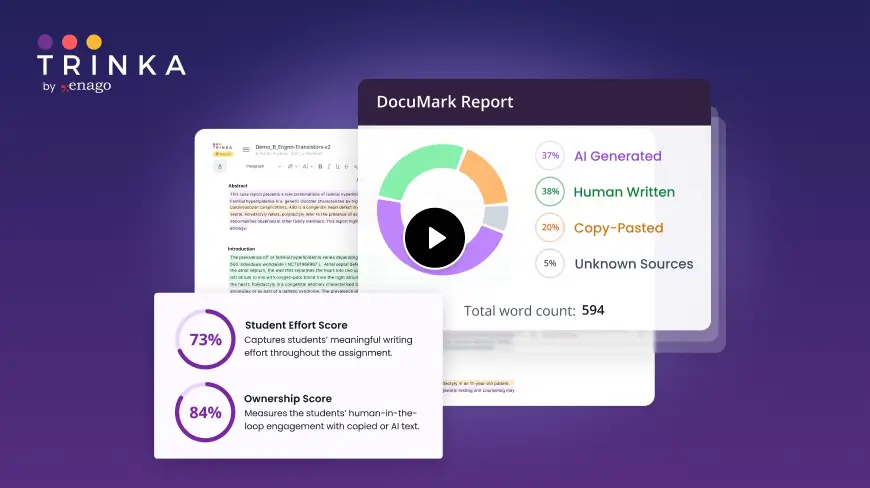
DocuMark: Responsible AI Use for Academic Integrity
Knowing your institution's AI policy is step one. DocuMark helps enforce it fairly by empowering universities to manage AI-generated content, prevent cheating, and support student writing through responsible AI use.
Common Questions About West Virginia University's AI Policies
West Virginia University has defined AI policies in 11 of 12 categories, with an overall coverage score of 92%.
When AI use is allowed, disclosure and citation may be required. WVU's student FAQ says students may have to cite tools and explain their use, and Faculty Senate syllabus materials include sample language requiring students to document, clearly cite, and identify AI-generated writing, text, or media.
WVU states that unauthorized AI use can be treated as academic misconduct or academic dishonesty. The provided sources do not define a university stance on AI detection software, but they do explicitly connect undisclosed or unauthorized AI use to academic integrity charges and reporting processes.
For administrative use, WVU prohibits entering personally identifiable information, confidential information, or other sensitive data into generative AI tools unless explicit approval is obtained through the IT Purchase Request process. The university also states that it does not currently have an enterprise contract with AI providers generally, while separately identifying Copilot in WVU's Office 365 suite as protected under the university's Enterprise Data Protection agreement with Microsoft when signed in with WVU credentials.