Teaching & Learning
- WPI operates on a principle of instructor discretion for AI use in coursework
- The university does not have a single overarching rule, instead empowering faculty to set specific policies for their courses within the general academic integrity framework against unauthorized assistance
As each course/project is unique, evaluation methods may differ in different courses/projects. Thus, instructors set the context of the academic integrity policy in their own courses.
Cheating: Attempting to use or intentionally using unauthorized study aids, materials, information, or assistance in any academic activity or assessment.
Any student act that interferes with the evaluation of students’ actual state of knowledge is a breach of the academic integrity policy.
- Instructors define what counts as authorized or unauthorized assistance for a given assessment
- For examinations and assessments, WPI applies its general academic integrity policy rather than a university-wide AI-specific rule
Cheating: Attempting to use or intentionally using unauthorized study aids, materials, information, or assistance in any academic activity or assessment.
As each course/project is unique, evaluation methods may differ in different courses/projects. Thus, instructors set the context of the academic integrity policy in their own courses.
Any student act that interferes with the evaluation of students’ actual state of knowledge is a breach of the academic integrity policy.
Research
- WPI does not provide AI-specific guidance for drafting or editing research manuscripts in the sources provided
- Its research misconduct policy applies to research records and treats plagiarism, fabrication, and falsification in research activities as misconduct, including in theses, abstracts, proposals, presentations, internal reports, and journal articles
Research Activities are proposing, conducting, processing, reviewing, or reporting the results of
research or other scholarly inquiry.
Research Misconduct is Fabrication, Falsification, or Plagiarism in Research Activities or
Deliberate Interference. It does not include honest error or differences of opinion.
− Research Record is the record of data or results that embody the facts resulting from
scientific or other scholarly inquiry and includes, but is not limited to, research proposals,
laboratory records (both physical and electronic), progress reports, abstracts, theses, oral
presentations, internal reports, and journal articles.
• Plagiarism is the appropriation of another person’s ideas, processes, results, or words without
giving appropriate credit.
- WPI does not state an AI-specific rule for using AI in research data analysis in the sources provided
- However, its research misconduct policy prohibits fabrication and falsification of research data or results, and its data-protection rules restrict how certain categories of data may be stored, transmitted, and accessed
Research Misconduct is Fabrication, Falsification, or Plagiarism in Research Activities or
Deliberate Interference. It does not include honest error or differences of opinion.
• Fabrication is making up data or results and recording or reporting them.
• Falsification is manipulating research materials, equipment, or processes, or changing or
omitting data or results such that the research is not accurately represented in the Research
Record.
Rules for Usage of Restricted Use Data
a. Restricted Use data shall be stored in institutionally supported applications residing in
the WPI Data Center or a contracted cloud service, but not in Word, Excel or Access
(with the exception of information required for critical business purposes and stored in
an approved, encrypted area). Restricted Use data can also reside in approved third
party hosted applications, but those applications must be approved by the CIO.
b. Employees shall not store or copy this data to laptop or desktop computers (whether
institutionally-owned or personally owned), smart phones, USB devices or other
portable or cloud based media (e.g. OneDrive, Dropbox). In addition, this data shall not
be transmitted via e-mail, instant message, chat or other social media technologies, with
the exception of approved third party vendors with appropriate encryption in place.
- WPI does not provide AI-specific rules for grant proposals, IRB applications, or research ethics declarations in the sources provided
- Its research misconduct policy applies across research activities, including proposing and reporting research, and student research misconduct is handled under the Student Code of Conduct provisions for student academic dishonesty unless grant or sponsor rules require otherwise
Except as they may be subject to the requirements of grants, sponsored research or research funded by
a governmental authority, allegations of Research Misconduct committed by students will be
addressed in accordance with provisions of the Student Code of Conduct dealing with Student
Academic Dishonesty.
Research Activities are proposing, conducting, processing, reviewing, or reporting the results of
research or other scholarly inquiry.
Research Misconduct is Fabrication, Falsification, or Plagiarism in Research Activities or
Deliberate Interference. It does not include honest error or differences of opinion.
− Research Record is the record of data or results that embody the facts resulting from
scientific or other scholarly inquiry and includes, but is not limited to, research proposals,
laboratory records (both physical and electronic), progress reports, abstracts, theses, oral
presentations, internal reports, and journal articles.
Academic Integrity
- WPI requires proper attribution for use of others' words, ideas, data, creative works, or graphics under its plagiarism policy, but the provided sources do not contain an AI-specific university-wide disclosure or citation requirement
Plagiarism: Using words, ideas, assertions, data, creative works, or graphics of another without proper attribution in any academic activity.
As each course/project is unique, evaluation methods may differ in different courses/projects. Thus, instructors set the context of the academic integrity policy in their own courses.
- Allegations are judged by a "preponderance of the evidence" standard, and students cannot drop a course or change grading options after an allegation is made
- While the provided WPI sources do not mention a policy on using AI detection software, they clearly define the enforcement process for academic integrity violations
The standard used in campus conduct
hearings is “preponderance of the evidence,” meaning more likely than not. Hearsay and circumstantial
evidence are allowed to be considered in hearings.
Per the Student Code of Conduct, once an
allegation concerning an academic integrity violation has been
made, a student may not drop the course/project, change to audit
status, change course/project grading to Pass/Fail, or withdraw
from the course/project.
Conduct records for any violation of academic integrity are maintained by the Dean of Students Office
in accordance with the Reporting of Student Conduct Records policy as established by WPI.
All decisions about whether a Respondent violated this Code, any WPI policy, or a standard of the WPI community are made using the Preponderance of the Evidence standard.
Institutional & Administrative
- For academic settings, individual faculty members are responsible for defining the rules for AI use in their own courses
- WPI's interim policy prohibits all faculty, staff, and students from entering confidential university, employee, or student data into generative AI tools, with WPI Microsoft Copilot as the only approved exception
This Policy applies to all students, faculty, and staff at WPI.
Do not enter Confidential Information into generative AI tools (e.g. ChatGPT, Google Gemini, etc.). The only exception is WPI Microsoft Copilot, which is the only approved AI platform for the use of “Confidential Information.”
If you have any questions or concerns, you should seek guidance from your manager, Department Head or WPI’s Information Technology Services (its@wpi.edu) before entering information in a generative AI tool.
- This AI-specific rule complements the broader Data Classification and Usage Policy
- WPI prohibits all students, faculty, and staff from entering confidential information into generative AI tools
- According to the university's interim policy, WPI Microsoft Copilot is the only approved AI platform for using confidential information
This Policy applies to all students, faculty, and staff at WPI.
“Confidential Information” means, for the purpose of this Policy, confidential WPI institutional data,
confidential WPI employee data, and WPI student data that is not publicly available and should not be released
publicly, including but not limited to:
• Social security numbers
• Financial account information
• Passwords
• Driver’s license numbers
• Health care information protected under HIPAA
• Human Resources and personnel information
• Student records protected by FERPA
• Gift and Donor Information
Do not enter Confidential Information into generative AI tools (e.g. ChatGPT, Google Gemini, etc.). The only exception is WPI Microsoft Copilot, which is the only approved AI platform for the use of “Confidential Information.”
- WPI has an interim AI governance approach focused on data-protection risk
- The sources also show institution-level enablement of Zoom AI Companion with host controls and attendee notice
- The Administrative Policy Group approved the interim policy, and the Administrative Policy Group and Committee on Information Technology Policy are collaborating to revise the Data Classification and Usage Policy to integrate generative AI language
As co-chairs of the Administrative Policy Group (APG), we write to inform you of the approval of the Interim Policy Prohibiting Entering Confidential Information into Generative AI.
While this Policy remains interim, the APG and the Committee on Information Technology Policy (CITP) are collaborating to revise and update WPI’s Data Classification and Usage Policy to integrate language related to generative AI usage. When that policy is updated and approved, it will replace this Interim Policy.
ITS has enabled optional automated transcription and summary for Zoom meetings, and updated meeting invite language.
The Zoom AI Companion, a generative Artificial Intelligence digital assistant, is set to “allowed” at the WPI Zoom account level. Individual meeting hosts can activate or disable the Zoom AI Companion in their own account settings. Attendees receive a prompt announcing the host’s intent to use AI Companion and can request it be turned off.
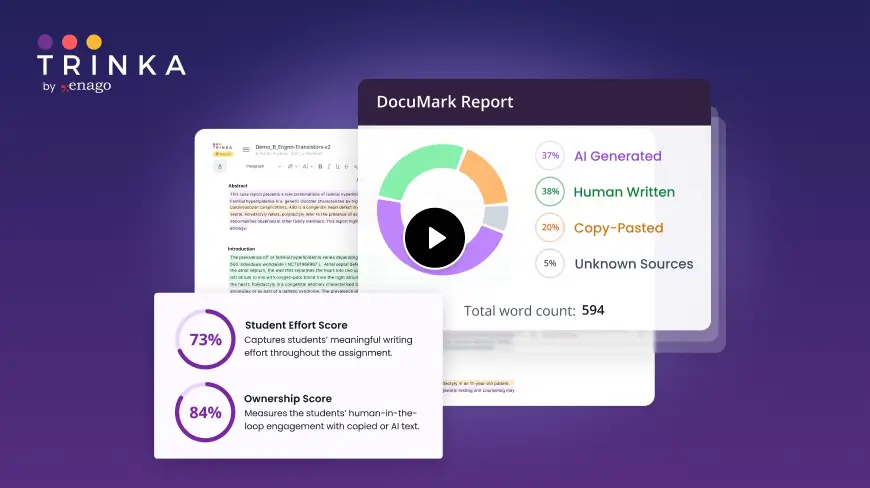
DocuMark: Responsible AI Use for Academic Integrity
Knowing your institution's AI policy is step one. DocuMark helps enforce it fairly by empowering universities to manage AI-generated content, prevent cheating, and support student writing through responsible AI use.
Common Questions About Worcester Polytechnic Institute (WPI)'s AI Policies
Worcester Polytechnic Institute (WPI) has defined AI policies in 10 of 12 categories, with an overall coverage score of 83%.
WPI requires proper attribution for use of others' words, ideas, data, creative works, or graphics under its plagiarism policy, but the provided sources do not contain an AI-specific university-wide disclosure or citation requirement.
While the provided WPI sources do not mention a policy on using AI detection software, they clearly define the enforcement process for academic integrity violations. Allegations are judged by a "preponderance of the evidence" standard, and students cannot drop a course or change grading options after an allegation is made.
WPI prohibits all students, faculty, and staff from entering confidential information into generative AI tools. According to the university's interim policy, WPI Microsoft Copilot is the only approved AI platform for using confidential information. This AI-specific rule complements the broader Data Classification and Usage Policy.