
Why Do Researchers Use Grammar Checkers Before Journal Submission?

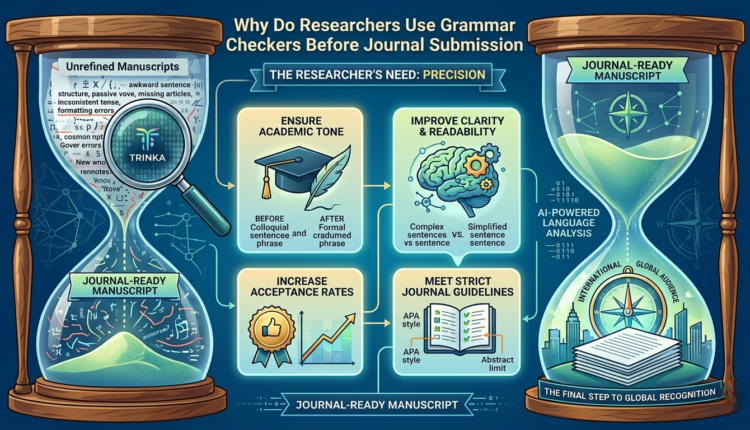
Ask any researcher what takes longer than expected and manuscript preparation will probably make the list.
By the time a paper is ready for submission, most authors have already spent weeks or months refining their arguments, checking references, reviewing data, and revising multiple drafts. Yet even after all that effort, small language issues often remain hidden in the manuscript.
The challenge is not that researchers don’t know grammar. The challenge is familiarity. After reading the same paper dozens of times, it’s surprisingly easy to miss awkward phrasing, repeated words, missing articles, or sentences that make perfect sense to the author but feel unclear to a reviewer seeing them for the first time.
This is one reason grammar checkers have become part of many researchers’ submission workflow. Before sending a manuscript to a journal, authors often use tools like Trinka Grammar Checker to review language issues that are difficult to spot during self-editing.
Is Good Research Enough for Journal Acceptance?
Strong research is always the foundation of a publishable paper. However, reviewers still need to understand the work clearly.
Imagine reading a manuscript that contains valuable findings but also includes unclear sentences in the methodology section and inconsistent wording in the discussion. The science may be solid, but the reading experience becomes harder than it needs to be.
Editors and reviewers evaluate research, not grammar. Still, clear writing helps ensure that attention stays on the research itself rather than the language used to describe it.
Why Are Researchers Often the Worst Proofreaders of Their Own Work?
Most authors know exactly what they intended to write. That familiarity can become a disadvantage during proofreading.
A missing word, an incorrect article, or a confusing sentence may go unnoticed because the brain automatically fills in the gaps. Many researchers have experienced the frustration of spotting an obvious mistake immediately after submission despite reviewing the manuscript multiple times beforehand.
A second layer of review often helps identify issues that become invisible after repeated reading.
What Types of Language Issues Commonly Appear in Research Papers?
Not every problem involves grammar rules.
Sometimes the issue is a sentence that stretches across four lines. Sometimes it’s a technical explanation that could be expressed more clearly. In other cases, the same phrase appears repeatedly throughout the manuscript without the author noticing.
Researchers frequently review papers for:
- Grammar and spelling issues
- Unclear sentence construction
- Inconsistent terminology
- Word choice problems
- Punctuation mistakes
- Repetitive phrasing
Individually, these issues may seem minor. Together, they can affect how easily a manuscript is understood.
How Does Trinka Help Before Journal Submission?
Many researchers use Trinka Grammar Checker as a final review step before submission.
Instead of manually searching for every language issue, they can paste their manuscript into the tool and review suggestions related to grammar, sentence structure, word choice, punctuation, and clarity. This helps authors spend less time hunting for errors and more time focusing on the quality of their research.
For non-native English speakers, this additional review can be particularly valuable when preparing a manuscript for an international journal.
Can a Grammar Checker Replace Peer Review?
No, and most researchers would not want it to.
Peer reviewers evaluate the originality, methodology, significance, and contribution of the research. A grammar checker serves a different purpose. It helps improve how the research is communicated.
Think of it this way: peer review evaluates the science, while a grammar checker helps ensure the science is presented clearly.
Why Do Many Researchers Run One Final Grammar Check Before Submission?
The final version of a manuscript is often the version that receives the least attention. After months of revisions, most authors are eager to submit.
Taking a few extra minutes to review grammar, sentence structure, punctuation, and wording can prevent small language issues from distracting readers. That’s why many researchers include Trinka Grammar Checker in their pre-submission checklist alongside reference checks, formatting reviews, and final manuscript revisions.
Ready to Submit Your Research with Confidence?
Before submitting your next manuscript, take a final look at the language as carefully as you review the research itself. Trinka Grammar Checker helps researchers identify grammar issues, improve sentence clarity, refine word choice, and strengthen overall writing quality so their work is presented as clearly as possible.
Adjectives with other letters
- Adjectives That Start with A
- Adjectives That Start with B
- Adjectives That Start With C
- Adjectives That Start With D
- Adjectives That Start with E
- Adjectives That Start with F
- Adjectives That Start with G
- Adjectives That Start with H
- Adjectives That Start with I
- Adjectives That Start with J
- Adjectives That Start with K
- Adjectives That Start with L
- Adjectives That Start with M
- Adjectives That Start with N
- Adjectives That Start with O
- Adjectives That Start with P
- Adjectives That Start with Q
- Adjectives That Start with R
- Adjectives That Start With S
- Adjectives That Start with T
- Adjectives That Start with U
- Adjectives That Start with V
- Adjectives That Start with W
- Adjectives That Start with X
- Adjectives That Start with Y
- Adjectives That Start with Z
- Can a Grammar Checker Fix Punctuation Errors?
- How Do I Check Grammar in ChatGPT-Generated Content?
- Which Grammar Checker Should Students Use?

-
Go beyond grammar & spelling
Get holistic language improvements - Write with Trinka