
AI Content Detectors vs. Plagiarism Checkers: What’s the Difference?

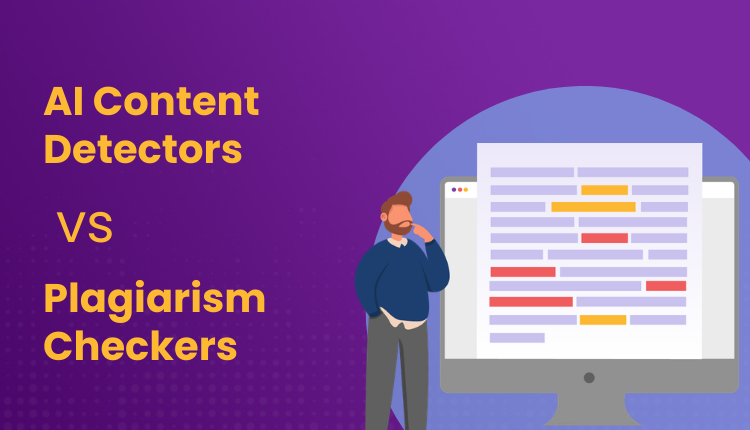
Many researchers and students worry about two related checks during submission: “Will my paper be flagged by a plagiarism checker?” and “Will it look like AI wrote this?” Understanding how AI content detectors differ from plagiarism checkers helps you manage risk, preserve academic integrity, and prepare manuscripts that meet journal and institutional expectations. This article explains what each tool does, why the difference matters for academic writing, how each works in practice, when to use them, and clear steps you can take before submission.
What each tool does
AI content detector
An AI content detector is a classifier that estimates whether text is likely produced or heavily edited by a large language model (LLM). Detectors typically score text using statistical features (for example, token probability patterns such as “perplexity”), machine learning classifiers, or model specific fingerprints. They can label text as “likely AI-generated,” “likely human,” or give a probability score at the paragraph level.
Plagiarism checker
A plagiarism checker is a text matching system that compares your text to webpages, journals, books, and private repositories to find identical or highly similar passages. These tools return similarity or match scores, highlight matched passages, and list matched sources so you can add citations, quote correctly, or rewrite. They do not decide intent; they provide evidence of overlap.
Why the difference matters for academics
The consequences and remedies differ. A plagiarism match is evidence you must add a citation, quote properly, or rewrite a passage. Plagiarism reports give source links you can verify. An AI detector flags style or statistical features and does not show copied sources. If an AI detector flags text but plagiarism tools show no matches, the issue is authorship transparency or heavy use of generative tools rather than unattributed copying. Misunderstanding this distinction can lead to unfair accusations or incorrect fixes.
How each tool works (brief technical view)
How plagiarism checkers’ work
Plagiarism checkers use exact and fuzzy matching algorithms across indexed corpora (open web, paywalled content, institutional repositories). They identify sequences of identical or near identical tokens and show matched sources so a reviewer can judge whether a citation or paraphrase is missing.
How AI content detectors work
AI content detectors use features that distinguish predicted token distributions from typical human writing patterns (for example, low perplexity or uniform word choice patterns). Some detectors are tuned to specific models; others are more general. Detectors can be fooled by paraphrasing, editing, or instructing an LLM to change style. They can also mislabel simple or non-idiomatic human prose as AI output. Multiple studies show current detectors are neither definitive nor robust.
Common real-world failures and biases
-
False positives for non-native speakers
GPT detectors often misclassify nonnative English writing as AI-generated because simpler or less idiomatic wording can lower perplexity, risking disadvantage to international students and early career researchers. -
Plagiarism tools miss novel hallucinations
If an LLM invents content or rewrites sources so they no longer match indexed material, a plagiarism checker will not flag it, even when the idea is unattributed.
When to run which tool (practical guidance)
Before submission
Run a plagiarism checker to find and fix missing citations, over quoted passages, and close paraphrases. Plagiarism reports give the evidence you need to correct the manuscript.
If you used LLMs for drafting or editing
Treat AI assistance as an authorship and transparency question. Use an AI content detector only as a secondary check to decide whether to disclose AI use to coauthors, your department, or a journal. Do not use detector output as the sole basis for punitive action.
For sensitive or confidential drafts
Prefer secure, compliant services or organizational plans that do not store or train on your data. For patient data, proprietary code, or confidential proposals, use privacy enabled workflows.
Before and after examples (concrete, short)
Plagiarism example
Before: “Climate change is causing more frequent and intense heatwaves across the globe.” (verbatim from a source without citation)
After: “Recent analyses show that rising global temperatures correlate with an increased frequency and intensity of heatwaves (Author et al., 2021).” Add citation and paraphrase.
AI assistance transparency example
Before: You run an LLM to rewrite a discussion paragraph and submit without disclosure.
After: “We used an LLM (tool name) to draft an initial version of the discussion; all substantive intellectual contributions and edits were made by the named authors, and we revised the text for accuracy and tone.” Disclose this in the methods or cover letter per journal policy.
Checklist: immediate steps before submission
-
Run a plagiarism check and address any highlighted overlaps.
-
Review and add citations for paraphrased or quoted material.
-
If you used LLMs, document how you used them and follow your target journal’s disclosure policy.
-
Keep draft histories and author contribution notes to demonstrate provenance if needed.
-
For confidential content, use privacy compliant plans or services when running checks.
Common mistakes to avoid
-
Treating an AI detector score as proof of misconduct. Detection scores are probabilistic, not forensic evidence.
-
Assuming no plagiarism if a detector flags AI output; the text may still contain unattributed ideas or close paraphrases.
-
Overlooking institutional or journal specific rules about AI use and disclosure. Always check submission guidelines.
How tools can support you (practical tool note)
Use plagiarism checkers to produce the concrete evidence you need to correct copy and citations. Use AI content detectors to decide whether to disclose AI assistance or rework text that could read as machine generated. Writing tools that combine grammar, similarity, and optional AI detection can speed revision while preserving traceability. For example, Trinka’s plagiarism checker helps you find matched sources and similarity scores prior to submission, and Trinka’s AI content detector provides paragraph level AI likelihood scoring for revision or disclosure decisions. Consider secure workflows or data protected plans if your manuscript contains sensitive information.
Conclusion
-
Use both tools, but for different purposes: plagiarism checkers to find overlap; AI detectors to guide transparency and revision.
-
Keep version history and a short log describing where and how you used any AI tool. That record clarifies provenance during peer review or audit.
-
If you or a coauthor is a non-native English speaker, be aware detectors may be biased. Prioritize clear editing and disclosure rather than relying on detector outputs alone.
-
Check journal and institutional policies on AI use and disclosure before submission and fix any citation problems identified by plagiarism checks.
Academic writing requires intellectual honesty and careful documentation. Plagiarism checkers and AI content detectors serve different roles: one finds textual overlap and points you to sources; the other flags statistical signatures that may indicate machine assistance. Use them together as complementary tools. Run a plagiarism check to remove unattributed overlap and use AI detection outputs to decide whether to revise or disclose AI assistance. Rely on transparent records and human judgment for any final determination.
Frequently Asked Questions
What is the main difference between AI detectors and plagiarism checkers?▼
AI detectors estimate whether text is likely AI written.
Plagiarism checkers find copied or closely matched sources.
Can an AI detector replace a plagiarism checker?▼
No, they solve different problems.
Using both gives better academic integrity coverage.
Are results from AI content detectors always reliable?▼
No, they can produce false positives or negatives.
Human review is still necessary for fair judgment.

-
Go beyond grammar & spelling
Get holistic language improvements - Write with Trinka